On this page
Finding the Unknown is Chapter 7 of Ganita Prakash, Grade 7 Part II (book code gegp2, First Edition October 2025, pages 164 to 190). Here algebra starts to do real work: you name an unknown with a letter, write an equation and solve it.
CBSE's curriculum page for 2026-27 covers Classes 9 to 12 only, so Class 7 follows the NCERT book and is assessed by the school.
What does Finding the Unknown cover in Class 7?
It has four sections, in this order:
Find the Unknowns. Weighing-scale and matchstick puzzles lead to the definition: an equation states that two algebraic expressions are equal. Solving it means finding the letter-number value that makes the LHS equal the RHS.
Solving Equations Systematically. Trial and error can be slow. The better tool: the same operation on both sides keeps them equal. It covers unknowns on both sides, word problems and writing equations for a given answer.
Mind the Mistake, Mend the Mistake. Faulty solutions to find and fix.
A Pinch of History. Bījagaṇita, algebra's old Indian name, and how the ideas travelled.
How do you solve an equation using the balance idea?
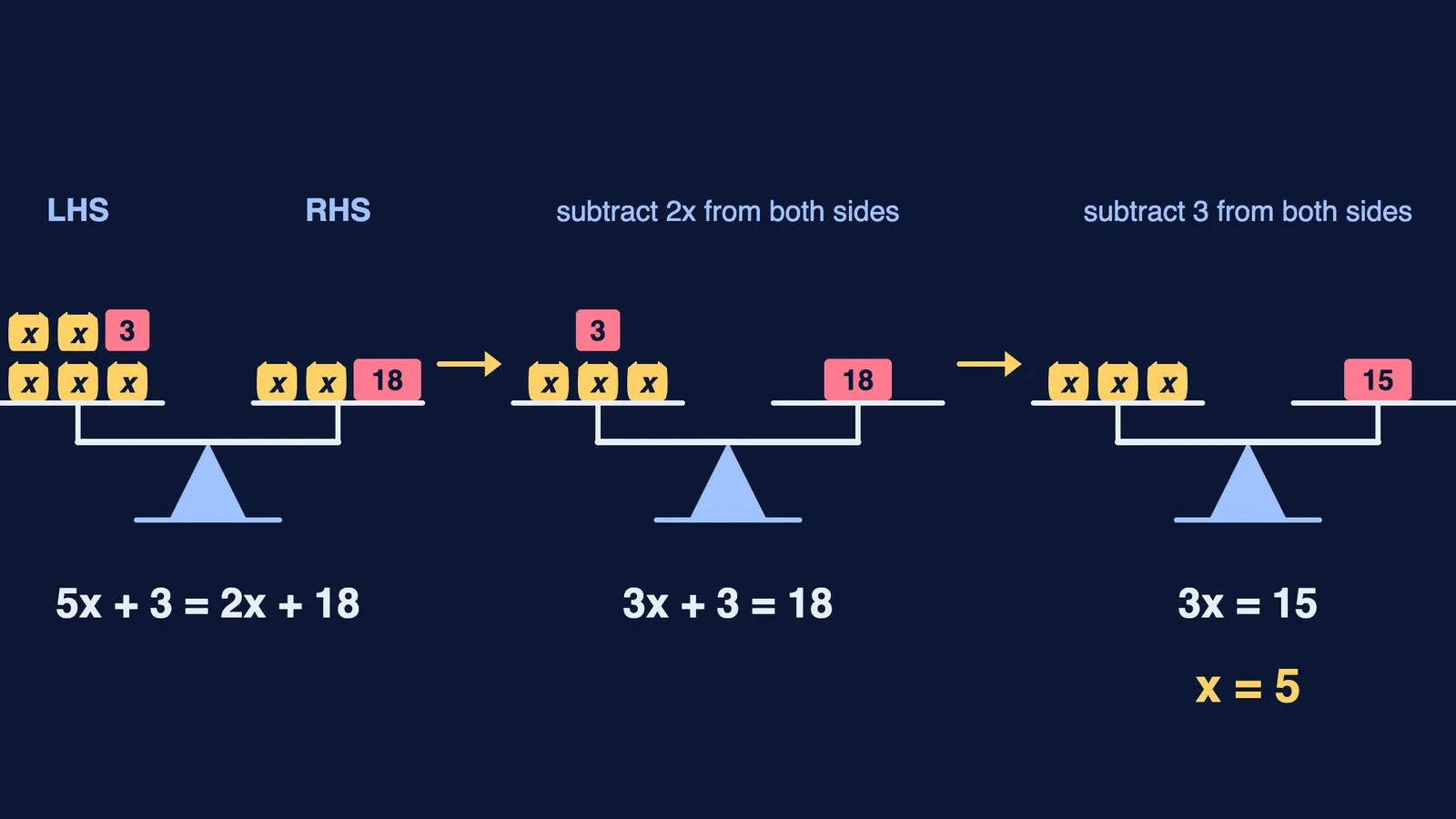
Take our own equation 5x + 3 = 2x + 18, drawn above as a scale with sacks of unknown weight x.
Subtract 2x from both sides: 3x + 3 = 18.
Subtract 3 from both sides: 3x = 15.
Divide both sides by 3: x = 5.
Check by putting x = 5 back in: the LHS is 25 + 3 = 28 and the RHS is 10 + 18 = 28. They match, so x = 5 is the solution.
The book then shortens the writing. A term removed from one side reappears as its additive inverse on the other, so 3x + 3 = 18 becomes 3x = 18 − 3. A factor removed from one side divides the other, so 3x = 15 becomes x = 15 ÷ 3. A removed divisor multiplies the other side.
How do you turn a word problem into an equation?
Our example: a class trip costs a fixed ₹1350 for the bus plus ₹95 per student, and the class has ₹5150. Let s be the number of students. Then 95s + 1350 = 5150. Subtract 1350: 95s = 3800. Divide by 95: s = 40. Check: 3800 + 1350 = 5150.
Growing patterns work the same way: if position n needs a known expression of sticks, finding the position for a given number of sticks is an equation.
Which mistakes does the chapter warn about?
Slips like these (our examples) are what the mistake section trains you to catch:
Wrong sign when moving a term. In 3y + 8 = 29, writing 3y = 29 + 8 is wrong. Removing +8 means subtracting 8: 3y = 21, so y = 7.
Dividing only part of a side. In 4(2p + 3) = 44, divide the whole side by 4: 2p + 3 = 11, so 2p = 8 and p = 4.
Dropping a negative. In −6m = 18, divide by −6 to get m = −3, not 3.
Practice questions (our suggestion)
Our own questions, not the book's exercises; marks are our suggestion.
Solve 7a − 9 = 3a + 15 and check your answer. (2 marks)
Solve w ÷ 15 − 2 = 5. (2 marks)
Position n of a stick pattern uses 4n + 3 sticks. Which position uses 83 sticks? Can any position use exactly 100 sticks? (3 marks)
Two numbers add up to 119, and one is six times the other. Find both. (2 marks)
Arjun has ₹1500 and saves ₹300 a month. Meera has ₹2700 and saves ₹180 a month. When will their savings first be equal? (3 marks)
Answers: 1. 4a = 24, so a = 6 (both sides equal 33). 2. w ÷ 15 = 7, so w = 105. 3. Position 20; 100 would need 4n = 97, which has no whole-number answer. 4. 7x = 119, so 17 and 102. 5. 120m = 1200, so after 10 months (₹4500 each).
How does this chapter connect to the rest of the book?
Part I's Expressions using Letter-Numbers introduced letter-numbers, and our guide to arithmetic expressions in Class 7 covers the bracket and sign rules you need to expand 4(2p + 3). Part II's Operations with Integers handles negative answers.
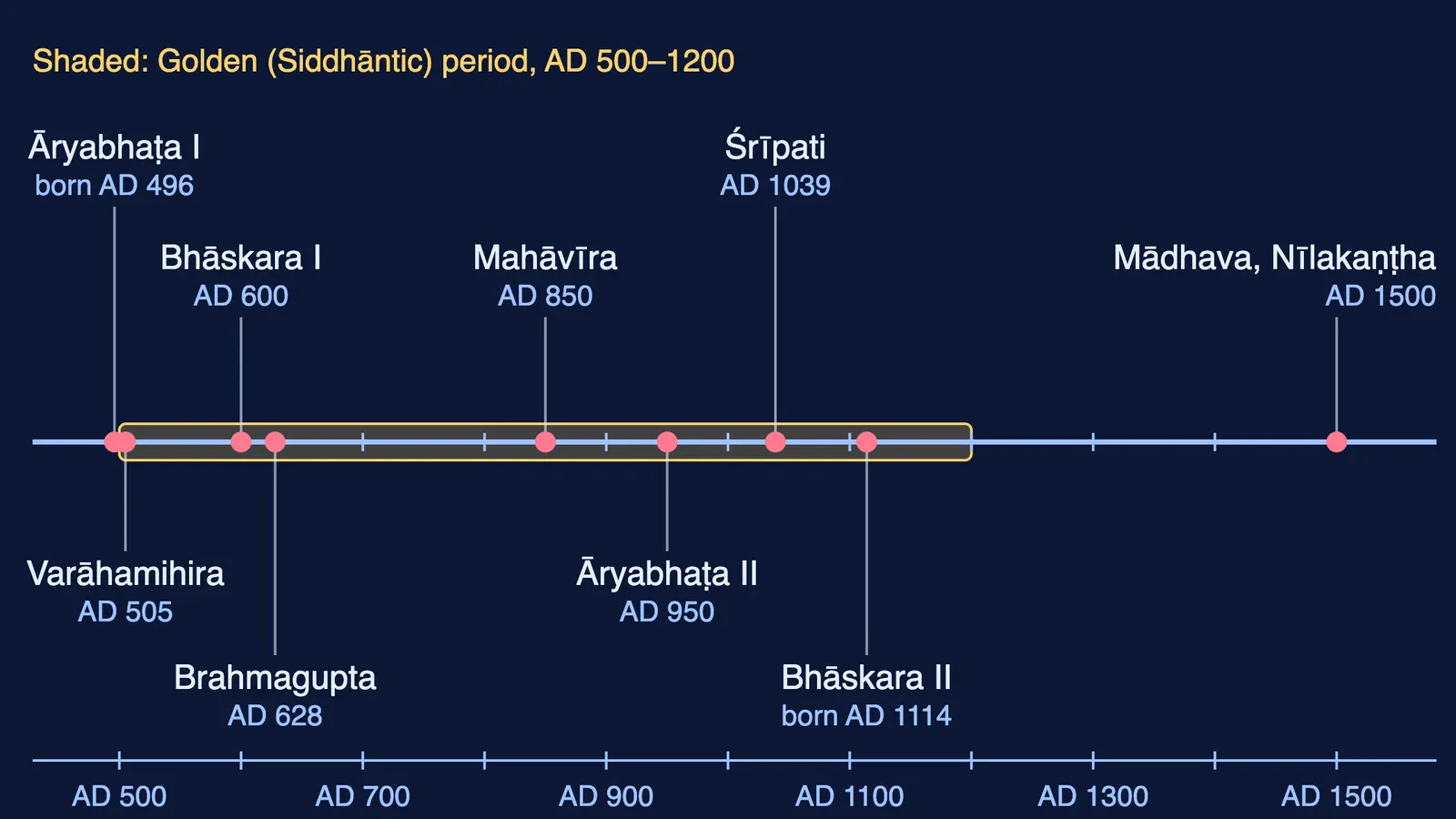
The history section says Aryabhata (499 CE) first proposed a systematic method for one unknown, which Brahmagupta outlined in the Brāhmasphuṭasiddhānta (628 CE). For Ax + B = Cx + D, Brahmagupta's formula is x = (D − B) ÷ (A − C). On our example, (18 − 3) ÷ (5 − 2) = 5. It also notes that al-jabr, from Al-Khwarizmi's book of around 825 CE, gave us the word algebra.
In Class 8, Algebra Play shows how letter-numbers prove that a number trick works every time.
Stuck on where to start with an equation? Fermi's AI tutor works out what you already know and builds a plan for the session.