On this page
Most small cameras focus by moving a glass lens with a tiny motor. A liquid lens focuses with no moving parts. It holds a drop of salty water against an oil, and a voltage changes the curve of the boundary between them. The physics joins two chapters you study separately: contact angle and capacitor energy. The effect is called electrowetting.
How can a voltage change the shape of a water drop?
Picture a short cylinder a few millimetres across. Its wall is a metal electrode covered by a thin insulating film with a water-repellent coating. Inside sit two liquids that do not mix: conducting salt water and an insulating oil. A second electrode touches the water.
Now look at the wall. The water is one plate, the electrode is the other plate, and the insulating film is the dielectric between them. Wherever the water touches the wall, you have a parallel-plate capacitor. Put a voltage V across it and the wetted strip of wall stores charge.
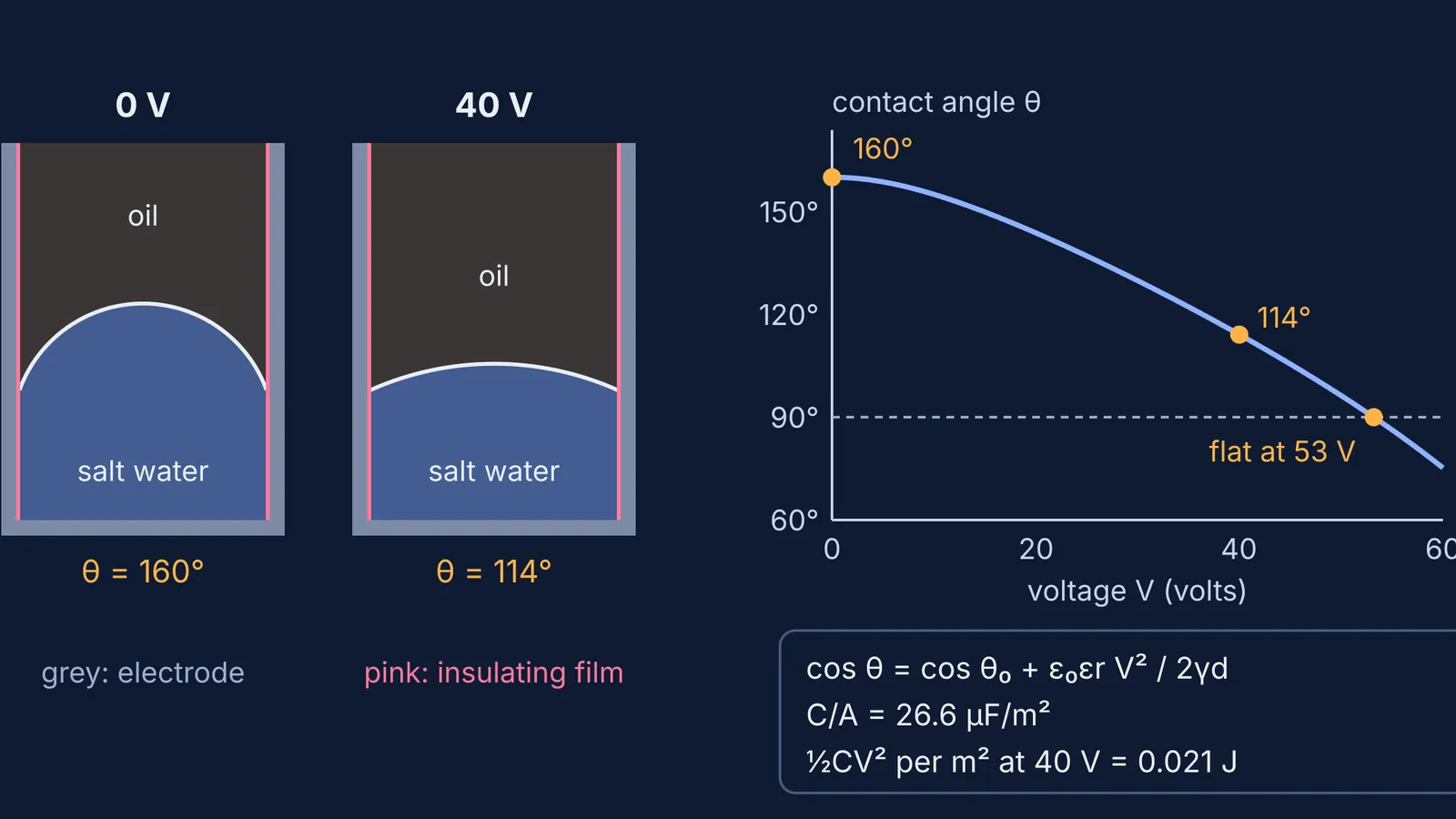
With no voltage, the coating repels water, so the water meets the wall at a large contact angle and its surface bulges strongly. Apply a voltage and the water spreads along the wall, the contact angle falls, and the boundary flattens. How the angle is measured, inside the liquid, is covered in the angle of contact and meniscus shape; here it is measured inside the water.
What is the Lippmann–Young equation?
Young's equation for the contact angle θ is cos θ = (γ_solid–oil − γ_solid–water)/γ, where γ is the water–oil interfacial tension. Electrowetting changes one term: the wetted wall behaves as if its surface energy had dropped.
Here is why. Charging a capacitor of capacitance C to voltage V stores ½CV², and the battery supplies CV²; the split is worked through in energy stored in a capacitor. When the water spreads over a little more wall at constant V, the free energy of the system (capacitor plus battery) falls by ½CV² for each unit area wetted. That acts exactly like lowering γ_solid–water by ½(C/A)V². With C/A = ε₀ε_r/d for a film of thickness d, Young's equation becomes the Lippmann–Young equation:
cos θ = cos θ₀ + ε₀ε_rV²/(2γd)
Check the dimensions. ε₀ε_r/d is in F/m², and multiplying by V² gives J/m². Divide by γ in N/m, which is also J/m², and the last term is a pure number. The combination ε₀ε_rV²/(2γd) is called the electrowetting number.
Worked example: how far does 40 V tip the angle?
Take round, illustrative values of the right size for such a cell (not the data of any particular product): an insulating film with ε_r = 3.0 and d = 1.0 µm, a water–oil tension γ = 0.040 N/m, and θ₀ = 160° at 0 V.
Capacitance per area. C/A = ε₀ε_r/d = 8.85 × 10⁻¹² × 3.0 / (1.0 × 10⁻⁶) = 2.66 × 10⁻⁵ F/m², or 26.6 µF/m².
Stored energy per area at 40 V. ½(C/A)V² = 0.5 × 2.66 × 10⁻⁵ × 40² = 0.021 J/m².
Electrowetting number. 0.021 / 0.040 = 0.53. The stored energy is about half of γ, which is why a few tens of volts are enough: the film is so thin that C/A is large.
New angle. cos θ = cos 160° + 0.53 = −0.940 + 0.531 = −0.409, so θ = 114°.
Repeat with other voltages:
20 V: cos θ = −0.807, θ = 144°.
53.2 V: cos θ = 0, θ = 90°. The boundary is flat.
60 V: cos θ = +0.256, θ = 75°.
Notice that V appears squared. Reverse the voltage and nothing changes, so an alternating voltage works just as well as a steady one.
How does a changing contact angle refocus a camera?
The water–oil boundary is a curved refracting surface. In a cylinder of radius a, a boundary that meets the wall at angle θ is close to a spherical cap of radius R = a/|cos θ|. Its power is P = Δn/R, where Δn is the difference in refractive index between the oil and the water.
Continue the example with a cell 3.0 mm across (a = 1.5 mm) and an illustrative Δn = 0.16:
0 V, θ = 160°. R = 1.5 mm / 0.940 = 1.60 mm, so P = 0.16 / 0.00160 m ≈ 100 D.
40 V, θ = 114°. R = 1.5 / 0.409 = 3.67 mm, so P ≈ 44 D.
53.2 V, θ = 90°. The boundary is flat and P = 0.
60 V, θ = 75°. R = 5.88 mm, P ≈ 27 D, now of the opposite sign because the boundary curves the other way.
The voltage changes the curvature, so it changes the focal length. A liquid layer acting as a lens of fixed shape appears in finding the refractive index of a liquid with a convex lens; here the shape is adjustable.
The simple model overstates what real parts do. The idea of an electrowetting lens was published by Berge and Peseux in The European Physical Journal E in 2000. A commercial example today, Corning's Varioptic A-39N0, has a 3.9 mm clear aperture and a focus range of −5 to +15 dioptres according to its Edmund Optics product page, which also notes that it has no moving parts. That 20 D range is much narrower than our model's swing. The model's round values show how the physics works; they do not describe a real cell.
Gravity is the other design problem. The Bond number Δρga²/γ compares gravity with surface tension. With a density difference of 200 kg/m³ it is 200 × 9.81 × (1.5 × 10⁻³)² / 0.040 ≈ 0.11, enough to sag the boundary when the camera tilts. Choose an oil with almost the same density as the salt water and the number drops towards zero, so the lens works the same way up or sideways.
What stops you turning the voltage up forever?
Contact-angle saturation. Above some voltage, measured angles stop falling, while the equation says cos θ should keep rising. The formula is reliable only below that point, so the 60 V value above may not be reached in practice.
Breakdown of the film. 60 V across 1.0 µm is a field of 60 MV/m, twenty times the roughly 3 MV/m at which air breaks down. The film has to be a good insulator with high dielectric strength, which is why its material matters as much as its thickness.
Thinner film, higher field. The angle depends on V²/d. Halve d and the same angle needs only 1/√2 of the voltage, about 71%, but the field V/d across the film rises by √2, about 41%.
To practise problems that mix contact angles and capacitors, the Fermi Problem Library has a step-by-step solver that explains the reasoning.
Quick checklist
Wetted wall + insulating film + water = a capacitor with C/A = ε₀ε_r/d.
Lippmann–Young: cos θ = cos θ₀ + ε₀ε_rV²/(2γd).
The change goes as V², so the sign of the voltage does not matter.
Example: 26.6 µF/m², 40 V gives 0.021 J/m² and θ from 160° to 114°; flat at about 53 V.
Lens power P = Δn/R with R = a/|cos θ|; changing θ changes the focus.
Limits: contact-angle saturation and breakdown of the film.