

On this page
This Class 12 optics practical is Experiment 15(ii) in NCERT's Class XII physics laboratory manual, where the liquid is water. You find a convex lens's focal length twice, with air and then with liquid between the lens and a plane mirror, and treat the liquid as a lens of its own.
How does a convex lens and plane mirror give the refractive index of a liquid?
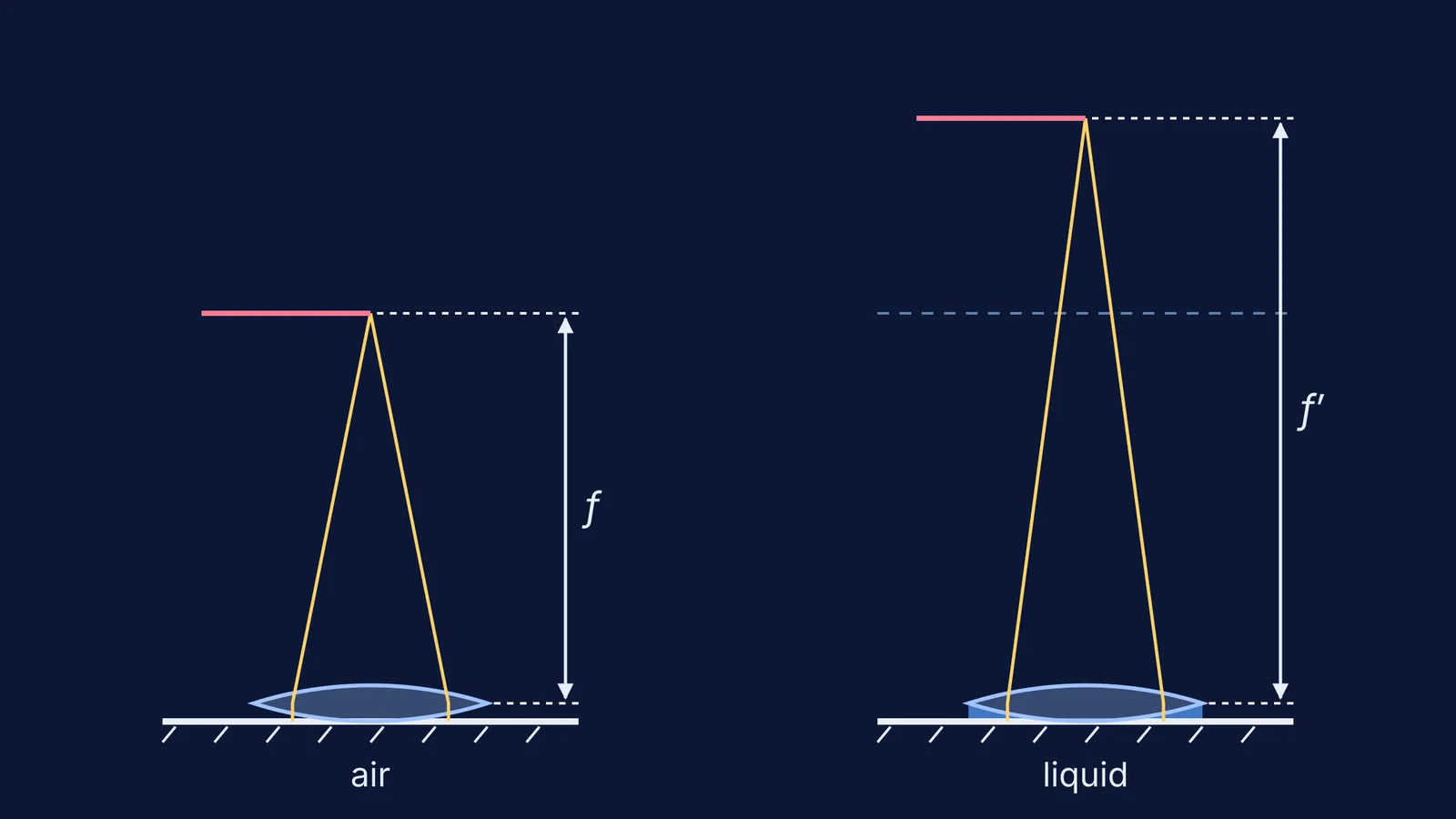
Put a pin at the focus of a convex lens resting on a plane mirror. Rays from the pin leave the lens parallel, strike the mirror normally and retrace their path, so the inverted image forms right at the pin. When there is no parallax between the pin and its image, the distance from the lens to the pin is the focal length f, as the NCERT lab manual explains. It is the same idea as finding focal length by auto-collimation.
Now add liquid. It fills the gap and becomes a plano-concave lens: one face takes the curve of the glass lens (radius R) and the other lies flat on the mirror. The two lenses act together, so the pin has to go higher to find the new focal length f′. If a diverging liquid lens sounds strange, see why a convex lens can act like a concave one in a liquid.
The manual's three relations, written with the size of the liquid lens's focal length f_l:
Lenses in contact: 1/f′ = 1/f + 1/f_l, so |f_l| = ff′/(f′ − f).
Lens maker's formula for a plano-concave lens: 1/|f_l| = (n − 1)/R.
Together: n = 1 + R/|f_l|.
You measure R with a spherometer, following Experiment 3 of the NCERT Class XI lab manual.
What do you actually do at the stand?
These steps follow the NCERT procedure:
Place the plane mirror on the base of a rigid stand, reflecting side up, and rest the convex lens on it.
Clamp a sharp pin horizontally so its tip sits directly above the optical centre of the lens. A plumb line and a spirit level help.
Raise the pin until its tip meets the tip of its image with no parallax. Measure the distance from the pin to the top of the lens and from the pin to the mirror. Their average is f.
With a dropper, gently put a few drops of liquid under the lens without moving it.
Raise the pin again until the parallax disappears. The same average gives f′.
Repeat for more readings, and find R with the spherometer.
Worked example: from three readings to n
Practice readings (made up, not from the manual):
Air: pin 19.5 cm above the top of the lens and 20.5 cm above the mirror, so f = 20.0 cm.
Water: 29.5 cm and 30.5 cm, so f′ = 30.0 cm.
Spherometer: R = 20.0 cm.
Step 1: |f_l| = (20.0 × 30.0)/(30.0 − 20.0) = 600/10 = 60.0 cm.
Step 2: n = 1 + 20.0/60.0 = 1.33.
That matches the refractive index of 1.33 listed for water in Table 9.1 of NCERT Class XII Physics, Ray Optics.
How sensitive is the answer? Keep f and R fixed and misread f′ by 1 cm:
f′ = 31.0 cm gives |f_l| = 620/11 ≈ 56.4 cm, so n ≈ 1.35.
f′ = 29.0 cm gives |f_l| = 580/9 ≈ 64.4 cm, so n ≈ 1.31.
A 1 cm slip in f′ moves n by about 0.02, because f′ − f is a small difference between two larger numbers. Take most care removing parallax on the second reading.
If combining lenses is where you lose the thread, the Fermi Problem Library has worked problems with a step-by-step solver that explains the reasoning rather than printing an answer.
Why does the liquid lens get a negative focal length?
The manual writes f_l = ff′/(f − f′) and notes it is negative, since f′ is bigger than f. The minus sign only tells you the liquid lens diverges. The manual's n = 1 + R/f_l has no modulus signs, so use the size |f_l|. Put in −60 cm by mistake and you get n ≈ 0.67, which is impossible for a liquid. If your answer comes out below 1, check the sign first.
Which mistakes cost marks in this practical?
From the manual's precautions and sources of error, plus the sign trap:
The pin tip is not above the optical centre, which makes parallax hard to remove.
Measuring from only one surface of the lens instead of averaging the two distances.
Adding liquid so roughly that the lens shifts between readings.
A mirror that is not horizontal, or a lens whose two surfaces have different radii.
Putting the signed f_l into n = 1 + R/|f_l|.
The same lens-combination idea comes up when measuring a concave lens's focal length in the lab. If the lens maker's formula itself is shaky, the Fermi Concept Library gives each concept its own lesson.


