On this page
Eight new questions, easy to hard, each with a worked solution and its trap. The official JEE (Advanced) 2026 syllabus lists Coulomb's law, field and potential, the energy of a system of point charges, flux and Gauss's law for a wire, a sheet and a thin shell, and capacitors with dielectrics. Concepts are in our guide on how to prepare electrostatics for JEE Advanced.
How should you use this practice set?
Allow 35 minutes; answer before reading each solution.
Each question is labelled single-correct, one or more options correct, or numerical answer.
Judge every option of a "one or more" question on its own; our guide to JEE Advanced question types explains the formats.
Take k = 1/(4πε₀) = 9 × 10⁹ N m² C⁻² and ignore gravity.
Easy: superposition, shells and energy
Q1 (easy, single-correct). A thin ring of radius 6 cm carries +4 nC spread uniformly. What is the greatest field strength anywhere on its axis?
(A) 1.0 × 10⁴ N/C (B) 3.8 × 10³ N/C (C) 3.5 × 10³ N/C (D) zero
Answer: (B). On the axis, E = kQz/(R² + z²)^(3/2). Setting dE/dz = 0 gives z = R/√2, where E = 2kQ/(3√3 R²) = 3.85 × 10³ N/C. Trap: (C) evaluates the field one radius out; (A) treats the ring as a point charge R away.
Q2 (easy, one or more options correct). A thin non-conducting shell of radius 15 cm carries +6 nC uniformly. A −1 nC point charge is fixed inside, 5 cm from the centre. Which are correct?
(A) The flux through a concentric sphere of radius 30 cm is (5 nC)/ε₀. (B) The shell exerts no net force on the −1 nC charge. (C) The potential at the centre is 180 V. (D) The field is 500 N/C at every point 30 cm from the centre.
Answer: (A), (B), (C). Gauss's law counts enclosed charge: 5 nC. Inside, the shell's own field is zero. At the centre, V = k(6 nC)/0.15 − k(1 nC)/0.05 = 360 − 180 = 180 V. Trap: (D). Equal flux is not equal field; the off-centre charge makes it range from about 456 to 527 N/C.
Q3 (easy, numerical-value). Charges of +1 µC are fixed at three corners of a square of side 20 cm. A particle of mass 1 g and charge +1 µC is released from rest at the centre. Find its speed far away, in m/s.
Answer: 19.5. Each charge is 0.141 m away, so U = 3kq²/0.141 = 0.191 J, all turning into kinetic energy: v = √(2 × 0.191/0.001) = 19.5 m/s. Trap: counting four charges gives 22.6.
Medium: potential maps, dielectrics and flux
Q4 (medium, single-correct). In a region V = (3xy − y²) volts, x and y in metres. A +2 µC charge moves from (1, 1) to (2, 2). Find the field magnitude at (1, 1) and the work done by the field.
(A) √10 V/m, +12 µJ (B) 3 V/m, −12 µJ (C) √10 V/m, −12 µJ (D) √10 V/m, −16 µJ
Answer: (C). E = −∇V = (−3y, −(3x − 2y)) = (−3, −1) V/m at (1, 1), so |E| = √10 V/m. V rises from 2 V to 8 V, so W = q(V₁ − V₂) = −12 µJ. Trap: (A) is the work done by an external agent; (B) drops the y-component.
Q5 (medium, one or more options correct). An air capacitor has C₀ = 10 pF. In P, a slab of dielectric constant 3 fills the full gap over half the plate area. In S, it covers the full area but half the gap. Which are correct?
(A) C = 20 pF in P. (B) C = 15 pF in S. (C) In S, the field in air is three times the field in the dielectric. (D) In P, the field in the dielectric half is one third of that in the air half.
Answer: (A), (B), (C). P is 5 pF and 15 pF in parallel: 20 pF. S is 20 pF in series with 60 pF: 15 pF. In S, E_air = KE_dielectric. Trap: (D). In P, same voltage across the same gap means equal fields.
Q6 (medium, numerical-value). A cube has +q at its centre and +q at one corner. The flux through a face that does not touch that corner is q/(nε₀). Find n.
Answer: 4.8. The centre charge gives q/6ε₀ per face. The corner charge is shared by eight cubes; this cube's q/8ε₀ splits over three far faces: q/24ε₀ each. Sum: 5q/24ε₀, so n = 4.8. Trap: forgetting the corner charge gives 6.
Hard: earthing shells and a sheet with a hole
Q7 (hard, one or more options correct). Concentric thin conducting shells of radii 10 cm and 20 cm carry +4 nC (inner) and +8 nC (outer). Step 1: the outer shell is earthed, then disconnected. Step 2: the inner shell is earthed. Which are correct?
(A) After step 1, the inner shell is at 180 V. (B) In step 1, 8 nC flows from the outer shell to earth. (C) After step 2, the inner shell carries +2 nC. (D) After step 2, the outer shell is at −90 V.
Answer: (A), (C), (D). Earthing makes the outer shell's potential zero, so it ends at −4 nC and 12 nC flows to earth. V_inner = k(4 nC)/0.10 − k(4 nC)/0.20 = 180 V. In step 2, kq/0.10 − k(4 nC)/0.20 = 0 gives q = +2 nC, and V_outer = k(−2 nC)/0.20 = −90 V. Trap: (B) assumes earthing leaves it neutral.
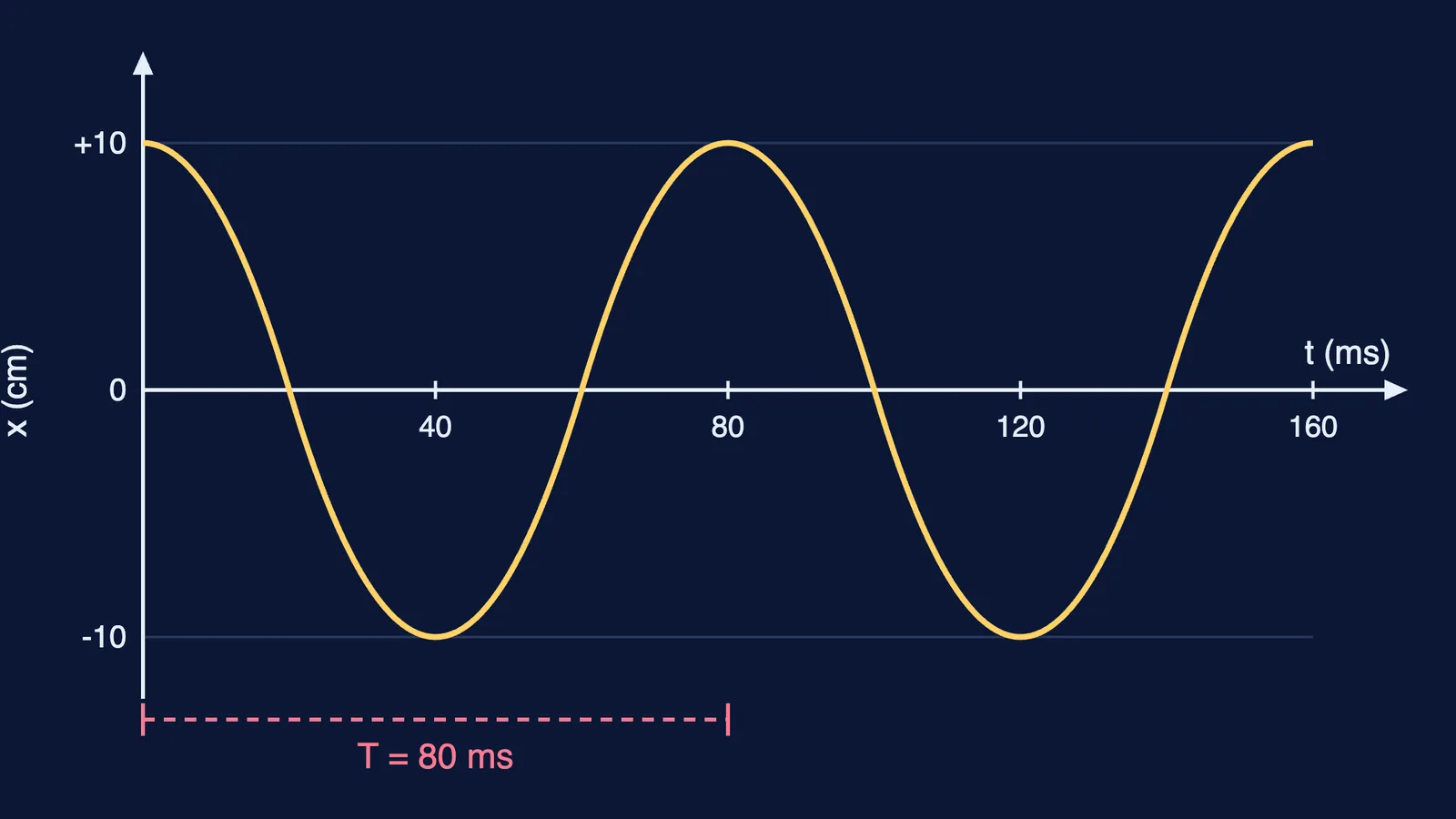
Q8 (hard, numerical-value). A large positively charged sheet, with σ/(2ε₀) = 500 N/C, has a tiny hole. A particle of mass 1 mg and charge −1 µC is released from rest 10 cm from the sheet, on the line through the hole. Find the period of its motion, in ms.
Answer: 80. The field is the same size on both sides, so a = qE/m = 500 m/s², always towards the sheet. Reaching the sheet takes √(2 × 0.10/500) = 20 ms; a cycle is four such legs: 80 ms. Trap: assuming simple harmonic motion; the force is constant.
What should you do after this set?
Gauss slips (Q2, Q6, Q7): write what each surface encloses. Energy slips (Q3, Q4): write every sign first. Capacitor slips (Q5): ask what is shared, voltage or charge. Redo misses a week later.
For more practice, the Fermi Problem Library has worked problems with a step-by-step solver that explains the reasoning rather than printing an answer.