On this page
These are the key terms of Chapter 12, Ecosystem, in the NCERT Class 12 Biology textbook (Reprint 2026-27), grouped the way the chapter is built. The CBSE 2026-27 Biology curriculum lists its scope as patterns, components, productivity, decomposition, energy flow and three pyramids. For answer practice, see our Ecosystem Class 12 board exam guide.
Not in the 2026-27 chapter: ecological succession and the carbon and phosphorus cycles; nutrient cycling appears only in the summary.
What is an ecosystem made of?
Ecosystem: a functional unit of nature made of a community of organisms plus the physical environment they constantly exchange matter and energy with. Example: a pond, a forest, or a man-made crop field.
Abiotic component: the non-living part, such as air, water and soil. Example: a pond's water and bottom mud.
Biotic component: the living part, made up of producers, consumers and decomposers.
Producers (autotrophs): organisms that make food from inorganic materials using sunlight. Example: phytoplankton in a pond; trees on land.
Consumers (heterotrophs): organisms that depend on producers for food, directly or indirectly. Example: zooplankton.
Species composition: which plant and animal species an ecosystem holds.
Stratification: the layering of species at different heights. Example: a forest has a tree canopy on top, shrubs below it, and herbs and grasses at ground level. Don't confuse with: species composition, which says which species are present, not where.
What is the difference between GPP and NPP?
Primary production: the amount of organic matter plants make by photosynthesis in a given area over a period, in g m⁻² or kcal m⁻².
Productivity: the rate of making that biomass, in g m⁻² yr⁻¹ or kcal m⁻² yr⁻¹. Don't confuse with: production, which is an amount; productivity always has "per year" in its unit.
Gross primary productivity (GPP): the total rate at which plants make organic matter during photosynthesis.
Net primary productivity (NPP): what remains after the plants' own respiration (R) is subtracted, so GPP − R = NPP. It is the food available to herbivores and decomposers.
Secondary productivity: the rate at which consumers build new organic matter.
The biosphere's yearly NPP is about 170 billion tons (dry weight), of which oceans make only 55 billion tons despite covering about 70 per cent of the surface (NCERT).
What are the steps of decomposition?
Detritus: dead plant and animal remains, including leaves, bark and faecal matter; the raw material of decomposition.
Decomposition: the breakdown of complex organic matter into carbon dioxide, water and inorganic nutrients.
Detritivores: animals that eat detritus and break it into small pieces. Example: earthworm. Don't confuse with: decomposers, which are mostly fungi and bacteria that digest dead matter chemically.
Fragmentation: detritivores breaking detritus into smaller particles.
Leaching: water-soluble inorganic nutrients seeping down the soil horizon and precipitating as salts that plants cannot use.
Catabolism: the enzyme-driven chemical breakdown of detritus, by bacteria and fungi, into simpler inorganic substances.
Humification: the build-up of humus in soil.
Humus: a dark, shapeless, colloidal material that resists microbes, breaks down very slowly and stores nutrients.
Mineralisation: microbes breaking down humus to release inorganic nutrients. Don't confuse with: humification, which builds humus up rather than breaking it down.
All these steps act on detritus at the same time, and most need oxygen.
Rate check: lignin and chitin slow decomposition; nitrogen and sugars speed it. Warm, moist soil speeds it; cold and anaerobiosis (no oxygen) slow it.
How does energy flow through an ecosystem?
Photosynthetically active radiation (PAR): the part of sunlight that plants can use for photosynthesis. Per NCERT, it is less than 50 per cent of incident solar radiation, and plants capture only 2-10 per cent of PAR.
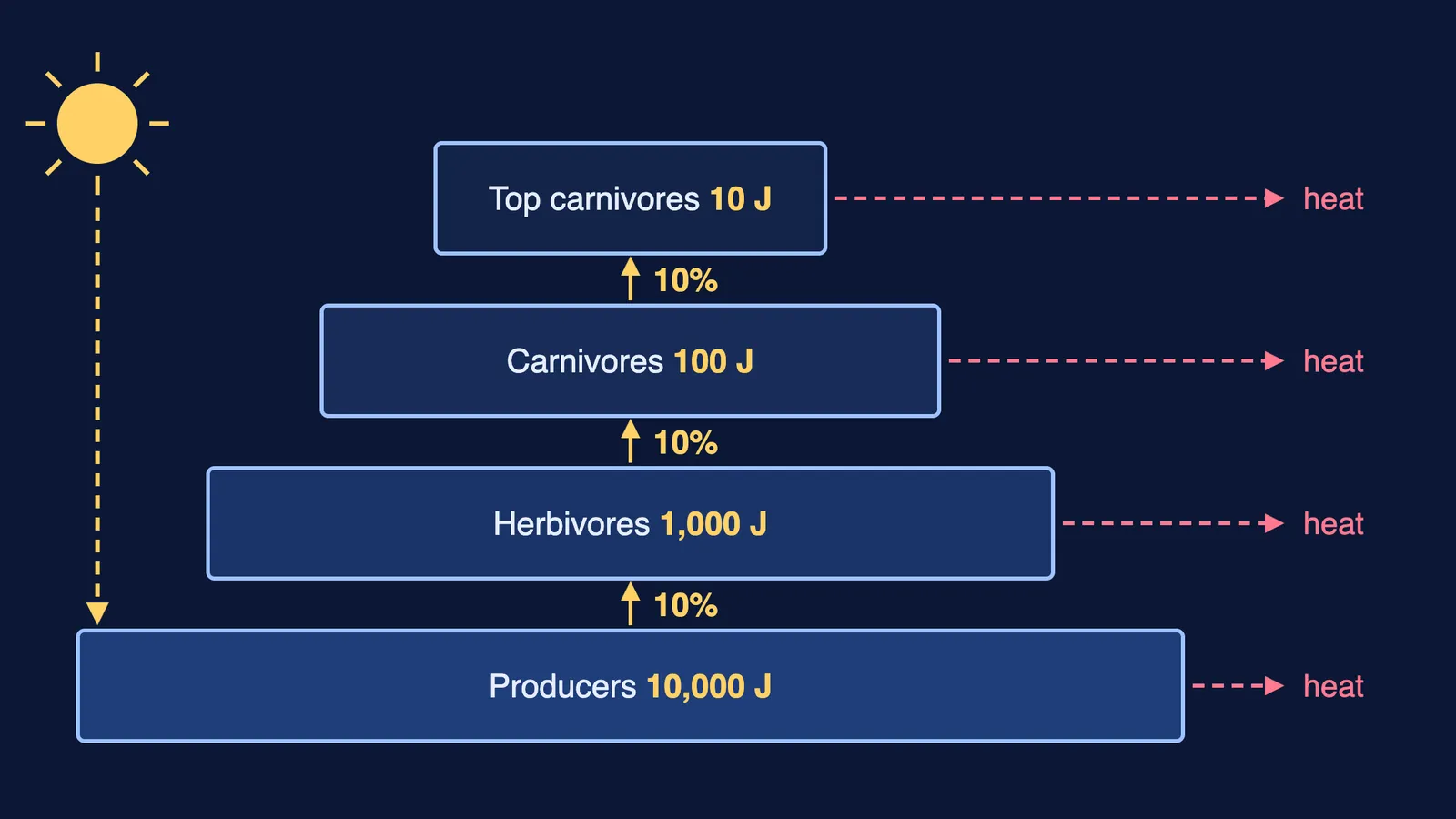
Unidirectional energy flow: energy moves one way, sun to producers to consumers, and leaves as heat; it never cycles back.
Grazing food chain (GFC): a food chain (who-eats-whom sequence) starting from living plants. Example: grass → goat → man.
Detritus food chain (DFC): a chain starting from dead organic matter, run by decomposers. Don't confuse with: GFC. In water the GFC carries most energy; on land more energy flows through the DFC.
Saprotrophs: decomposers that secrete enzymes onto dead matter and absorb the simple products. Example: fungi.
Food web: interlinked food chains. Example: omnivores like crows and cockroaches link chains.
Trophic level: feeding position: producers first, herbivores (primary consumers) second, carnivores (secondary consumers) third. It is a functional level, not a species: a sparrow eating seeds is a primary consumer; eating insects, a secondary one.
Standing crop: the living biomass, or number, at a trophic level at a given time in a unit area.
Biomass: the mass of living organisms; dry weight is the more accurate measure.
10 per cent law: only about 10 per cent of energy at one trophic level reaches the next, which keeps grazing food chains short (NCERT).
Why is the pyramid of energy never inverted?
Ecological pyramid: trophic levels stacked by number, biomass or energy, producers at the base.
Pyramid of number: individuals at each level. Upright in a grassland; inverted when one big tree supports many insects.
Pyramid of biomass: standing crop at each level. Generally inverted in the sea, where a small standing crop of phytoplankton supports a much larger one of consumers.
Pyramid of energy: energy at each level. Always upright, because energy is lost as heat at every step. Don't confuse with: the pyramid of biomass, which can be inverted.
Limitations: pyramids ignore species that feed at more than one level, assume a simple chain instead of a web, and leave out saprophytes.
How to learn these terms
Learn the mix-up pairs above together, not one term at a time.
Draw decomposition as a cycle around detritus, with fragmentation, catabolism and humification acting together and leaching dropping into the soil.
Work one number chain: 10,000 J at producers gives 1,000, 100 and 10 J at the next three levels. Then explain why it cannot invert.
Tie each pyramid to its example: grassland, one tree with insects, the sea.
If a term feels abstract, the Fermi Concept Library gives each biology concept its own lesson. For more practice, try our notes on productivity and decomposition in ecosystems and the ecology questions on food chains and pyramids.