On this page
Most of us learn a neat shortcut in school: testosterone is the male hormone and oestrogen (spelt estrogen in American books) is the female hormone. It is a useful first step, but it is wrong in one important way. Men and women both make both hormones. What differs is how much, where it is made, and which jobs it does.
Do men have oestrogen and women have testosterone?
Yes. The difference is one of amount, not presence or absence. A 2018 review in Endocrine Reviews by David Handelsman and colleagues gives the reference ranges measured by mass spectrometry: 7.7 to 29.4 nmol/L of testosterone for healthy men aged 18 to 40, and 0 to 1.7 nmol/L for healthy premenopausal women.
The same review notes that before puberty there is no sex difference in circulating testosterone. From puberty the testes make 30 times more testosterone than before, and men's blood levels end up more than 15 times women's at any age.
A review by Henry Burger in Fertility and Sterility adds a surprise: women secrete greater amounts of androgen than of oestrogen02985-0). The androgens it counts include weaker precursors such as DHEA and DHEA sulphate, not just testosterone.
Where is oestrogen made in men?
Mostly not in the testes. A 2017 review in Physiological Reviews, Estrogens in Male Physiology, states that in males the testes produce only about 20% of circulating oestrogens. The rest is made locally in fat, brain, skin and bone.
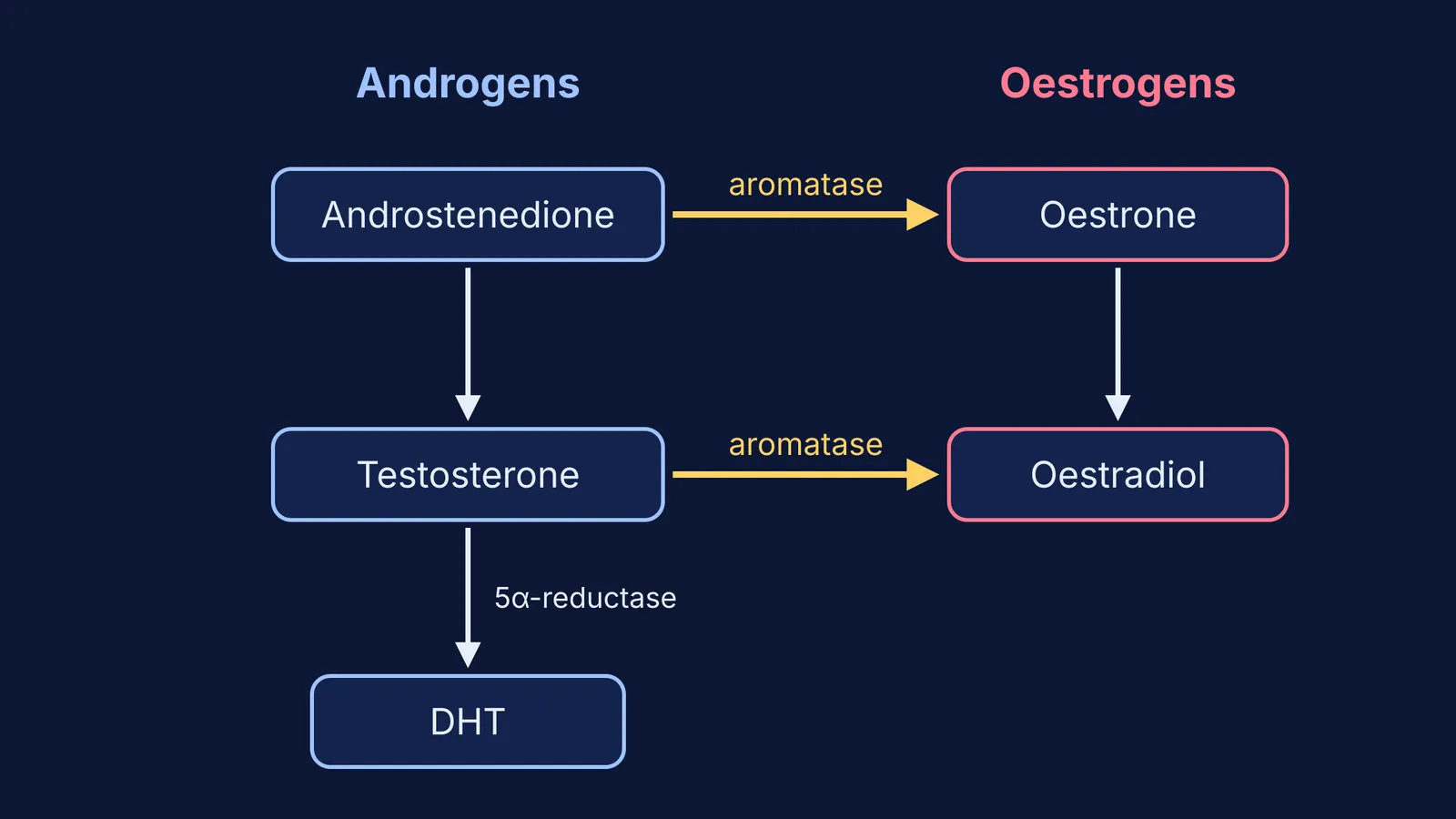
The tool that does this is an enzyme called aromatase, which converts androgens into oestrogens. The same review lists it in the Leydig cells and the lining of the sperm-making tubules, as well as in other organs. MedlinePlus, the US National Library of Medicine's health site, adds that the weak oestrogen estrone is made mostly by body fat and the adrenal glands in both sexes.
So in a man, much of the oestrogen is testosterone changed in place.
Where is testosterone made in women?
From three places in roughly equal shares, according to the Handelsman review: direct release from the ovaries, direct release from the adrenal glands, and conversion of precursor hormones in the liver, kidney, muscle, fat and skin.
Burger's review02985-0) adds that the ovary keeps secreting androgens after menopause and that testosterone levels are not directly affected by menopause itself.
What does oestrogen do in men?
The clearest evidence comes from rare cases where it is missing.
Bones stop growing because of oestrogen. In 1994 doctors described a 28-year-old man whose oestrogen receptor gene did not work. He was 204 cm tall, his growth plates had not closed, he had kept growing into adulthood, and his spine had very low bone density, even though his testosterone was normal.
Men who cannot make aromatase look similar. The Physiological Reviews article reports that they are tall with open growth plates and weak bones, and that giving them oestradiol closed the growth plates.
Body fat and sex drive. A 2013 New England Journal of Medicine trial in 400 healthy men aged 20 to 50 found that low testosterone mainly cut muscle and strength, low oestrogen mainly raised body fat, and both lowered sexual function.
And testosterone in women? MedlinePlus says that in both sexes testosterone helps control sex drive and helps with muscle and bone growth.
How should you write this in a biology exam?
Your textbook statements are still correct: Leydig cells do secrete androgens, and the ovary does secrete oestrogen and progesterone. The error only creeps in when "main source" becomes "only source". Revise our post on what the testis and ovary hormones do first, then use this four-step check.
Name the main source: testosterone mostly from Leydig cells in males, oestradiol mostly from ovarian follicles in females.
Add the word "mainly" or "in larger amounts" instead of "only".
If the question allows, mention aromatase: testosterone is converted to oestradiol in many tissues.
In MCQs, answer what the syllabus asks; use the nuance to explain, not to argue with the key.
Worked example. Question: "Is testosterone a male hormone?" A strong two-line answer: "Testosterone is the main androgen and is made in much larger amounts in males, chiefly by Leydig cells. Females also make it, in the ovaries, the adrenal glands and peripheral tissues."
To see how these levels are kept steady, read about hormone feedback loops, and for the changes they drive in teenagers, see what happens to the body in puberty.
If you want to trace how steroid hormones connect to the glands that make them, the Fermi Concept Library has a lesson for every biology concept and shows where it sits in the map. Fermi's AI tutor can then check your understanding as it goes, so a shortcut does not harden into a wrong fact.