On this page
Ceric sulphate solution is yellow, and cerous (Ce³⁺) solution is colourless. Add thiocyanate and the yellow disappears. In 1952 G. S. Deshmukh, Assistant Professor of Chemistry at Benares Hindu University, and B. R. Sant turned that colour change into a way of measuring cerium, and in doing so pinned down how many ceric ions one thiocyanate ion can reduce: six. Their paper is "A new volumetric method of cerium determination by thiocyanate", Proceedings of the Indian Academy of Sciences, Section A, volume 37, pages 504 to 507, received 26 February 1952 and communicated by Prof. S. S. Joshi (full text at the Indian Academy of Sciences). It is a neat lesson in oxidation numbers and n-factors. One product is hydrogen cyanide, a highly poisonous gas, so this post covers the history and the stoichiometry only, not a method to repeat.
What reaction did Deshmukh and Sant find?
The paper notes that when thiocyanates are oxidised, "in practically every case the sulphur atom of the anion is oxidized to sulphate, and in most cases the nitrogen escapes as hydrogen cyanide". Their titrations fitted this equation, printed in the paper:
6Ce(SO₄)₂ + KCNS + 4H₂O → 3Ce₂(SO₄)₃ + KHSO₄ + 3H₂SO₄ + HCN
Check it yourself. Both sides have 6 Ce, 13 S, 52 O, 8 H, and one each of K, C and N. Written as ions (our own rewrite, not in the paper):
6Ce⁴⁺ + SCN⁻ + 4H₂O → 6Ce³⁺ + SO₄²⁻ + HCN + 7H⁺
The charge is +23 on both sides (24 − 1 on the left, 18 − 2 + 7 on the right).
How many electrons does one thiocyanate ion lose?
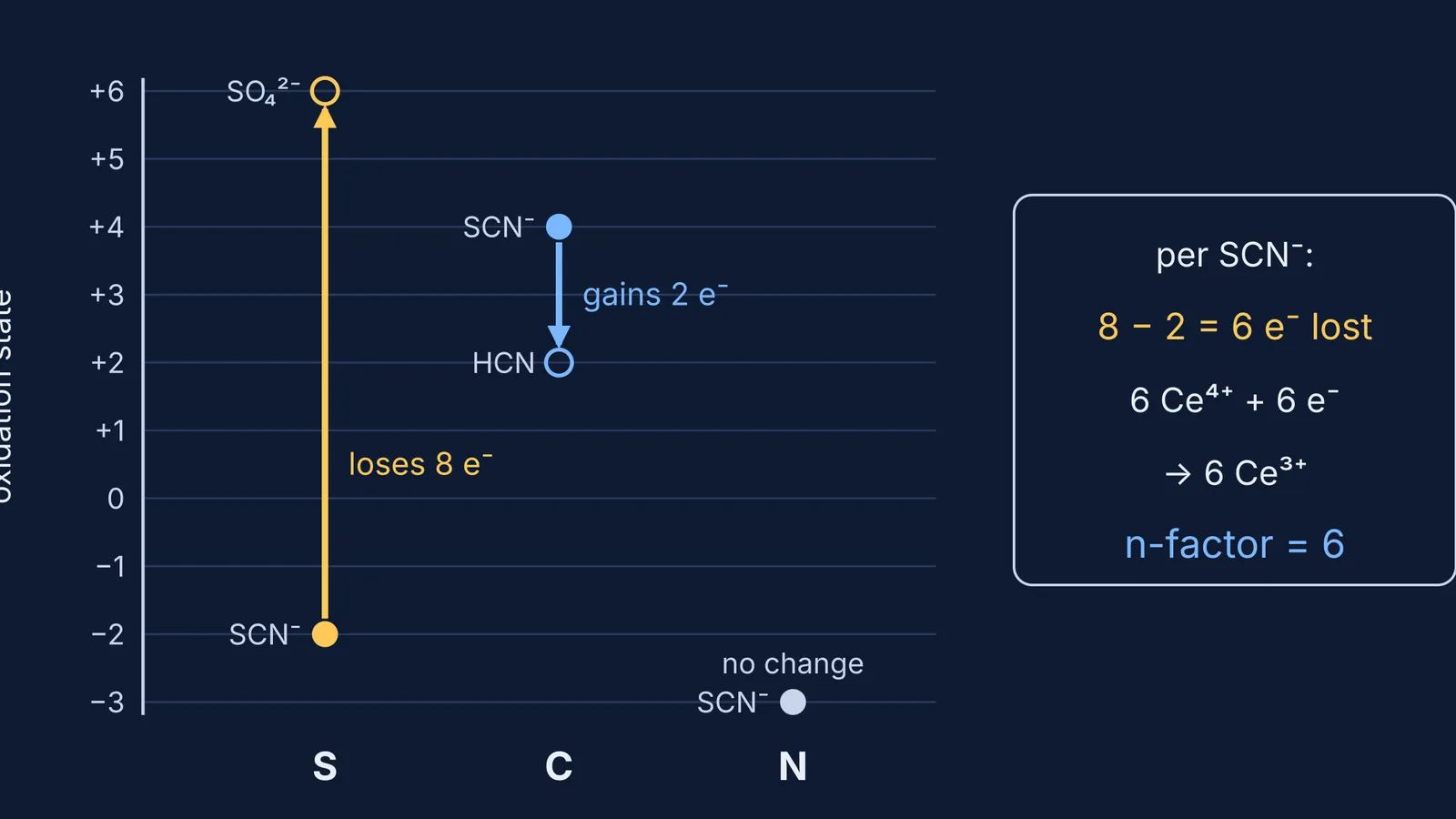
Assign oxidation numbers. In SCN⁻, nitrogen is the most electronegative atom, so take N = −3. With S = −2, carbon must be +4 to give an overall −1. In HCN, H = +1 and N = −3, so C = +2. In sulphate, S = +6.
Sulphur: −2 → +6, loses 8 electrons.
Carbon: +4 → +2, gains 2 electrons.
Nitrogen: −3 → −3, no change.
Net: 8 − 2 = 6 electrons lost per SCN⁻. Each Ce⁴⁺ gains one electron to become Ce³⁺, so one thiocyanate needs six ceric ions. That is exactly the 6 : 1 ratio the titrations gave.
A useful point (our reasoning): the net count does not depend on how you split the charge inside SCN⁻. If a book uses S = −1 and C = +3, sulphur loses 7 and carbon gains 1, and the net is still 6. The total depends only on the starting ion and the final products.
What is the n-factor of thiocyanate, and why does it depend on the reaction?
In this reaction the n-factor of SCN⁻ is 6. The equivalent mass of KSCN (M ≈ 97.18 g/mol) is then 97.18 ÷ 6 ≈ 16.20 g. For the general rules, see the n-factor and the equivalent concept in redox titrations.
The same compound behaves differently in Volhard's method, where SCN⁻ only precipitates Ag⁺ as AgSCN. No electrons move, and one SCN⁻ matches one Ag⁺, so its n-factor there is 1. Deshmukh and Sant standardised their thiocyanate by Volhard's method, so the "normality" of KCNS in their table is a Volhard normality, numerically equal to the molarity. As a reductant towards Ce⁴⁺ the same solution is six times as concentrated in equivalents (our reading of the table; the worked example below bears it out).
The paper also compares oxidants: "one molecule of KCNS is equivalent to 6/5 and 6 molecules of permanganate and Ce(SO₄)₂ respectively." Permanganate in acid takes 5 electrons per MnO₄⁻, ceric ion takes 1, and thiocyanate gives 6, so 6/5 and 6 follow at once.
How did the titration work?
The end point was the problem. Adding thiocyanate fast risked overshooting. Adding it slowly, drop by drop, used up extra reductant and gave high results.
Their answer was a back titration. A known excess of thiocyanate reduced all the Ce⁴⁺. The leftover thiocyanate was then found by the Volhard route: excess silver nitrate, then more thiocyanate with a ferric salt as indicator, which turns red once SCN⁻ is in excess. If a mL of thiocyanate went in first, the silver nitrate matched d mL of thiocyanate, and e mL more was needed at the end, the thiocyanate used by cerium was (a + e − d) mL. The logic is the same as in other back titration calculations.
Worked example: experiment 3 of Table I
Their experiment 3 used 10 mL of 0.03793 N ceric sulphate. The thiocyanate used, (a + e − d), was 5.8 mL of 0.01089 N KCNS (Volhard normality, so 0.01089 M).
Ceric ion. Ce⁴⁺ → Ce³⁺ is one electron, so N = M. Milliequivalents = 10 × 0.03793 = 0.3793 meq.
Thiocyanate, in moles. 5.8 × 0.01089 = 0.06316 mmol.
Thiocyanate, in equivalents. n-factor 6, so 6 × 0.06316 = 0.3790 meq.
Compare. 0.3790 against 0.3793, a difference of about 0.09%.
As CeO₂. One cerium per meq, and CeO₂ has M ≈ 172.11 g/mol. 0.3790 mmol × 172.11 = 65.23 mg, or 0.06523 g. The paper lists 0.06523 g "found" against 0.06525 g "calculated", an error of 0.03%.
Using n = 1 for thiocyanate in step 3 would give 0.0632 meq, six times too small.
Try one. How many mL of 0.02 M KMnO₄ (acid, n-factor 5) are equivalent to 1 mmol KSCN in a reaction that takes it to sulphate and HCN? Equivalents of KSCN = 6 × 1 = 6 meq. MnO₄⁻ needed = 6 ÷ 5 = 1.2 mmol. Volume = 1.2 ÷ 0.02 = 60 mL.
How did a barium sulphate weighing confirm the equation?
The equation makes a second prediction. Six Ce(SO₄)₂ carry twelve sulphate ions. After the reaction, Ce₂(SO₄)₃, KHSO₄ and H₂SO₄ carry thirteen. The extra one is the thiocyanate's sulphur, now sulphate.
So Deshmukh and Sant precipitated the sulphate as BaSO₄ from ceric sulphate solutions, once with thiocyanate added and once without. The extra BaSO₄ agreed with the calculated amount to within 0.0002 to 0.0003 g in their three trials. This is independent of the titration: it confirms where sulphur's eight electrons went.
When did the method go wrong?
In four runs with larger volumes of ceric solution (experiments 13 to 16), the errors rose to between 0.88% and 1.83%, against 0.02% to 0.45% elsewhere. The authors suggested that the high concentration of Ce³⁺ and/or sulphate interfered with the red ferric thiocyanate end point. They also pointed out that the trivalent rare earths that usually contaminate cerium do not interfere, because only cerium is reduced. Cerium is the lanthanoid with a common +4 state; for why, see why Ce⁴⁺ is oxidising and Eu²⁺ is reducing.
For more n-factor and back-titration numericals of the JEE Main and Advanced kind, Fermi Test Prep is built for exam preparation, with an AI tutor. To see oxidation-number counting solved one step at a time, try the Fermi Problem Library, a step-by-step solver that explains the reasoning.
Quick checklist
6Ce(SO₄)₂ + KCNS + 4H₂O → 3Ce₂(SO₄)₃ + KHSO₄ + 3H₂SO₄ + HCN.
In SCN⁻: S −2, C +4, N −3. S goes to +6, C goes to +2.
Net 6 electrons per SCN⁻, so n = 6 in this reaction.
In Volhard's method the n-factor of SCN⁻ is 1.
Sulphate ions go from 12 to 13 per six Ce⁴⁺, which BaSO₄ weighings confirmed.
One KCNS is equivalent to 6 Ce⁴⁺ or 6/5 MnO₄⁻.