

On this page
Some reactions you need cannot go on their own. Turning glucose into glucose-6-phosphate, the first step of glycolysis, has a positive standard Gibbs energy change, so on its own the equilibrium lies far to the left. Your cells make it happen anyway, by tying it to a reaction that runs strongly downhill: the breakdown of ATP. This idea is called reaction coupling, and the same arithmetic explains why carbon can pull a metal out of its oxide in a furnace.
What is a coupled reaction?
A coupled reaction is a pair of reactions that share an intermediate, so that one cannot happen without the other. If the first reaction has ΔG° > 0 (uphill) and the second has a larger negative ΔG° (downhill), the combined reaction has a negative ΔG° and can proceed.
The important word is share. Two reactions that simply happen in the same flask are not coupled. Coupling needs a real chemical link: a species made in one step and used in the next, or an enzyme that carries a group directly from one molecule to the other.
If spontaneity and the sign of ΔG are new to you, start with Gibbs energy and spontaneity, worked out.
Why do ΔG° values add and K values multiply?
Gibbs energy is a state function, so when you add two chemical equations, you add their ΔG° values. That is the same rule used in adding ΔG°, not E°, to combine two electrode couples.
Each ΔG° is linked to an equilibrium constant by ΔG° = −RT ln K. So:
ΔG°(total) = ΔG°₁ + ΔG°₂
−RT ln K(total) = −RT ln K₁ − RT ln K₂
ln K(total) = ln K₁ + ln K₂
K(total) = K₁ × K₂
This is the thermodynamic reason behind the rule in what happens to K when you add, reverse or multiply reactions. A small K₁ multiplied by a very large K₂ can give a combined K well above 1.
How does ATP drive glucose phosphorylation?
Here is the full calculation, using biochemical standard values (ΔG°′, measured at pH 7) and body temperature, T = 310 K.
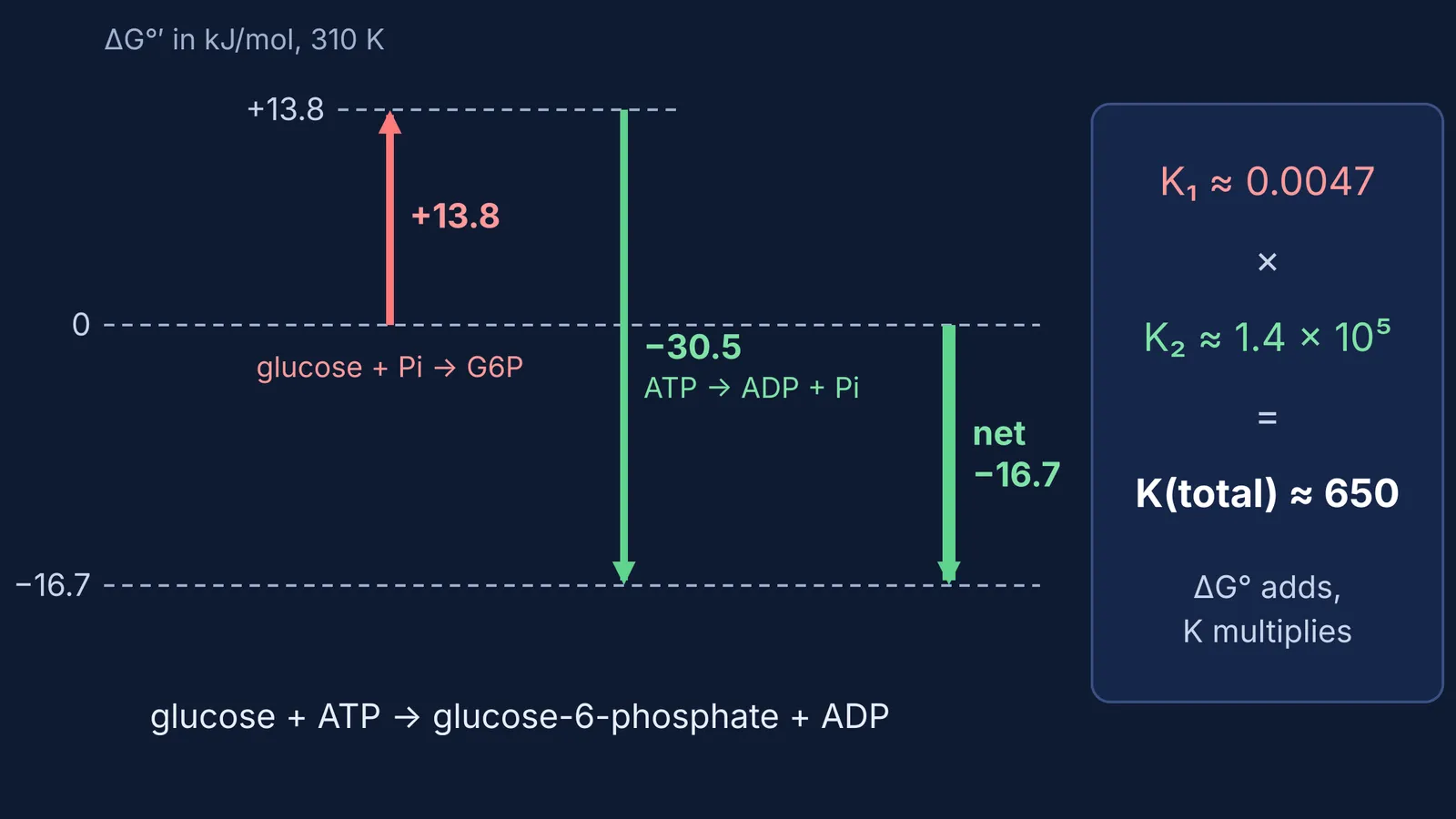
Uphill step. glucose + Pi → glucose-6-phosphate + H₂O, ΔG°′ = +13.8 kJ/mol. K₁ = exp(−13800 / (8.314 × 310)) = exp(−5.35) ≈ 0.0047. At equilibrium, almost no glucose is phosphorylated.
Downhill step. ATP + H₂O → ADP + Pi, ΔG°′ = −30.5 kJ/mol. K₂ = exp(30500 / (8.314 × 310)) = exp(11.83) ≈ 1.4 × 10⁵.
Add the equations. Pi and H₂O appear on both sides and cancel: glucose + ATP → glucose-6-phosphate + ADP.
Add the ΔG°′ values. +13.8 + (−30.5) = −16.7 kJ/mol. The combined reaction is downhill.
Multiply the K values. 0.0047 × 1.4 × 10⁵ ≈ 650.
Check. exp(16700 / (8.314 × 310)) = exp(6.48) ≈ 650. Both routes agree, as they must.
So the equilibrium has moved from about 0.005 (almost all glucose) to about 650 (almost all glucose-6-phosphate). Some sources give −30.6 kJ/mol for ATP hydrolysis instead of −30.5; the answer barely changes.
Keep R and T consistent. If you use 298 K by mistake, K₂ comes out larger (about 2.2 × 10⁵), because the same ΔG° gives a different K at a different temperature.
A quick extension: suppose a reaction had ΔG°′ = +40 kJ/mol. One ATP (−30.5) is not enough under standard conditions, since the sum is +9.5 kJ/mol. Coupling it to the hydrolysis of two ATP gives +40 − 61 = −21 kJ/mol, which is downhill. This is why some uphill steps in metabolism use more than one ATP equivalent.
Why is the real ΔG in a cell different from ΔG°′?
ΔG°′ refers to standard conditions: 1 M of each species (except H⁺, fixed at pH 7). Cells are not at standard conditions. The actual Gibbs energy change follows ΔG = ΔG°′ + RT ln Q.
Cells keep the ratio of ATP to ADP high, far from equilibrium. That makes Q for ATP hydrolysis small, so ln Q is negative and the real ΔG for ATP hydrolysis inside a cell is more negative than −30.5 kJ/mol. Textbook figures for working cells are commonly around −50 kJ/mol, though the exact value depends on the cell.
For exam questions, use the standard values you are given. Just remember that "standard" is a reference point, not a description of the cell.
How is carbon reducing a metal oxide the same idea?
Metallurgy uses exactly the same trick. Take zinc oxide:
2ZnO(s) → 2Zn + O₂(g) has a large positive ΔG°. Zinc oxide will not decompose on heating at ordinary furnace temperatures.
2C(s) + O₂(g) → 2CO(g) has a negative ΔG° that becomes more negative as temperature rises, because one mole of gas becomes two and ΔS° is positive.
Adding them: 2ZnO + 2C → 2Zn + 2CO. O₂ cancels, and above the temperature where the two ΔG° lines cross, the sum is negative.
Oxygen is the shared species. Carbon "pulls" it away, just as hexokinase moves a phosphate group. An Ellingham diagram is simply a way of doing this addition graphically for many oxides at once; how to read an Ellingham diagram walks through it. Notice that the Ellingham lines are plotted per mole of O₂, so the O₂ cancels cleanly when you subtract one line from another.
In the real furnace much of the reduction happens through CO rather than solid carbon touching solid oxide, but the thermodynamic bookkeeping is the same: what matters is that the overall ΔG° is negative.
How do exam questions test coupled reactions?
Expect one of these patterns:
Given ΔG° for two reactions, find ΔG° and K for the combined reaction.
Given K₁ and K₂, find K for the sum (multiply), or for the difference (divide).
Decide whether an uphill reaction can be driven by a given downhill one (is the sum negative?).
Explain why a reducing agent works only above a certain temperature (the crossover on an Ellingham diagram).
If you want to practise these with feedback on each step, the Fermi Problem Library has a step-by-step solver that explains the reasoning, not just the final number.
Quick checklist
Coupling needs a shared intermediate or an enzyme that links the two reactions.
ΔG° values add; K values multiply, because ΔG° = −RT ln K.
Glucose → G6P: +13.8 kJ/mol alone, −16.7 kJ/mol when coupled to ATP (−30.5).
K goes from about 0.0047 to about 650 at 310 K.
Use the same R and T throughout, and ln, not log₁₀, unless you include 2.303.
Real cellular ΔG differs from ΔG°′ because concentrations are not standard.
Carbon reducing ZnO is the same addition, with O₂ as the shared species.


