On this page
These terms come from Chapter 1 of NCERT Class 10 Science, Chemical Reactions and Equations (reprint 2026-27). Each has a plain definition and an example. For the balancing method itself, read our guide to balancing chemical equations in Class 10.
What counts as a chemical reaction?
Chemical reaction: a change that makes new substances, as bonds between atoms break and new ones form. Example: magnesium ribbon burning to a white powder. Don't confuse with: a physical change, where no new substance forms.
Reactants: the starting substances, written left of the arrow. Example: magnesium and oxygen.
Products: the new substances, written right of the arrow; the arrowhead points to them. Example: magnesium oxide.
Signs of a chemical reaction: a change in state, colour or temperature, or a gas given off. Example: zinc in dilute sulphuric acid gives off hydrogen.
How do you write and balance a chemical equation?
Word equation: a reaction written with names. Example: Magnesium + Oxygen → Magnesium oxide.
Chemical equation: the reaction written with symbols and formulae. Example: Mg + O2 → MgO.
Skeletal chemical equation: correct formulae but unequal atom counts on the two sides. Example: Mg + O2 → MgO has two oxygen atoms on the left, one on the right.
Law of conservation of mass: the total mass of the products equals the total mass of the reactants, so each element needs the same atom count on both sides. This is why we balance equations.
Balanced chemical equation: the same number of atoms of each element on both sides. Example: 2Mg + O2 → 2MgO. Don't confuse with: a skeletal equation.
Coefficient: the number in front of a formula. Example: 4H2O is four water molecules. Don't confuse with: the small number inside a formula, which you never change. Changing H2O to H2O4 changes the formula.
Hit-and-trial method: trying the smallest whole-number coefficients, starting with the compound that has the most atoms. Example: Fe + H2O → Fe3O4 + H2 becomes 3Fe + 4H2O → Fe3O4 + 4H2.
State symbols: (s) solid, (l) liquid, (g) gas, (aq) aqueous. Example: in 3Fe(s) + 4H2O(g) → Fe3O4(s) + 4H2(g), (g) shows the water is steam. Don't confuse (aq), a substance dissolved in water, with (l), a substance that is itself a liquid, such as water.
Reaction conditions: temperature, pressure, catalyst or light, written above or below the arrow. Example: sunlight and chlorophyll for photosynthesis.
What are the types of chemical reactions?
The CBSE Class 10 Science syllabus for 2026-27 names these reaction types; examples are from the NCERT chapter.
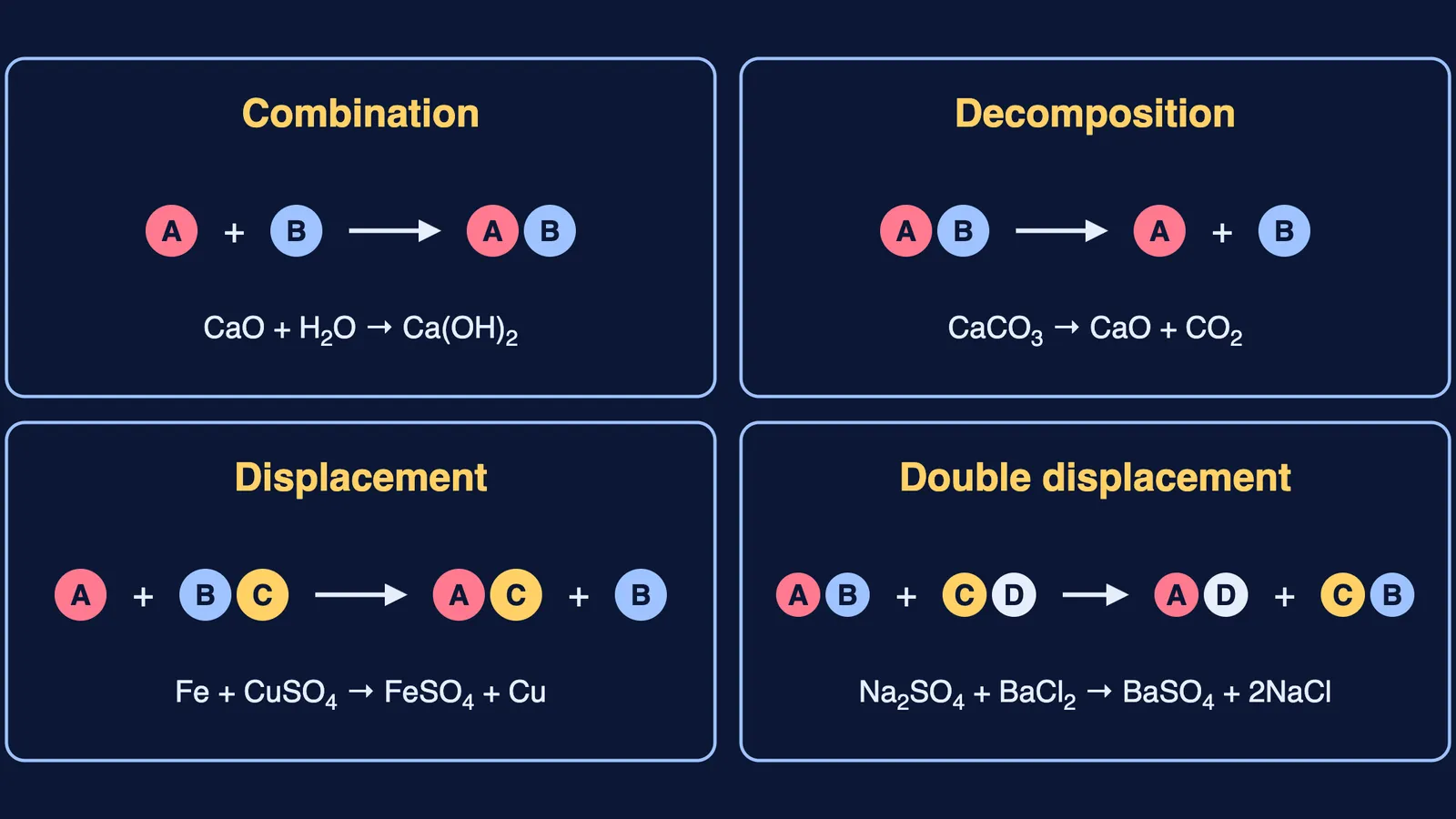
Combination reaction: two or more substances form a single product. Example: CaO + H2O → Ca(OH)2, or C + O2 → CO2.
Quick lime and slaked lime: calcium oxide (CaO) and calcium hydroxide (Ca(OH)2). Water on quick lime gives slaked lime.
Decomposition reaction: one substance breaks into two or more simpler ones, the reverse of combination, using heat, light or electricity.
Thermal decomposition: decomposition by heating. Examples: CaCO3 → CaO + CO2; heating green ferrous sulphate crystals: 2FeSO4 → Fe2O3 + SO2 + SO3.
Electrolysis of water: splitting water into hydrogen and oxygen with an electric current. The hydrogen tube collects twice the volume of the oxygen tube, because 2H2O → 2H2 + O2.
Decomposition by light: light breaking a substance down. Example: 2AgCl → 2Ag + Cl2 in sunlight, so white silver chloride turns grey; black and white photography uses this.
Displacement reaction: a more reactive element pushes a less reactive one out of its compound. Example: Fe + CuSO4 → FeSO4 + Cu; the blue fades, the nail turns brownish.
Double displacement reaction: two compounds swap ions. Example: Na2SO4 + BaCl2 → BaSO4 + 2NaCl. Don't confuse with: displacement, where one reactant is a single element.
Precipitate: an insoluble solid formed when solutions mix. Example: white barium sulphate.
Precipitation reaction: any reaction that produces a precipitate. Don't confuse with: precipitate, the solid itself.
What is the difference between exothermic and endothermic reactions?
Exothermic reaction: gives out heat. Examples: quick lime with water, burning natural gas (CH4 + 2O2 → CO2 + 2H2O), composting.
Endothermic reaction: absorbs energy. Examples: heating limestone; barium hydroxide with ammonium chloride (the tube feels cold). Don't confuse with: exothermic; ask whether energy leaves or enters.
Respiration: glucose combining with oxygen in cells to give carbon dioxide, water and energy, so it is exothermic.
Oxidation, reduction and their everyday effects
Oxidation: a substance gaining oxygen or losing hydrogen. Example: 2Cu + O2 → 2CuO; heated copper gets a black coating.
Reduction: a substance losing oxygen or gaining hydrogen. Example: CuO + H2 → Cu + H2O; copper oxide loses oxygen (reduced), hydrogen gains it (oxidised).
Redox reaction: one reactant is oxidised while another is reduced. Example: ZnO + C → Zn + CO. Common slip: in 2PbO + C → 2Pb + CO2, say lead oxide is reduced (not lead) and carbon is oxidised (not carbon dioxide).
Corrosion: a metal attacked by its surroundings, such as moisture and acids. Example: black coating on silver, green on copper.
Rusting: corrosion of iron, leaving a reddish-brown coating. Don't confuse with: corrosion, the word for any metal.
Rancidity: oxidised fats and oils whose smell and taste change. Don't confuse with: corrosion, which affects metals.
Antioxidant: a substance added to fatty foods to slow oxidation; chip bags are flushed with nitrogen for the same reason.
How to learn these terms
Learn opposite pairs together (combination and decomposition, exothermic and endothermic, oxidation and reduction), with one equation for each side.
Draw the four letter patterns (A + B → AB, AB → A + B, A + BC → AC + B, AB + CD → AD + CB) and sort every chapter equation under one.
Tie terms to experiments. The 2026-27 syllabus practical list includes water on quicklime, heating ferrous sulphate, iron nails in copper sulphate and sodium sulphate with barium chloride; name each type.
Balance with an atom-count table and change only coefficients. More examples: types of chemical reactions in Class 10.
If a term still feels shaky, the Fermi Concept Library has every concept in chemistry, each with its own lesson.
Next chapter: acids, bases and salts in Class 10.