On this page
Eight new JEE Advanced-style bonding questions, easy to hard: single-correct, one or more options correct, numerical-value and one list-match, each with a solution and the trap.
The bonding block of the official JEE (Advanced) 2026 syllabus lists orbital overlap, hybridisation involving s, p and d orbitals, MO diagrams for homonuclear diatomic species up to Ne₂, hydrogen bonding, dipole moment and nine VSEPR shapes; every question stays inside it. NCERT Class 11 Chemistry, Unit 4 gives two MO orders: σ2p below π2p for O₂ and F₂, π2p below σ2p for lighter molecules up to N₂. We fill ions by electron count: 14 or fewer electrons take the N₂ order. For the chapter plan, read how to prepare chemical bonding for JEE Advanced.
How should you use this practice set?
Allow 30 minutes. Cover each solution; write the electron count or steric number before reading the options.
In a "one or more options correct" question, judge each option on its own; our guide to JEE Advanced question types explains the formats.
Easy: shapes, hybridisation and overlap
Q1 (easy, single-correct). Which species is square pyramidal?
(A) [XeF₅]⁺ (B) AsF₅ (C) [ICl₄]⁻ (D) SeF₄
Answer: (A). Xe brings 8 valence electrons; the positive charge leaves 7. Five Xe–F bonds use 5, leaving one lone pair: steric number 6, sp³d². Trap: (B) has no lone pair: trigonal bipyramidal.
Q2 (easy, numerical-value). How many of these have an sp³d central atom? PCl₅, [PCl₄]⁺, SF₄, ClF₃, XeF₂, [I₃]⁻, BrF₅, [SbCl₆]⁻
Answer: 5. Steric number 5: PCl₅ (5 bonds), SF₄ (4 + 1 lone pair), ClF₃ (3 + 2), XeF₂ (2 + 3) and [I₃]⁻ (2 + 3). [PCl₄]⁺ is sp³; BrF₅ and [SbCl₆]⁻ are sp³d². Trap: missing the lone pairs on linear XeF₂ and [I₃]⁻ gives 3.
Q3 (easy, one or more options correct). The internuclear axis is z. Which pairs of atomic orbitals give a bonding interaction?
(A) 2s and 2p_z, giving a σ bond (B) 2p_x and 2p_x, giving a π bond (C) 2p_x and 2p_y, giving a π bond (D) 2s and 2p_x, giving a σ bond
Answer: (A), (B). s meets the p_z lobe head-on: σ. Parallel p_x orbitals overlap sideways: π. In (C) and (D) the lobes cancel: zero overlap. Trap: ticking (D) because "s with p" sounds like a σ bond; that is only true for the p orbital along the axis.
Medium: MO theory and polarity
Q4 (medium, one or more options correct). Which statements are correct?
(A) O₂⁻ has a longer bond than O₂. (B) N₂⁺ and N₂⁻ have the same bond order. (C) Li₂⁺ has a higher bond order than Li₂. (D) Ne₂⁺ has a bond order of 0.5.
Answer: (A), (B), (D). O₂⁻ adds a π* electron: bond order 2 → 1.5, a longer bond. N₂⁺ loses a bonding σ2p electron and N₂⁻ gains an antibonding π* electron; both land at 2.5. Ne₂ has bond order 0; removing one σ*2p electron leaves 8 bonding and 7 antibonding valence electrons: 0.5. Trap: (C) fails: Li₂⁺ loses a bonding σ2s electron, so its bond order falls from 1 to 0.5.
Q5 (medium, single-correct). In which pair are both species polar?
(A) XeF₂ and BrF₅ (B) XeO₃ and BrF₅ (C) [ICl₄]⁻ and IF₅ (D) PF₅ and SO₃
Answer: (B). XeO₃ is pyramidal (three groups, one lone pair); BrF₅ is square pyramidal, its lone pair leaving the bond moments unbalanced. Trap: (A) and (C) each hide one nonpolar species (linear XeF₂, square planar [ICl₄]⁻).
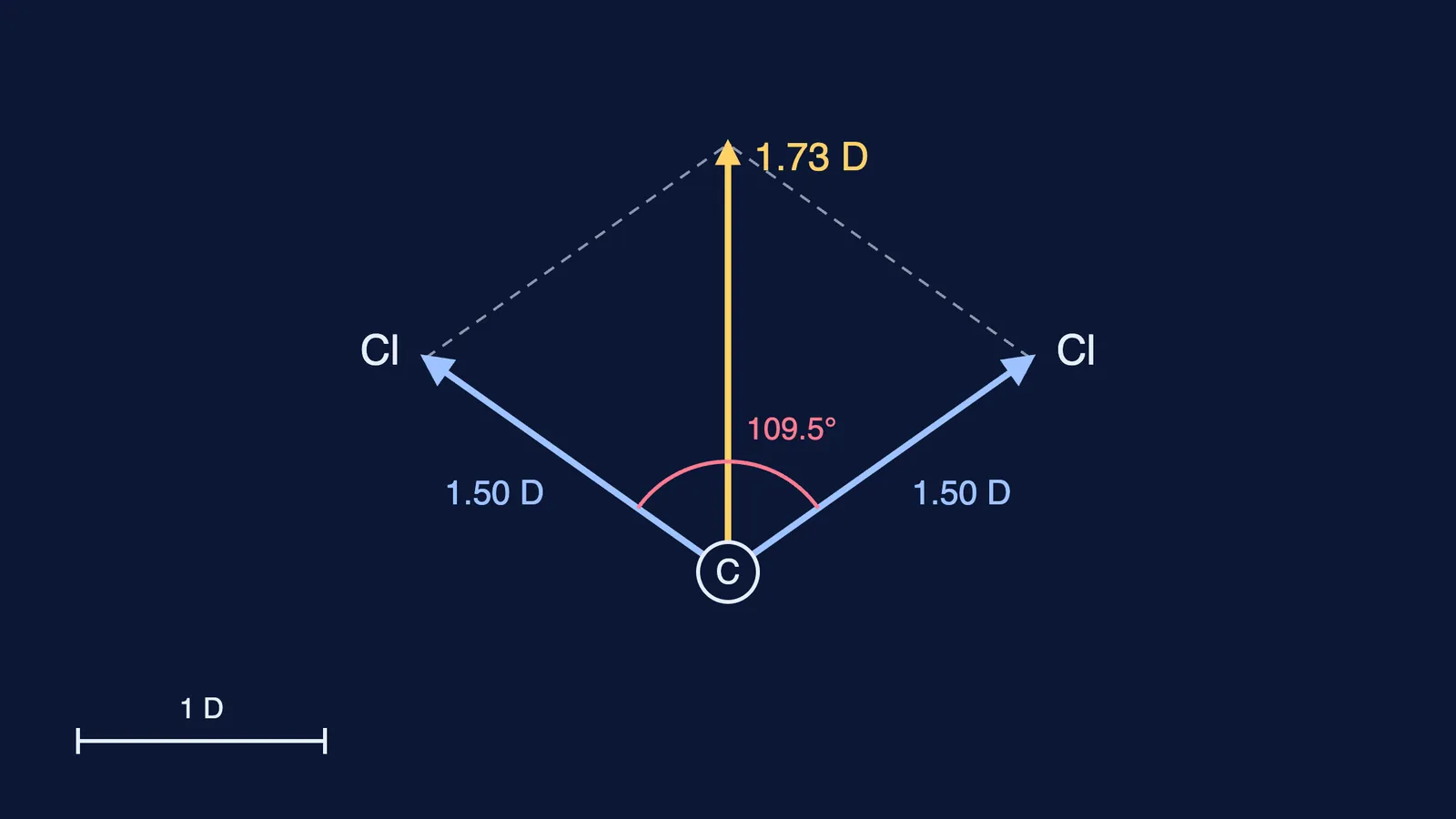
Q6 (medium, numerical-value). Model CH₂Cl₂ and CHCl₃ as ideal tetrahedra (109.5°). Each C–Cl bond moment is 1.50 D and the C–H bond moment is taken as zero. Give μ(CH₂Cl₂)/μ(CHCl₃) to two decimal places.
Answer: 1.15. In CH₂Cl₂ the two C–Cl moments add along their bisector: 2 × 1.50 × cos(54.75°) = 1.73 D, as drawn at the top. In CHCl₃, the four tetrahedral unit vectors sum to zero, so three C–Cl moments add to one moment pointing away from H: 1.50 D. The ratio is 2/√3 = 1.15. Trap: counting chlorines gives 2/3 = 0.67, as if all moments were parallel. Real values differ because C–H is not zero.
Hard: list-match and MO reasoning
Q7 (hard, list-match). Match each species in List-I with its shape in List-II.
List-I: (P) [BrF₂]⁺ (Q) [ClF₂]⁻ (R) XeO₃F₂ (S) [ClF₄]⁻
List-II: (1) linear (2) angular (3) square planar (4) trigonal bipyramidal (5) tetrahedral
(A) P→2, Q→1, R→4, S→3 (B) P→1, Q→2, R→4, S→3 (C) P→2, Q→1, R→4, S→5 (D) P→1, Q→1, R→3, S→3
Answer: (A). [BrF₂]⁺: 7 − 1 = 6 electrons, 2 bonds, 2 lone pairs, steric number 4, angular. [ClF₂]⁻: 8 electrons, 2 bonds, 3 equatorial lone pairs, linear. XeO₃F₂: all 8 Xe electrons go into bonds, steric number 5 with no lone pair, trigonal bipyramidal. [ClF₄]⁻: 4 bonds and 2 lone pairs opposite each other, square planar. Trap: (B) assumes that the AX₂ cation and anion swap shapes; the charge changes the lone pairs, not the formula. (C) forgets the two lone pairs on [ClF₄]⁻.
Q8 (hard, one or more options correct). Which statements are correct?
(A) Ionising N₂ to N₂⁺ lengthens the bond, but ionising O₂ to O₂⁺ shortens it. (B) The highest occupied MO of N₂ is σ2p_z; that of O₂ is π*2p. (C) Removing an electron from Be₂ to make Be₂⁺ lowers the bond order. (D) N₂²⁺ has a shorter bond than N₂ and is diamagnetic.
Answer: (A), (B). N₂'s highest pair sits in bonding σ2p_z, so ionising drops the bond order from 3 to 2.5; O₂ loses an antibonding π* electron, raising it from 2 to 2.5. (C) fails: Be₂⁺ loses an antibonding σ*2s electron, so its bond order rises from 0 to 0.5. (D) fails on length: N₂²⁺ loses both σ2p_z electrons, so its bond order falls to 2 and the bond lengthens, though it is diamagnetic. Trap: assuming every cation has a shorter bond.
What should you do after this set?
Shape slips (Q1, Q2, Q5, Q7): write electrons, bonds, lone pairs and steric number for every species. Our explainer on interhalogen shapes drills the same count.
MO slips (Q4, Q8): fill the diagram, then ask which orbital gained or lost the electron.
Vector slips (Q3, Q6): draw the arrows first.
The Fermi Problem Library has worked problems with a step-by-step solver that explains the reasoning rather than printing an answer.