On this page
Chemical bonding takes one short paragraph of the syllabus, but it feeds coordination compounds, p-block chemistry and organic reasoning. A single multiple-correct question can make you fill an MO diagram, predict magnetism and compare bond orders at once, as example 1 below does. Below: the official syllabus, the gap from JEE Main, three solved problems and a plan.
What is in the JEE Advanced chemical bonding syllabus?
The official JEE (Advanced) 2026 syllabus lists: "Orbital overlap and covalent bond; Hybridisation involving s, p and d orbitals only; Molecular orbital energy diagrams for homonuclear diatomic species (up to Ne2); Hydrogen bond; Polarity in molecules, dipole moment; VSEPR model and shapes of molecules (linear, angular, triangular, square planar, pyramidal, square pyramidal, trigonal bipyramidal, tetrahedral and octahedral)." The same document notes that the 2026 syllabus is unchanged from 2025. The 2027 syllabus has not been published yet (as of 19 November 2026).
What is announced: JEE (Advanced) 2027 will be held on 23 May 2027 (Sunday), organised by IIT Delhi. To appear, you must be among the top 2,50,000 successful candidates in the B.E./B.Tech. paper of JEE (Main) 2027, plus other criteria.
How is JEE Advanced chemical bonding different from JEE Main?
On paper, the Advanced list is shorter. The JEE (Main) 2027 syllabus also names ionic bonding, lattice enthalpy, Fajan's rule, resonance and metallic bonding in its bonding unit. The Advanced list is more exact in two places: it says MO diagrams for diatomic "species", so ions count, and it names nine shapes, including square pyramidal and octahedral. If you have worked through our chemical bonding plan for JEE Main, the syllabus is not the gap. Depth is.
The JEE (Advanced) 2026 Information Brochure shows that JEE (Advanced) 2026 had two compulsory papers of three hours each. The brochure said marking details would come in the instructions at exam time, so practise single-correct, multiple-correct and numerical-answer questions alike. Our post on how partial marking works in multiple-correct questions explains how partial marking worked in past papers.
Three habits make the difference:
Count electrons before you draw. Total electrons decide the MO order and the VSEPR steric number; most errors start here.
Check each option on every property asked. A species can pass on bond order and fail on magnetism.
Test a limiting case. Push a bond angle to 180° or 0° and ask whether your dipole formula still makes sense.
Worked examples at Advanced level
These problems and numbers are our own. MO filling uses the usual rule: π2p below σ2p for 14 electrons or fewer, σ2p first above 14.
1. MO diagram, multiple-correct. Which of C₂⁻, C₂²⁻, N₂²⁻, O₂⁺ and B₂⁻ are paramagnetic with bond order 2.5 or more? Count electrons: 13, 14, 16, 15 and 11. Fill and subtract: C₂⁻ has bond order 2.5 with one unpaired electron; C₂²⁻ is 3.0 with none; N₂²⁻ is 2.0 with two; O₂⁺ is 2.5 with one; B₂⁻ is 1.5 with one. Answer: C₂⁻ and O₂⁺. C₂²⁻ fails on magnetism, N₂²⁻ on bond order.
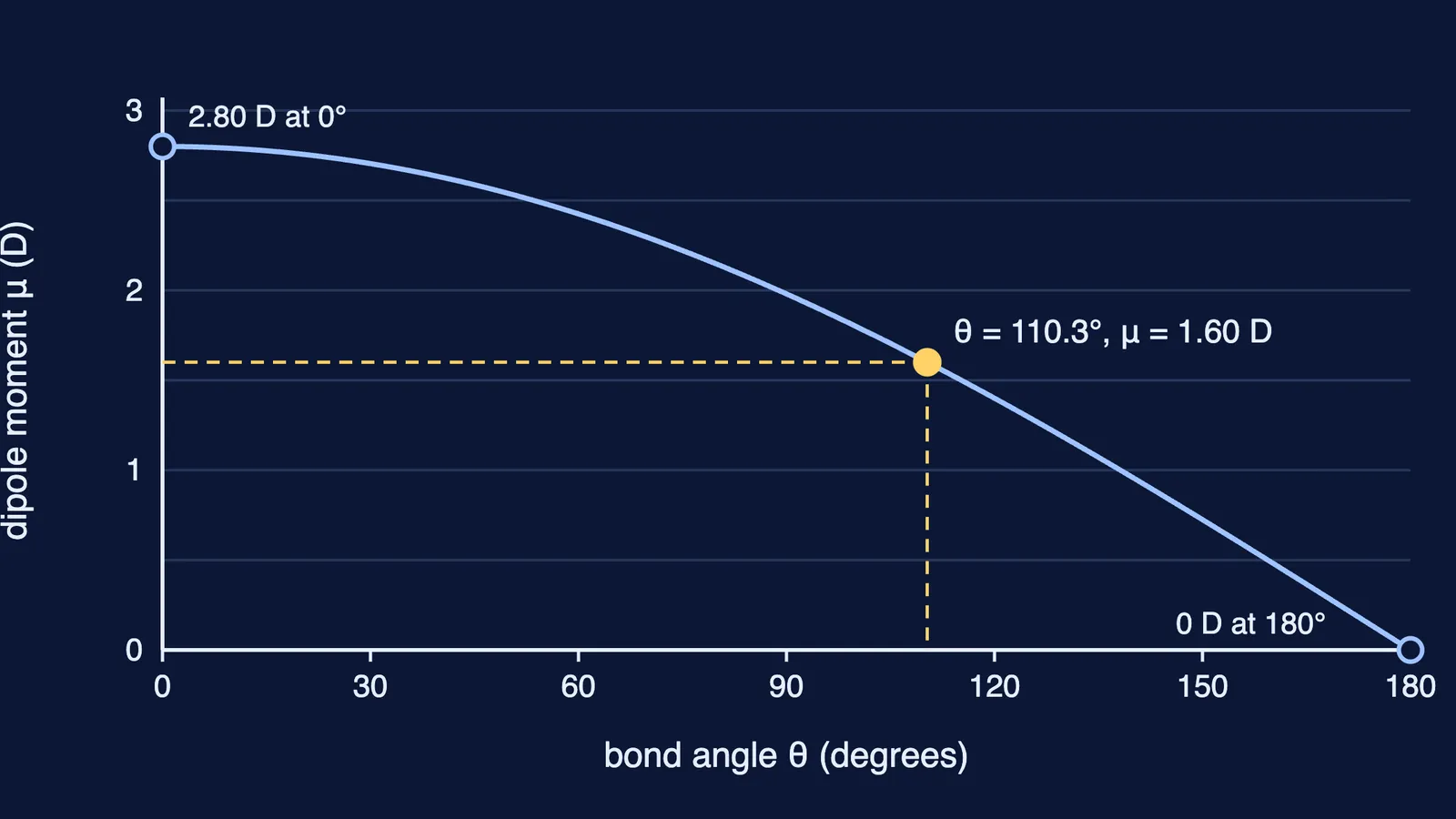
2. Dipole moment and bond angle. An angular molecule AX₂ has an A–X bond moment of 1.40 D and a molecular dipole of 1.60 D. Treating it as two bond vectors, μ = 2μ(A–X)cos(θ/2), so cos(θ/2) = 1.60/2.80 = 0.571 and θ = 110.3°. Limiting check: at 180° the formula gives 0 D, as for a linear molecule; at 0° it gives 2.80 D. Our answer sits between, as it must.
3. Hybridisation, shape and polarity. Which of [BrF₄]⁻, XeOF₄, [ICl₂]⁻ and [IF₆]⁺ are sp³d² and have zero dipole moment? Steric numbers are 6 (four bonds, two lone pairs), 6 (five, one), 5 (two, three) and 6 (six, none). So [BrF₄]⁻ is square planar and [IF₆]⁺ octahedral, both nonpolar. XeOF₄ is sp³d² but square pyramidal and polar; [ICl₂]⁻ is nonpolar but sp³d. Answer: [BrF₄]⁻ and [IF₆]⁺.
Stuck on why a step works rather than what the answer is? The Fermi Problem Library has worked problems with a step-by-step solver that explains the reasoning rather than printing an answer.
How should you practise chemical bonding for JEE Advanced?
Revise VSEPR, hybridisation and MO basics with our Class 11 chemical bonding guide if any feel shaky.
Week one: MO diagrams from Li₂ to Ne₂ and their ions. Write bond order, unpaired electrons and bond-length order for each.
Week two: VSEPR for all nine listed shapes, with hybridisation and polarity, including species with lone pairs on the central atom.
Week three: hydrogen bonding and dipole moment, then mixed multiple-correct sets that combine all of it.
For every answer, state the electron count and one limiting case.
Practice:
Give the bond order and number of unpaired electrons of B₂⁺ and F₂⁺.
AX₂ has bond moments of 1.00 D at 120°. Find the dipole moment.
Give the hybridisation, shape and polarity of [SF₅]⁻.
Answers: B₂⁺ 0.5 and one, F₂⁺ 1.5 and one; 1.00 D; sp³d², square pyramidal, polar.