On this page
Three original cases, easiest first. For the theory and the BPT proof, start with our Triangles (similarity) Class 10 guide.
What do Triangles case-study questions look like?
The CBSE Class 10 Mathematics Standard sample paper for 2026-27 has three case study-based questions of 4 marks each in Section E, each with three sub-parts, and calculators are not allowed. Our cases have four parts each, and every number works out by hand. They stay inside the CBSE 2026-27 syllabus and the rationalised NCERT Chapter 6, Triangles (Reprint 2026-27): the basic proportionality theorem (BPT), its converse, and the AA, SSS and SAS criteria.
Case 1: The mirror on the school ground
Kavya wants the height of a neem tree in her school in Pune without climbing it. She lays a small flat mirror on level ground 16 m from the foot of the tree. She walks backwards, away from the tree, until at 2.5 m from the mirror she just sees the top of the tree in the mirror's centre. Her eyes are 1.5 m above the ground. Light reflects so that the two rays make equal angles with the ground, and both Kavya and the tree stand vertical.
(i) The triangle formed by Kavya's eye, her feet and the mirror is similar to the triangle formed by the treetop, the tree's foot and the mirror by: (a) SSS (b) SAS (c) AA (d) RHS
(ii) Write the proportion that links the tree's height h to Kavya's measurements.
(iii) Find the height of the tree.
(iv) Her brother, whose eyes are 1.2 m above the ground, uses the same mirror in the same place. How far from the mirror must he stand to see the treetop?
Answers.
(i) (c). Both triangles have a right angle at the ground, and the angles at the mirror are equal, so AA applies.
(ii) h/1.5 = 16/2.5: height over eye level equals tree-to-mirror distance over Kavya-to-mirror distance.
(iii) h = 1.5 × 16/2.5 = 24/2.5 = 9.6 m.
(iv) 1.2/9.6 = d/16, so d = 16 × 1.2/9.6 = 2 m.
Case 2: The drip line in a triangular field
A farmer near Nashik owns a triangular field ABC. Side BC runs along a village road and is 90 m long. He lays a straight drip-irrigation pipe DE parallel to the road, with D on boundary AB and E on boundary AC. Measured from the corner A, AD = 24 m and DB = 36 m along AB, and AE = 20 m along AC.
(i) Since DE ∥ BC, which of these must be true? (a) AD/DB = AE/EC (b) AD/AE = DB/BC (c) AD/DB = DE/BC (d) AE/EC = DE/BC
(ii) Find EC.
(iii) How long is the pipe DE?
(iv) A second pipe FG is planned with F on AB, AF = 42 m, and G on AC, CG = 14 m. Is FG parallel to the road? If not, where on AC should G be?
Answers.
(i) (a), by the BPT (Theorem 6.1).
(ii) 24/36 = 20/EC, so EC = 20 × 36/24 = 30 m.
(iii) ∠A is common and ∠ADE = ∠ABC (corresponding angles), so ΔADE ~ ΔABC by AA. DE/BC = AD/AB = 24/60, so DE = 90 × 0.4 = 36 m.
(iv) AC = 20 + 30 = 50 m, so AG = 36 m. AF/FB = 42/18 = 7/3 but AG/GC = 36/14 = 18/7. The ratios differ, so FG is not parallel to BC. By the converse of the BPT, it would be parallel if AG/GC = 7/3, which gives AG = 50 × 7/10 = 35 m, so CG = 15 m.
Case 3: The pinhole camera in the science club
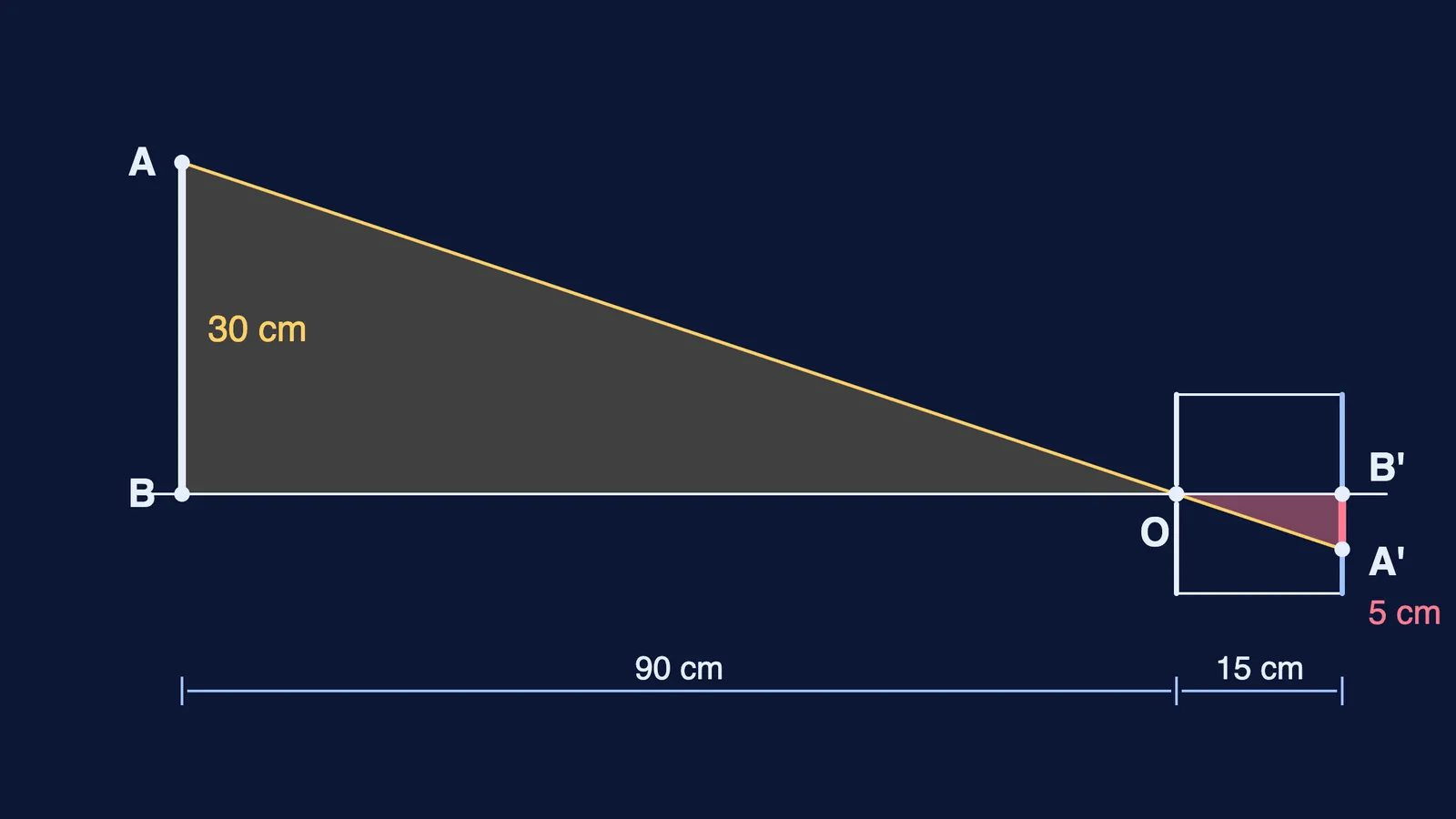
Ananya's science club in Jaipur builds a pinhole camera: a box with a tiny hole O in front and a tracing-paper screen 15 cm behind it. They point it at a brightly lit 30 cm tall model of the Qutub Minar, AB, standing upright 90 cm in front of the hole. The foot B of the model, the hole O and the point B' on the screen lie on one horizontal line that is perpendicular to both the model and the screen. Light from the top A passes straight through O and lands at A' on the screen, below B'.
(i) Which pair of angles is equal because they are vertically opposite? (a) ∠OAB and ∠OA'B' (b) ∠AOB and ∠A'OB' (c) ∠OBA and ∠OAB (d) ∠AOB and ∠OAB
(ii) Complete the similarity ΔOBA ~ ? and name the criterion.
(iii) How tall is the image A'B' on the screen?
(iv) Without changing the box, the club wants an image exactly 6 cm tall. How far from the hole should the model stand?
Answers.
(i) (b). The lines AA' and BB' cross at O, so ∠AOB = ∠A'OB'.
(ii) ΔOBA ~ ΔOB'A' by AA: ∠AOB = ∠A'OB' (vertically opposite) and ∠OBA = ∠OB'A' = 90°.
(iii) A'B'/AB = OB'/OB, so A'B' = 30 × 15/90 = 5 cm, upside down.
(iv) 6/30 = 15/OB, so OB = 15 × 30/6 = 75 cm. The model moves 15 cm closer.
How do you attack case-study questions on Triangles?
Redraw the situation as a labelled figure, marking every right angle and parallel line.
Decide which tool fits: two pieces of one side cut by a parallel line call for the BPT; a missing length elsewhere calls for similar triangles.
Name the criterion (AA, SSS or SAS) and the reason for each equal angle, such as "common angle" or "corresponding angles".
Write the correspondence in order and put the unknown in the numerator, so the arithmetic is one step.
In "is it parallel?" parts, compare the two ratios as fractions in lowest terms and quote the converse of the BPT.
For more practice, see our guide to case-based questions in board exams and the Triangles assertion-reason set. If a step keeps slipping, the Fermi Problem Library has worked problems with a step-by-step solver that explains the reasoning rather than printing an answer.