On this page
What do plant growth case-study questions test?
A case-study question asks graded questions on a short real-world passage. Plant Growth and Development is Chapter 13 of NCERT Class 11 Biology (Reprint 2026-27), and the CBSE Class XI Biology curriculum for 2026-27 lists seed germination, phases of growth and growth rate, conditions of growth, differentiation, dedifferentiation and redifferentiation, and five growth regulators: auxin, gibberellin, cytokinin, ethylene and ABA. Class 11 exams are set by your school, so treat these as case-based practice, not a prediction of any paper.
Cases and numbers are ours; every fact follows NCERT. For the chapter plan, read our Plant Growth and Development Class 11 guide; for the general method, see how to handle case-based questions.
Case 1: How fast does a moong root grow?
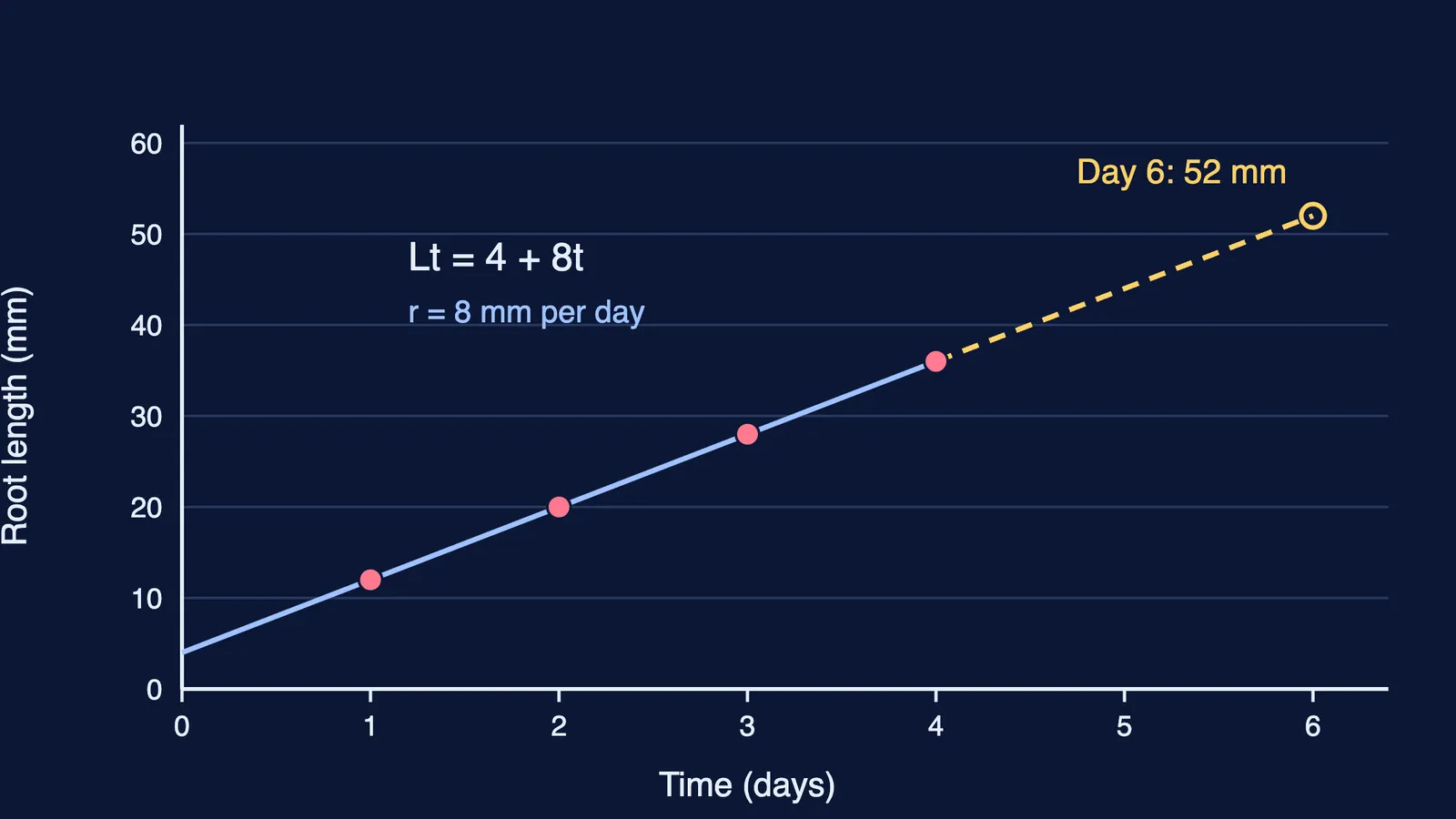
Kabir, a Class 11 student in Jaipur, germinates moong seeds on wet blotting paper and measures one root each morning. On day 1 it is 12 mm long, on day 2 20 mm, on day 3 28 mm and on day 4 36 mm. He then draws ink marks 1 mm apart along the first few millimetres behind the root tip. A day later, the marks a few millimetres behind the tip have moved far apart, while marks higher up the root have barely moved. Cells in that stretched region look large and vacuolated.
(i) Cells showing increased vacuolation, enlargement and new cell wall deposition are in the phase of: (a) meristematic growth (b) elongation (c) maturation (d) senescence
(ii) What shape of graph does Kabir get when he plots root length against time, and what kind of growth does it show?
(iii) Using Lt = L0 + rt, find r and L0, and predict the length on day 6 if the rate holds.
(iv) At the level of cell division, what makes this kind of growth possible?
Answers.
(i) (b). Meristematic cells are rich in protoplasm with large nuclei; maturing cells reach their maximal size.
(ii) A straight line, since the root adds the same length daily: arithmetic growth.
(iii) r = (36 − 12) ÷ (4 − 1) = 8 mm per day. L0 = 12 − 8 × 1 = 4 mm. On day 6, Lt = 4 + 8 × 6 = 52 mm.
(iv) In arithmetic growth, after mitosis only one daughter cell keeps dividing while the other differentiates and matures, so cells are added at a steady rate.
Case 2: Why did one callus grow faster than the other?
A plant tissue culture lab in Bengaluru cuts small pieces of leaf parenchyma and places them on a nutrient medium with an auxin and a cytokinin. The team weighs two calli: callus A grows from 0.5 g to 1.5 g in 6 days, and callus B grows from 2.0 g to 3.0 g in the same 6 days. In one flask a trainee left out the cytokinin; that explant barely divided. Calli moved to fresh medium later form shoots and roots.
(i) Mature leaf parenchyma cells dividing again to form callus is an example of: (a) differentiation (b) dedifferentiation (c) redifferentiation (d) senescence
(ii) Find the absolute growth rate of each callus.
(iii) Find the relative growth rate of each, per gram of starting mass. How many times faster is A?
(iv) Explain why the flask without cytokinin failed, and name the process when the calli form shoots and roots.
Answers.
(i) (b). Cells that had lost the capacity to divide regain it.
(ii) Each callus gains 1.0 g in 6 days, so both have an absolute growth rate of 1.0 ÷ 6 = 0.167 g per day.
(iii) A: 1.0 ÷ 0.5 ÷ 6 = 0.333 per day. B: 1.0 ÷ 2.0 ÷ 6 = 0.083 per day. A's relative growth rate is 4 times B's, though their absolute rates are equal.
(iv) Cytokinins promote cell division (cytokinesis); Skoog and co-workers found tobacco callus proliferated only when the auxin medium was supplemented, for example with coconut milk. Cells from the callus that stop dividing and mature into shoot and root tissues are redifferentiating.
Case 3: Which growth regulator should the farmer spray?
A vegetable grower near Nashik brings three problems to an agriculture officer. His wheat field has broad-leaved weeds. His cucumber vines carry about 40 flowers each, but only 8 are female; after a dilute ethephon spray, a sample vine carries 18 female flowers out of 40. Some young cucumbers on sprayed vines have dropped. Finally, he wants his harvested spinach to stay green longer before it reaches the market.
(i) Which compound can clear broad-leaved weeds without harming mature wheat? (a) GA3 (b) 2,4-D (c) kinetin (d) ABA
(ii) Find the percentage of female flowers before and after the spray, and how many times the female count rose.
(iii) Which class of PGR would delay yellowing of the spinach leaves, and how?
(iv) Explain why some young fruits dropped after the ethephon spray, and name the PGR class that helps prevent early fruit drop.
Answers.
(i) (b). 2,4-D is a synthetic auxin that kills dicot weeds but does not affect mature monocots such as wheat.
(ii) Before: 8 ÷ 40 × 100 = 20%. After: 18 ÷ 40 × 100 = 45%. The female count rose 18 ÷ 8 = 2.25 times. Ethephon releases ethylene, which promotes female flowers in cucumber.
(iii) Cytokinins. They promote nutrient mobilisation, delaying leaf senescence.
(iv) Ethephon releases ethylene slowly, and ethylene promotes abscission of flowers and fruits; that is why ethephon is used to thin cotton, cherry and walnut. Auxins help prevent fruit and leaf drop at early stages.
How to attack case-study questions on plant growth
Look at the numbers first: equal daily gains mean arithmetic growth; gains that rise with size point to geometric growth.
Write the formula with every symbol named before substituting, then give units: mm per day, g per day, or per day for a relative rate.
For tissue-culture passages, track one cell through three words: dedifferentiation, division, redifferentiation.
For farm and market passages, match each effect to its PGR: rooting and weedkillers to auxins, bolting and stalk length to gibberellins, green leaves to cytokinins, ripening and female flowers to ethylene, stomatal closure and dormancy to ABA.
If growth-rate sums keep tripping you up, the Fermi Problem Library has worked problems with a step-by-step solver that explains the reasoning rather than printing an answer.