On this page
Three original cases, easy to hard. For timing the whole paper, read our section-by-section plan for the CBSE Class 10 maths paper.
What do case-study questions on linear equations look like?
The CBSE Class 10 Mathematics Standard sample paper for 2026-27 has three case study-based questions of 4 marks each in Section E, each with three sub-parts of 1, 1 and 2 marks, and calculators are not allowed. We add a fourth part; every number works out by hand. All cases stay inside the CBSE 2026-27 Class X Mathematics curriculum (graphical method, consistency, substitution and elimination) and the rationalised NCERT Chapter 3, Pair of Linear Equations in Two Variables (Reprint 2026-27).
Case 1: Choosing a cricket academy
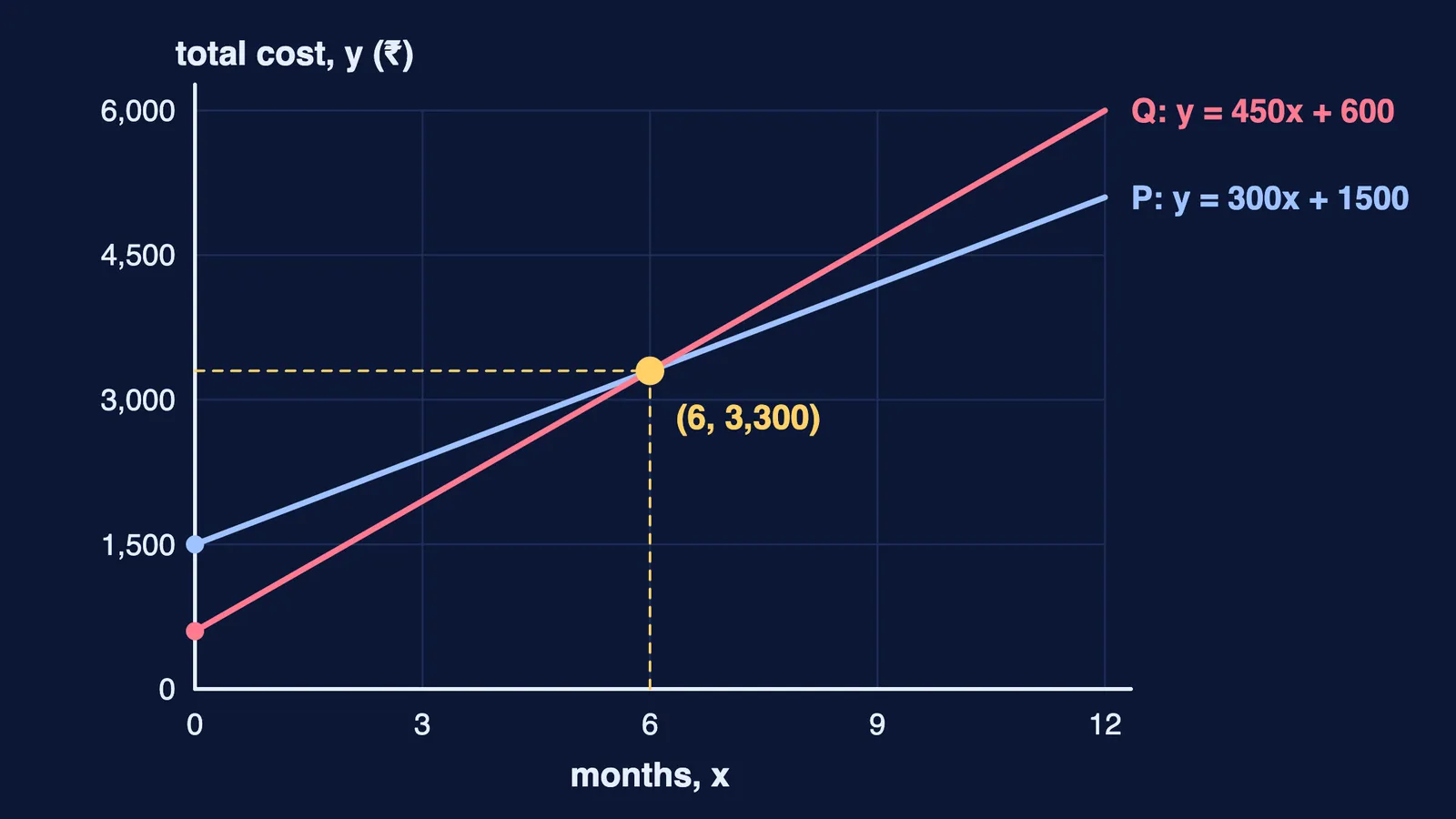
Aarav, a Class 10 student in Lucknow, wants to join a cricket academy for the coaching season. Academy P charges a one-time registration fee of ₹1,500 and then ₹300 per month. Academy Q charges a registration fee of only ₹600 but ₹450 per month. His father plots total cost y (in ₹) against months x for both on one graph to compare them. Aarav is not yet sure whether he will train for 4 months or for the full 10-month season.
(i) The total cost at Academy P after x months is: (a) y = 1500x + 300 (b) y = 300x + 1500 (c) y = 450x + 600 (d) y = 1800x
(ii) After how many months do the two academies cost the same, and what is that total?
(iii) If Aarav trains for 4 months, which academy is cheaper, and by how much?
(iv) To win students for the full season, Academy Q lowers only its monthly fee so that both academies cost the same for 10 months. Find the new monthly fee.
Answers.
(i) (b). A fixed ₹1,500 plus ₹300 for each of x months.
(ii) 300x + 1500 = 450x + 600 gives 150x = 900, so x = 6. Total: 300 × 6 + 1500 = ₹3,300 at both.
(iii) P: 1500 + 1200 = ₹2,700. Q: 600 + 1800 = ₹2,400. Academy Q is cheaper by ₹300.
(iv) P for 10 months costs 1500 + 3000 = ₹4,500. So 600 + 10f = 4500, and f = ₹390 per month.
Case 2: Mixing milk at a dairy cooperative
A village dairy cooperative near Anand sells two kinds of milk: full-cream milk with 6% fat and toned milk with 3% fat. A sweet shop orders 300 litres of milk with exactly 4% fat for its Diwali rush. The manager decides to mix x litres of full-cream milk with y litres of toned milk, and nothing else, to fill the order. The cooperative values full-cream milk at ₹66 per litre and toned milk at ₹54 per litre. Later, a second shop asks whether the same two milks can be mixed into 300 litres with 7% fat.
(i) Which equation shows the fat in the mixture? (a) 6x + 3y = 4 (b) x + y = 12 (c) 0.06x + 0.03y = 12 (d) 0.6x + 0.3y = 1.2
(ii) How many litres of each milk are needed?
(iii) What does the mixture cost the cooperative per litre?
(iv) Show algebraically that the 7% order cannot be filled with these two milks.
Answers.
(i) (c). 4% of 300 litres is 12 litres of fat.
(ii) Multiply (c) by 100 and divide by 3: 2x + y = 400. Subtract x + y = 300 to get x = 100, so y = 200. That is 100 L full-cream and 200 L toned.
(iii) 100 × 66 + 200 × 54 = 6,600 + 10,800 = ₹17,400, and 17,400 ÷ 300 = ₹58 per litre.
(iv) 7% of 300 L is 21 L of fat: 0.06x + 0.03y = 21 gives 2x + y = 700. With x + y = 300, x = 400 and y = −100. Litres cannot be negative, so no such mix exists.
Case 3: Roads on a town plan
A planning team in Bhubaneswar draws a new layout on a grid where 1 unit is 1 km, with a canal along the x-axis. An existing road follows the line 2x + 3y = 12. A contractor proposes a second road along 4x + ky = c. Before approval, the team checks whether the roads would cross. In the final plan, the second road is 4x − 3y = 6. The two roads and the canal enclose a triangular plot that will become a public park.
(i) If the proposal were 4x + 6y = 24, the two lines would be: (a) intersecting (b) parallel (c) coincident (d) impossible to tell without a graph
(ii) If c = 20, for what value of k would the roads never meet?
(iii) In the final plan, where do the two roads cross?
(iv) Find the area of the triangular park.
Answers.
(i) (c). 2/4 = 3/6 = 12/24, so both equations describe the same road.
(ii) k = 6. Then 2/4 = 3/6, but 12/20 = 3/5 ≠ 1/2, so the lines are parallel, not coincident.
(iii) Add 2x + 3y = 12 and 4x − 3y = 6: 6x = 18, so x = 3, and 3y = 12 − 6 gives y = 2. They cross at (3, 2).
(iv) Road 1 meets the canal (y = 0) at x = 6, and road 2 at x = 1.5. Base = 6 − 1.5 = 4.5 km; height = 2 km. Area = ½ × 4.5 × 2 = 4.5 km².
How do you solve case-study questions on linear equations?
Name both variables with units first: "x = months, y = total cost in ₹".
When the question asks whether lines meet, compare a1/a2 with b1/b2 first; check c1/c2 only if those two match.
Eliminate when a variable has equal or opposite coefficients, as in Case 3; otherwise substitute.
Substitute back into both equations, then check the story.
For graph parts, use axis intercepts as quick, exact points.
Read our guide to case-based questions in board exams, then try the assertion-reason set on pair of linear equations. If one step keeps slipping, the Fermi Problem Library has worked problems with a step-by-step solver that explains the reasoning rather than printing an answer.