On this page
These 10 original questions stay inside the CBSE 2026-27 Class 10 Mathematics syllabus, which covers the graphical method, consistency, conditions for the number of solutions, substitution and elimination. Need the methods first? See our Class 10 guide to substitution, elimination and graphs.
How do you answer assertion-reason questions on linear equations?
For assertion-reason (Q1 to Q6):
(A) Both A and R are true and R is the correct explanation of A.
(B) Both A and R are true but R is NOT the correct explanation of A.
(C) A is true but R is false.
(D) A is false but R is true.
For Statement I and Statement II (Q7 to Q10):
(A) Both statements are correct.
(B) Both statements are incorrect.
(C) Statement I is correct, Statement II is incorrect.
(D) Statement I is incorrect, Statement II is correct.
Judge A, then R; only if both are true, ask whether R is the reason A holds.
In the NCERT Class 10 chapter on pair of linear equations, for a1x + b1y + c1 = 0 and a2x + b2y + c2 = 0: if a1/a2 ≠ b1/b2 the lines intersect (one solution); if a1/a2 = b1/b2 = c1/c2 they coincide (infinitely many); if a1/a2 = b1/b2 ≠ c1/c2 they are parallel (no solution). A pair with no solution is inconsistent; a dependent pair is always consistent.
Assertion-reason questions on pair of linear equations
Q1 (easy). Assertion (A): The pair x + y = 5 and x – y = 1 has exactly one solution. Reason (R): If a1/a2 ≠ b1/b2, the pair of equations has a unique solution.
Answer: (A). Here 1/1 ≠ 1/(–1), so the lines intersect, and R is the rule that says so.
Trap: thinking you must solve first.
Q2 (easy). Assertion (A): x = 2, y = 1 is a solution of the pair 3x – y = 5 and x + 2y = 4. Reason (R): A point is a solution of a pair of equations if it satisfies at least one of them.
Answer: (C). A is true: 6 – 1 = 5 and 2 + 2 = 4. R is false; a solution must satisfy both.
Trap: checking only the first equation.
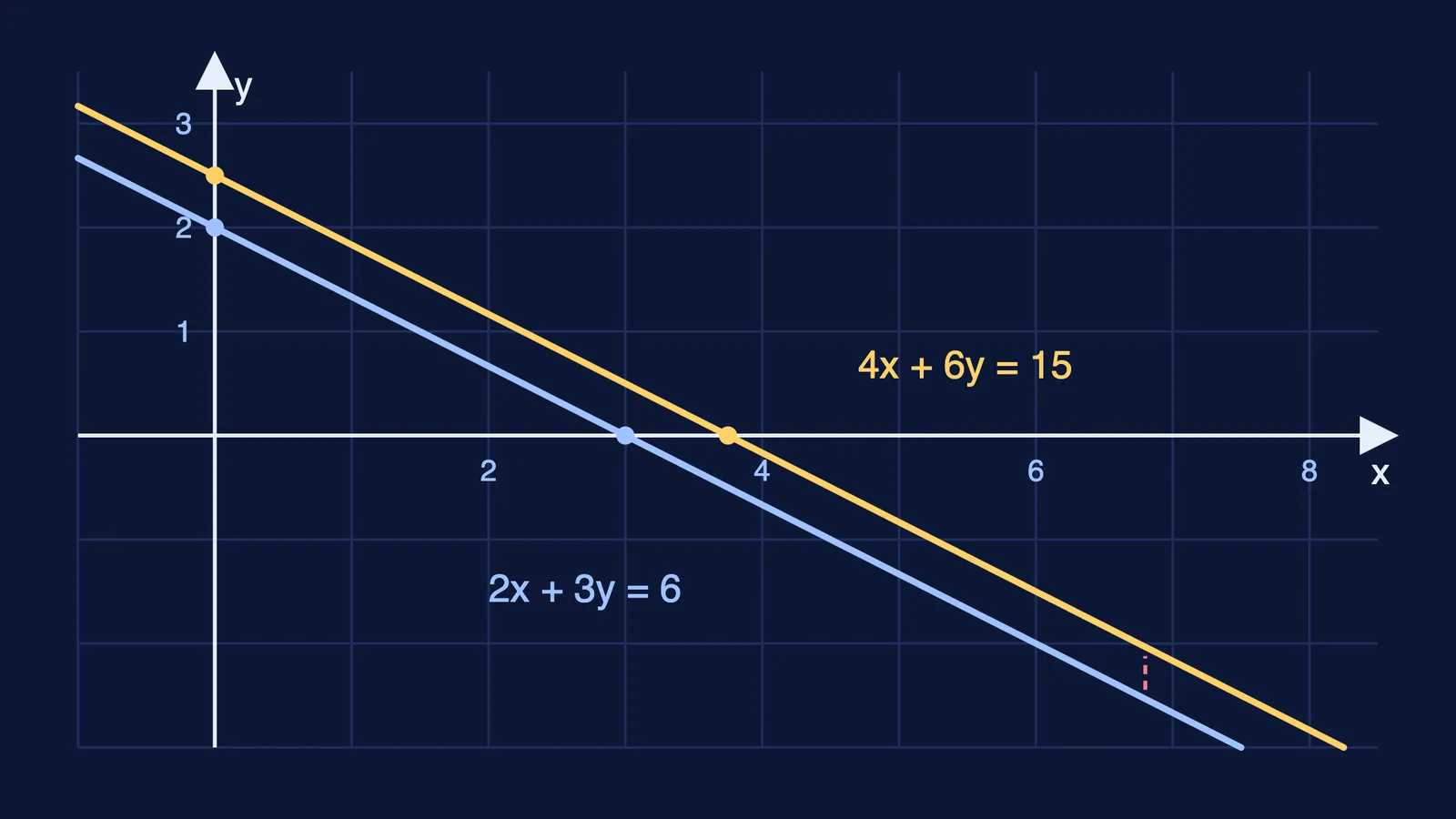
Q3 (medium). Assertion (A): The lines 2x + 3y = 6 and 4x + 6y = 15 never meet. Reason (R): Both lines slope downwards from left to right.
Answer: (B). A is true: 2/4 = 3/6 but 6/15 = 2/5, so the lines are parallel. R is true, but downward lines of different steepness do meet; the equal ratios are the reason.
Trap: accepting any true fact as the reason.
Q4 (medium). Assertion (A): The pair x – 2y = 3 and 3x – 6y = 9 is inconsistent. Reason (R): If a1/a2 = b1/b2 = c1/c2, the pair has infinitely many solutions.
Answer: (D). R is true. Here 1/3 = –2/–6 = 3/9, so the lines coincide; the pair is consistent and A is false.
Trap: stopping before checking the constants.
Q5 (medium). Assertion (A): For k = 4, the pair 2x + 5y = 3 and kx + 10y = 8 has no solution. Reason (R): A pair has no solution when a1/a2 = b1/b2 ≠ c1/c2.
Answer: (A). With k = 4, 2/4 = 5/10 but 3/8 ≠ 1/2: exactly R's condition.
Trap: answering "infinitely many" because two ratios match.
Q6 (hard). Assertion (A): If 2 pens and 3 notebooks cost ₹110, and 4 pens and 6 notebooks cost ₹200, no prices fit both. Reason (R): Any pair of linear equations whose x-coefficients are in the same ratio as their y-coefficients has no solution.
Answer: (C). A is true: double the first purchase costs ₹220, not ₹200, so the lines are parallel. R is false; if the constants share the ratio too, the lines coincide.
Trap: forgetting coincident lines.
Statement I and Statement II questions on linear equations
Q7 (medium). Statement I: Two lines of a linear pair can meet at exactly two points. Statement II: A dependent pair of linear equations is always consistent.
Answer: (D). Straight lines meet at one point, none or all. Statement II is NCERT's own remark.
Trap: picturing curves.
Q8 (medium). Statement I: The solution of x + y = 9 and 3x – 2y = 2 is x = 5, y = 4. Statement II: If substitution leaves a false statement such as 0 = 3, the pair has infinitely many solutions.
Answer: (B). x = 9 – y gives 27 – 5y = 2, so y = 5, x = 4; Statement I swaps them. A false statement means no solution; a true one means infinitely many.
Trap: not substituting back.
Q9 (hard). Statement I: The pair 2x + y = 4 and 6x + ky = 12 has infinitely many solutions when k = 3. Statement II: For every other value of k, the pair has exactly one solution.
Answer: (A). At k = 3, 2/6 = 1/3 = 4/12. For any other k, 1/k ≠ 1/3 (k = 0 gives x = 2, y = 0), so the lines cross once.
Trap: expecting some k to give parallel lines; both pass through (2, 0).
Q10 (hard). Statement I: A gym charges a one-time joining fee plus a fixed fee per month. Four months cost ₹3,400 in all and seven months cost ₹5,350, so the joining fee is ₹650. Statement II: On the same plan, ten months cost ₹7,300.
Answer: (D). Subtracting f + 4m = 3400 from f + 7m = 5350 gives 3m = 1950, so m = 650 and f = 800. ₹650 is the monthly fee; 800 + 10 × 650 = 7,300.
Trap: reporting the first variable you find.
How should you use this set?
Answer key at a glance: 1-A, 2-C, 3-B, 4-D, 5-A, 6-C, 7-D, 8-B, 9-A, 10-D.
Attempt all 10 cold, with a one-line reason each.
Mark each miss as a fact error or a link error.
For fact errors, write all three ratios first.
For link errors, write one item where R does explain A.
For method slips, the Fermi Problem Library has worked problems with a step-by-step solver that explains the reasoning. For timing the whole paper, see our section-by-section plan for the CBSE Class 10 maths paper; for a method across subjects, how to solve assertion-reason questions with three checks.