On this page
What do Our Environment case-study questions test?
Our Environment is Chapter 13 of the NCERT Class 10 Science textbook (Reprint 2026-27). The CBSE Class X Science syllabus for 2026-27 places it in Unit V, Natural Resources, worth 5 marks.
The CBSE Class X Science sample paper for 2026-27 tests this chapter with a trophic-level MCQ, an assertion-reason item on the 1% and 10% figures, and a 3-mark food-chain question that asks which level holds the most pesticide.
The cases below are ours, easy to hard. Revise first with our Our Environment Class 10 guide to food chains, ozone and waste.
Case 1: A waste audit in a Pune housing society
A Pune housing society of 40 flats weighs one day's waste. The total is 80 kg: 54 kg of kitchen waste (peels, tea leaves, leftover rice), 12 kg of newspaper and cardboard, 9 kg of plastic wrappers and milk packets, 3 kg of glass and metal, and 2 kg of old cotton clothes. The kitchen waste goes into a compost pit. Three months later, residents dig it open. The peels and tea leaves have turned into dark, crumbly soil, but a plastic wrapper thrown in by mistake looks almost unchanged.
(i) Which group from the society's waste is entirely biodegradable? (a) Vegetable peels, tea leaves and cotton cloth (b) Tea leaves, a glass bottle and newspaper (c) A milk packet, newspaper and cotton cloth (d) A metal can, peels and tea leaves
(ii) Name the two groups of microorganisms that turned the kitchen waste into soil.
(iii) What percentage of the society's daily waste is biodegradable?
(iv) Why did the peels break down in the pit while the plastic wrapper did not?
Answers.
(i) (a). Every other option contains glass, plastic or metal.
(ii) Bacteria and fungi, the decomposers. They turn complex organic matter into simple inorganic substances.
(iii) Biodegradable waste = 54 + 12 + 2 = 68 kg. 68 ÷ 80 × 100 = 85%.
(iv) Enzymes are specific, NCERT explains. Decomposers have enzymes for plant matter but none for plastic, so the wrapper is non-biodegradable and persists under ordinary conditions.
Case 2: Energy in a tiger reserve meadow
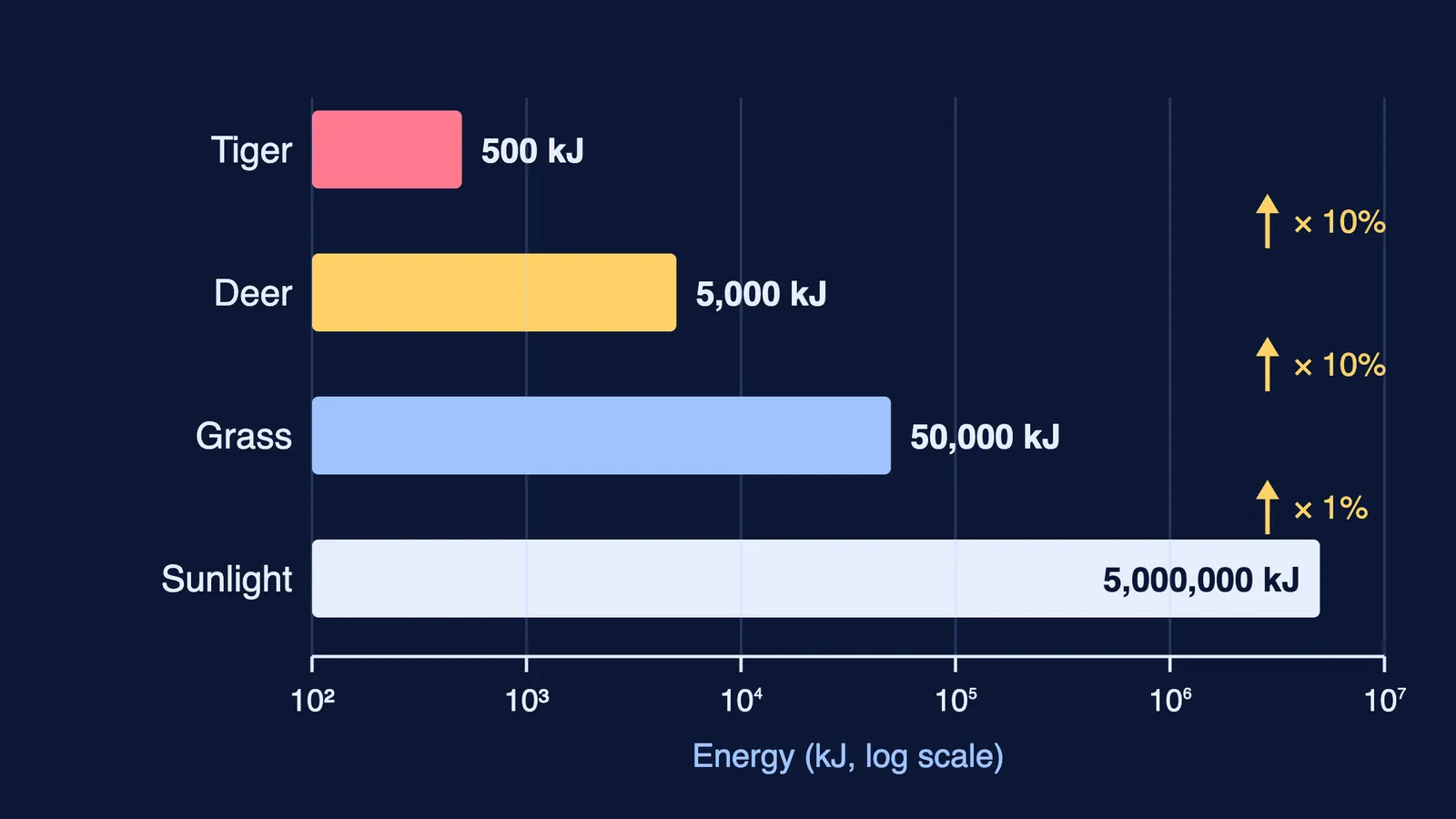
For a project, Riya models a food chain in a meadow of a Madhya Pradesh tiger reserve: grass → deer → tiger. Over one season, her model assumes that 5,000,000 kJ of sunlight falls on the leaves of the meadow's grass. She uses NCERT's average figures for how much energy plants capture and pass on. Her teacher asks her to work out the energy at each level, and to explain why the meadow can feed many deer but only a few tigers.
(i) Green plants on land convert what fraction of the sunlight on their leaves into food energy? (a) About 1% (b) About 10% (c) About 50% (d) About 90%
(ii) Give the trophic level of the deer and the type of consumer it is.
(iii) Calculate the energy available at the grass, deer and tiger levels.
(iv) Suppose the tigers instead need 1,200 kJ. How much sunlight must fall on the grass? Use this to explain why there are far fewer tigers than deer.
Answers.
(i) (a). About 1%, as stated in NCERT section 13.1.1.
(ii) Second trophic level; a herbivore, or primary consumer.
(iii) Grass: 5,000,000 × 1/100 = 50,000 kJ. Deer: 50,000 × 10/100 = 5,000 kJ. Tiger: 5,000 × 10/100 = 500 kJ.
(iv) Only 500 ÷ 5,000,000 = 0.01% of the sunlight reaches the tigers, so 1,200 kJ needs 1,200 ÷ 0.0001 = 12,000,000 kJ of sunlight. At each step a great deal of energy is lost as heat, and some goes into digestion and work, so there is energy for many deer but few tigers.
Case 3: Pesticide in a village lake
Paddy fields surround a village lake in Odisha, and rain washes a non-degradable pesticide from them into the water. A college survey measures it in parts per million (ppm): 0.002 ppm in the lake water, 0.05 ppm in algae, 0.4 ppm in small fish that eat the algae, 2.5 ppm in murrel, a large fish that eats small fish, and 10 ppm in cormorants, birds that eat murrel. Villagers also catch and eat murrel. A fish seller tells them that washing and cleaning the fish removes the pesticide, and that people are safe because cormorants, not people, top the chain.
(i) In the chain algae → small fish → murrel → cormorant, the murrel is a: (a) producer (b) primary consumer (c) secondary consumer (d) tertiary consumer
(ii) Name the process by which the pesticide builds up along this chain.
(iii) By what factor is the pesticide concentrated from lake water to cormorants? If runoff halves and each step multiplies as before, what will cormorants carry?
(iv) Evaluate the fish seller's two claims and suggest one lasting fix.
Answers.
(i) (c). Algae are level 1, small fish level 2, so murrel are secondary consumers at level 3.
(ii) Biological magnification. The pesticide does not break down, so it accumulates at each level.
(iii) 10 ÷ 0.002 = 5,000 times. Halving the concentration in the water to 0.001 ppm gives 0.001 × 5,000 = 5 ppm in cormorants.
(iv) Neither claim holds. NCERT notes that pesticide residues cannot always be removed by washing. People eating murrel sit at level 4, like the cormorants, so the pesticide builds up in them too. The lasting fix is upstream: less pesticide on the paddy fields.
How do you attack case-study questions on Our Environment?
Count levels from the producer. Plants or algae are level 1; the first animal is level 2.
Use 1% once, then 10%. One line of working per step, with units.
Energy shrinks, pesticide grows. Check which one the question asks about.
Tie waste answers to enzymes. "Decomposers lack enzymes for plastic" earns more than "plastic does not rot".
Learn the ozone steps. Per NCERT, UV splits O₂ into O + O, and O + O₂ forms O₃. CFCs were linked to the fall in ozone, and in 1987 UNEP forged an agreement to freeze CFC production at 1986 levels.
For the general method, see our guide to case-based questions in CBSE board exams, then try our Our Environment assertion-reason questions. If a concept feels shaky, the Fermi Concept Library has every concept in physics, chemistry, biology, mathematics and computing, each with its own lesson.