On this page
This set has 10 original questions on Our Environment, Chapter 13 of the NCERT Class 10 Science textbook: six assertion-reason items and four statement pairs, easy to hard. Revise the chapter first with our Our Environment Class 10 guide to food chains, ozone and waste.
How do you answer assertion-reason questions?
The CBSE Class X Science sample question paper for 2026-27 has assertion-reason items in its biology, chemistry and physics sections, and the CBSE Science syllabus for 2026-27 lists assertion-reasoning among its question types. Keys for Q1 to Q6:
(A) Both A and R are true and R is the correct explanation of A.
(B) Both A and R are true but R is NOT the correct explanation of A.
(C) A is true but R is false.
(D) A is false but R is true.
Keys for Q7 to Q10:
(A) Both statements are correct.
(B) Both statements are incorrect.
(C) Statement I is correct, Statement II is incorrect.
(D) Statement I is incorrect, Statement II is correct.
Judge A alone, then R alone. If both are true, join them with "because" and ask whether NCERT gives R as the cause of A; if not, the answer is (B).
Assertion-reason questions (Q1 to Q6)
Every statement is checked against the NCERT chapter text, including its figure of about 1% of sunlight captured by plants.
Q1 (easy). Assertion (A): A school garden is an ecosystem. Reason (R): Its organisms interact with each other and are affected by abiotic factors such as soil, temperature and rainfall.
Answer: (A). Both true; R is NCERT's own test: interacting organisms plus the non-living parts of an area form an ecosystem.
Trap: thinking an ecosystem has to be large or wild, like a forest.
Q2 (easy). Assertion (A): A crop-field is a natural ecosystem. Reason (R): A crop-field has both biotic and abiotic components.
Answer: (D). R is true. A is false: NCERT calls gardens and crop-fields human-made (artificial) ecosystems.
Trap: reading "has plants and soil" as "natural".
Q3 (medium). Assertion (A): Plastics persist in the environment for a long time. Reason (R): Plastics cannot be acted upon by any process, physical or biological.
Answer: (C). A is true. R is false: bacteria do not break plastics down, but NCERT says physical processes like heat and pressure do act on them. Plastics persist because ambient conditions in our environment do not break them down.
Trap: treating "non-biodegradable" as "cannot be changed by anything".
Q4 (medium). Assertion (A): The flow of energy in an ecosystem is unidirectional. Reason (R): Green plants in a terrestrial ecosystem capture only about 1% of the solar energy that falls on their leaves.
Answer: (B). Both true. A holds because energy never returns to an earlier level. R is about how much energy enters, not its direction.
Trap: choosing (A) because both lines are about energy.
Q5 (medium). Assertion (A): Food chains generally consist of only three or four steps. Reason (R): Each organism is generally eaten by two or more kinds of organisms.
Answer: (B). Both true. A follows from energy loss at each level. R explains why feeding links form a food web.
Trap: linking them because they share a section.
Q6 (hard). Assertion (A): When a non-degradable pesticide washes into a lake, the fish-eating birds at the top of the chain aquatic plants → small fish → birds end up with the highest concentration of it. Reason (R): A chemical that does not break down builds up progressively at each trophic level.
Answer: (A). Both true, and R is NCERT's cause: the chemicals do not break down, so they build up to the top. This is biological magnification.
Trap: assuming that because energy shrinks up the chain, the pesticide must shrink too.
Statement I and Statement II questions (Q7 to Q10)
Judge each statement alone; there is no explanation step. Q10 uses the 10% average transfer from NCERT section 13.1.1.
Q7 (easy). Statement I: Herbivores occupy the first trophic level of a food chain. Statement II: Small carnivores, the secondary consumers, occupy the third trophic level.
Answer: (D). I is incorrect: producers are first, herbivores second. II is correct.
Trap: counting levels from the first animal instead of from the plant.
Q8 (medium). Statement I: Ozone (O3) is a molecule made of three oxygen atoms. Statement II: In the upper atmosphere, high-energy UV radiation splits some O2 molecules into free oxygen atoms, which then combine with O2 to form ozone.
Answer: (A). Both correct: UV splits O2 into O + O, then O + O2 gives O3.
Trap: marking II wrong because UV is "harmful".
Q9 (medium). Statement I: The fall in atmospheric ozone has been linked to chlorofluorocarbons (CFCs), which are used as refrigerants and in fire extinguishers. Statement II: In 1987, the United Nations Environment Programme forged an agreement to stop all CFC production immediately.
Answer: (C). I is correct. II is incorrect: the 1987 agreement froze CFC production at 1986 levels.
Trap: remembering the year but not what was agreed.
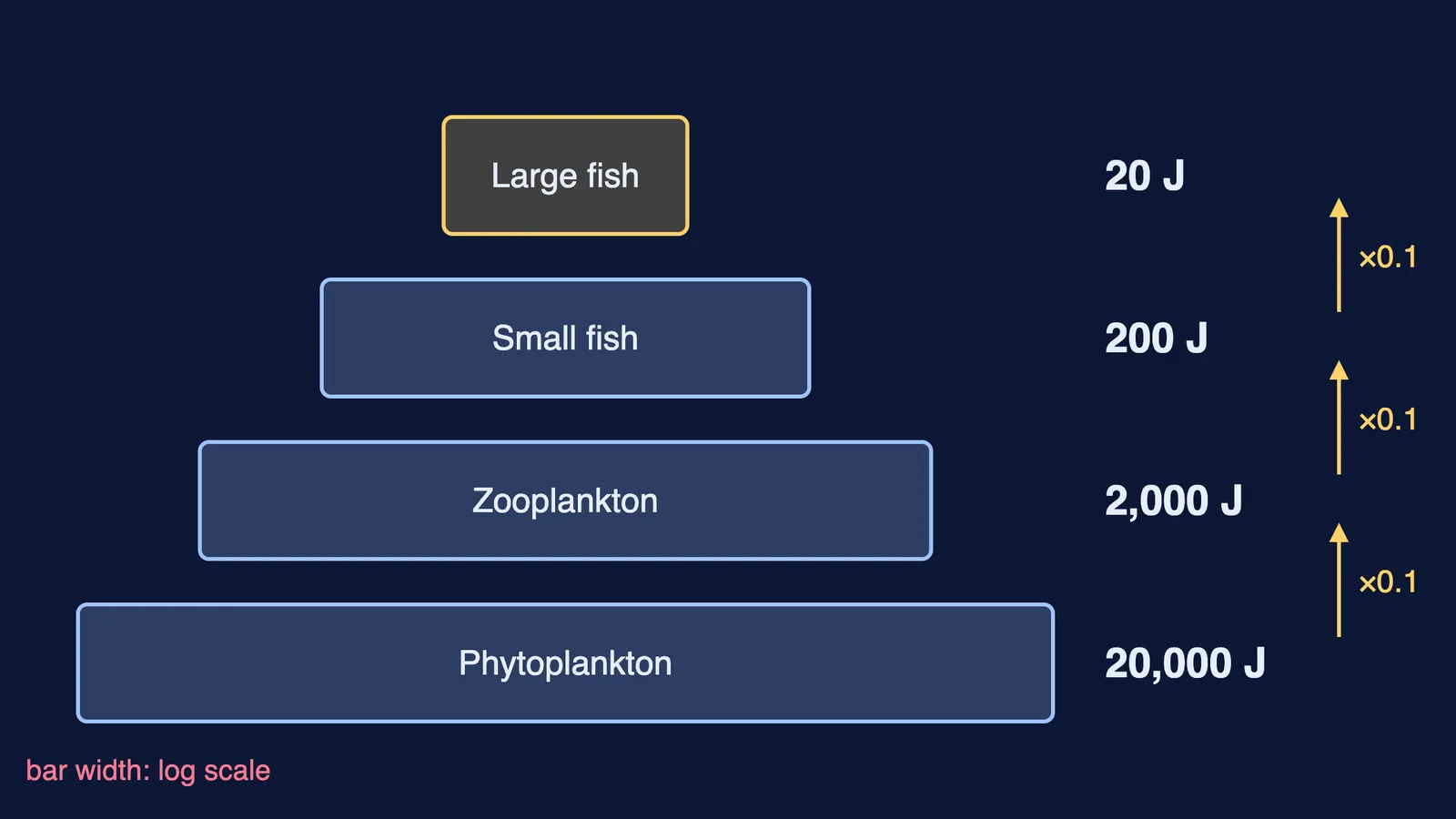
Q10 (hard). Statement I: Phytoplankton in a pond make 20,000 J of energy available as food; using the 10% average, about 200 J reaches the large fish in the chain phytoplankton → zooplankton → small fish → large fish. Statement II: Energy that passes from autotrophs to herbivores can later flow back to the autotrophs.
Answer: (B). I is incorrect: three transfers give 20,000 → 2,000 → 200 → 20 J, so the large fish gets about 20 J. II is incorrect: energy flow is unidirectional.
Trap: multiplying by 0.1 only twice. Four organisms means three feeding steps.
How should you use this set?
Cover the answers and take 10 minutes, writing a "because" sentence for each assertion-reason item.
Mark each miss as a fact error or a link error (mixing up (A) and (B)). Link errors mean rereading NCERT's stated reasons.
Flip a key yourself: change Q9's "stop all CFC production immediately" to "freeze CFC production at 1986 levels" and the answer becomes (A).
If a term such as trophic level or biological magnification still feels shaky, the Fermi Concept Library has its own lesson for every concept in physics, chemistry, biology, mathematics and computing.
For the reasoning step in other subjects, see how to approach assertion-reason questions; for ecology beyond Class 10, read our notes on ecosystem productivity and decomposition.