On this page
How are case-based questions set in CBSE Class 10 Science?
The CBSE Class X Science sample question paper for 2026-27 has 39 questions in three sections. Its 4-mark chemistry case question, Q28, is on metals conducting heat: two 1-mark parts and a 2-mark part with an internal choice (marking scheme). Our cases avoid that topic. For how the whole paper is built, read our CBSE Class 10 science sample paper guide.
The chemistry below follows Chapter 3 of the NCERT Class 10 Science textbook (Reprint 2026-27), as set in the CBSE 2026-27 Science curriculum. The scenarios and numbers are our own.
Case 1: A 22 carat chain in Thrissur
Meenu's family buys a gold chain for her cousin's wedding at a jewellery shop in Thrissur. The bill says the chain is 22 carat and weighs 12.0 g. The shopkeeper explains that it is gold melted together with a little copper and then cooled, and that 24 carat gold would be pure gold. Her grandmother hands over a pair of silver anklets that have turned black, for polishing. Meenu notices a second tray of 18 carat bangles, each weighing 16.0 g.
(i) The chain is best described as: (a) a compound of gold and copper (b) an alloy, a homogeneous mixture of gold and copper (c) an amalgam (d) a heterogeneous mixture
(ii) What is the black coating on the anklets, and what in the air causes it?
(iii) Find the mass of pure gold and of copper in the chain.
(iv) Why is jewellery not made from 24 carat gold? Which holds more pure gold: the chain or one 18 carat bangle?
Answers.
(i) (b) An alloy is a homogeneous mixture of two or more metals, or a metal and a non-metal. An amalgam needs mercury.
(ii) Silver sulphide. Silver reacts with sulphur in the air.
(iii) 22 carat is 22 parts gold in 24. Gold = 12.0 × 22/24 = 11.0 g; copper = 12.0 − 11.0 = 1.0 g.
(iv) Pure gold is very soft, so it is alloyed with copper or silver to make it hard. Bangle gold = 16.0 × 18/24 = 12.0 g, 1.0 g more than the chain despite the lower carat.
Case 2: Four unknown metals in a Bhopal lab
In a Bhopal school lab, Ananya tests four clean metal pieces, W, X, Y and Z, with cold water, hot water, steam and dilute hydrochloric acid. W gives bubbles in cold water without catching fire, and after a while it starts to float. X shows no change in cold water but gives bubbles in hot water and also floats. Y does not react with cold or hot water, but when heated in steam it forms an oxide and hydrogen. Z, a shiny brown metal, does not react even with steam and gives no bubbles in dilute hydrochloric acid.
(i) W is most likely: (a) sodium (b) calcium (c) magnesium (d) aluminium
(ii) Why does X start to float in hot water?
(iii) Taking Y as iron, write the balanced equation for its reaction with steam.
(iv) Ananya drops X into copper sulphate solution and Z into iron(II) sulphate solution. Where does a reaction happen, and what does she see? Arrange W, X, Y and Z in decreasing order of reactivity.
Answers.
(i) (b) Calcium. With sodium the hydrogen catches fire; magnesium needs hot water; aluminium needs steam.
(ii) Bubbles of hydrogen gas stick to its surface. X is magnesium.
(iii) 3Fe(s) + 4H₂O(g) → Fe₃O₄(s) + 4H₂(g).
(iv) Only in the copper sulphate tube: magnesium is more reactive than copper, so Mg + CuSO₄ → MgSO₄ + Cu. Brown copper coats X and the blue colour fades. Copper (Z) is below iron, so nothing happens. Order: W > X > Y > Z (Ca > Mg > Fe > Cu).
Case 3: Refining copper in Gujarat
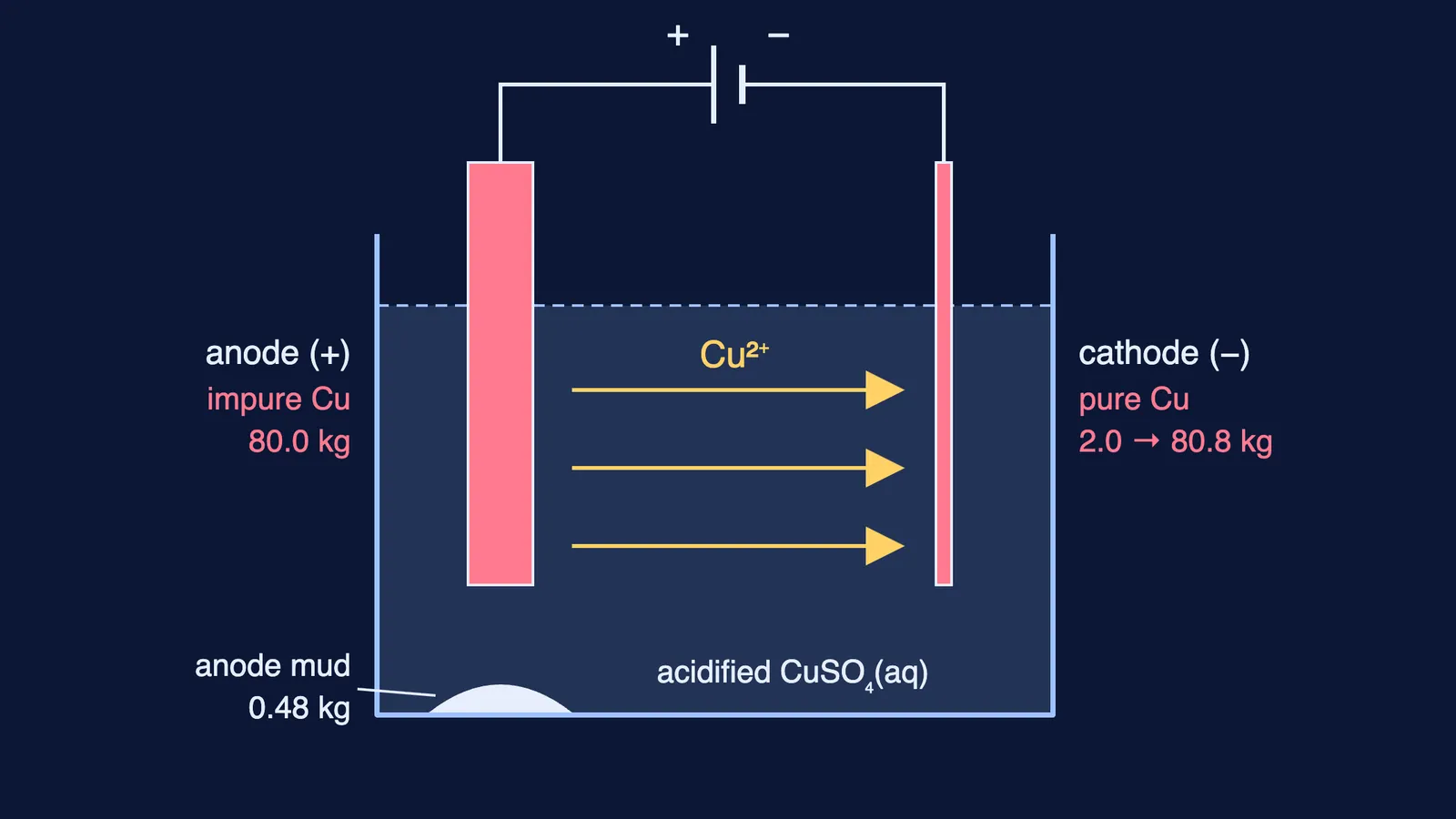
A copper refinery in Gujarat receives copper made by heating a Cu₂S ore in air. This copper is not very pure, so it is refined electrolytically. One slab weighs 80.0 kg. The lab report says it is 98.5% copper by mass; 0.9% is impurities that dissolve in the electrolyte, and 0.6% is impurities that do not. The slab hangs in a tank of acidified copper sulphate solution, facing a thin 2.0 kg sheet of pure copper, and current is passed until the slab has fully dissolved. Assume all its copper ends up on the sheet.
(i) The pure copper sheet is the: (a) anode, positive (b) cathode, negative (c) anode, negative (d) cathode, positive
(ii) What happens to the two kinds of impurity?
(iii) Find the final mass of the sheet and the mass of anode mud.
(iv) Write the two equations by which Cu₂S gives copper on heating in air. Why is heat alone enough for copper but not for zinc?
Answers.
(i) (b) Impure metal is the anode; a thin strip of pure metal is the cathode, the negative electrode.
(ii) Soluble impurities go into solution; insoluble ones settle below the anode as anode mud.
(iii) Copper = 80.0 × 0.985 = 78.8 kg, so the sheet ends at 2.0 + 78.8 = 80.8 kg. Anode mud = 80.0 × 0.006 = 0.48 kg (the other 0.72 kg dissolves).
(iv) 2Cu₂S + 3O₂ → 2Cu₂O + 2SO₂, then 2Cu₂O + Cu₂S → 6Cu + SO₂. Copper is low in the activity series, so heating alone works. Zinc is in the middle, so its oxide needs a reducing agent such as carbon.
How should you attack case-study questions on this chapter?
Turn observations into a place in the activity series: hydrogen catching fire in cold water means potassium or sodium; floating in cold water, calcium; hot water, magnesium; steam only, aluminium, zinc or iron; no reaction, copper, silver or gold.
In displacement parts, a metal displaces only metals below it in the series.
For carat sums, carat ÷ 24 is the fraction of gold; multiply by the mass.
Match extraction to position: electrolysis at the top, carbon in the middle, heat alone at the bottom. In refining, impure metal is always the anode.
For one-mark practice, try our assertion-reason questions on metals and non-metals, or read how to handle case-based questions in board exams. If displacement or refining still feels shaky, the Fermi Concept Library has every concept in chemistry with its own lesson and its place in the map.