On this page
Metals and Non-metals is Chapter 3 of the current NCERT Class 10 Science textbook. Every statement below can be checked in that chapter. Try each item before reading the answer.
How do you answer assertion-reason questions?
Judge each statement on its own first, then ask the link question. For the six assertion-reason items, use these keys:
(A) Both A and R are true and R is the correct explanation of A.
(B) Both A and R are true but R is NOT the correct explanation of A.
(C) A is true but R is false.
(D) A is false but R is true.
For the four statement pairs, use these keys:
(A) Both statements are correct.
(B) Both statements are incorrect.
(C) Statement I is correct, Statement II is incorrect.
(D) Statement I is incorrect, Statement II is correct.
A quick test for the link: put "because" between A and R and read it aloud. If NCERT gives R as the cause of A, the key is (A). If R is a true fact about the same topic but not the cause, it is (B). For a longer method, read our guide to assertion-reason question strategy.
Assertion-reason questions on metals and non-metals
Q1 (easy). Assertion (A): A lab keeps its potassium under kerosene rather than in an open jar. Reason (R): Potassium reacts with the oxygen in air so readily that it may burst into flame.
Answer: (A). Both are true, and NCERT gives this as the reason sodium and potassium are kept under kerosene. Trap: forgetting that kerosene is there to keep air away.
Q2 (easy). Assertion (A): An element that is lustrous must be a metal. Reason (R): Iodine, a non-metal, has a shiny surface.
Answer: (D). R is true, and it is the very example that makes A false. NCERT uses iodine to show that elements cannot be sorted by physical properties alone. Trap: marking (A) because the two lines "feel connected".
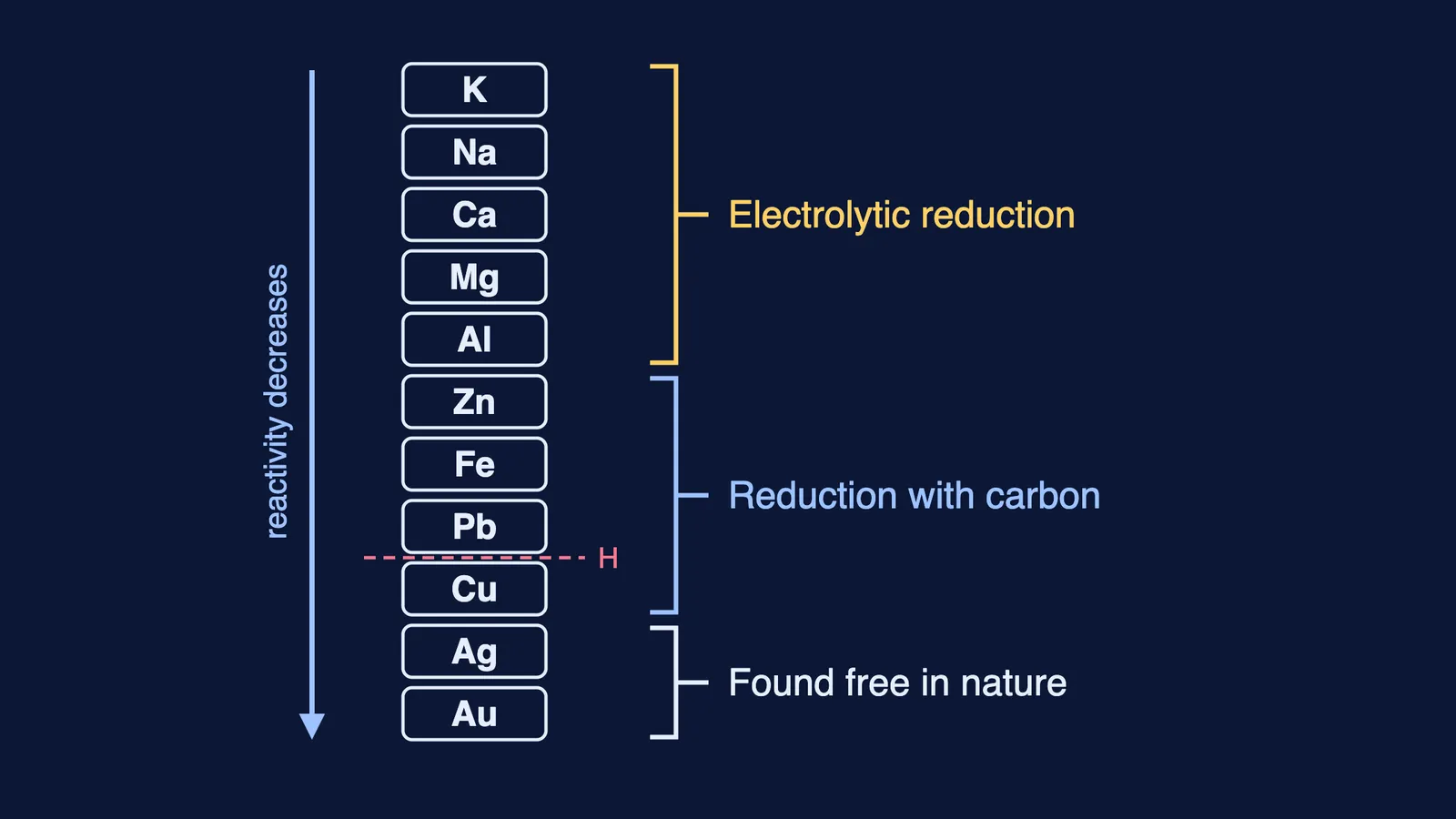
Q3 (medium). Assertion (A): Aluminium does not keep corroding in air, even though it is high in the activity series. Reason (R): A thin layer of aluminium oxide forms on its surface and protects the metal from further oxidation.
Answer: (A). Both are true, and the protective oxide layer is the direct cause. Trap: assuming a reactive metal must corrode quickly.
Q4 (medium). Assertion (A): Ionic compounds conduct electricity in the molten state. Reason (R): Ionic compounds are generally soluble in water.
Answer: (B). Both are true, but solubility has nothing to do with a melt. Molten ionic compounds conduct because heat overcomes the attraction between ions, so the ions can move. Trap: picking (A) because both lines are about ionic compounds.
Q5 (hard). Assertion (A): Calcium is extracted by passing current through molten calcium chloride, not by heating its oxide with carbon. Reason (R): In this process, calcium metal collects at the positive electrode.
Answer: (C). A is true: carbon cannot reduce the oxides of very reactive metals. R is false, because the metal is deposited at the cathode, the negative electrode; chlorine is released at the anode. Trap: mixing up which electrode receives the metal.
Q6 (hard). Assertion (A): Zinc gives hydrogen gas when it reacts with dilute nitric acid. Reason (R): Zinc lies above hydrogen in the activity series.
Answer: (D). R is true, but A is false. Nitric acid is a strong oxidising agent, so it oxidises the hydrogen to water and is itself reduced to nitrogen oxides. Only magnesium and manganese give hydrogen, and only with very dilute nitric acid. Trap: applying the "above hydrogen" rule to every acid.
Statement I and Statement II questions on metals and non-metals
Q7 (easy). Statement I: All metals are solids at room temperature. Statement II: All non-metals are gases at room temperature.
Answer: (B). Both are false. Mercury is a liquid metal, and non-metals can be solids (carbon, sulphur, iodine) or a liquid (bromine). Trap: letting a general rule pass when one exception is enough to break "all".
Q8 (medium). Statement I: Aluminium oxide reacts with both hydrochloric acid and sodium hydroxide to give a salt and water. Statement II: Zinc oxide behaves only as a basic oxide and does not react with bases.
Answer: (C). Statement I is true: aluminium oxide is amphoteric, and with sodium hydroxide it forms sodium aluminate. Statement II is false, because NCERT lists zinc oxide as amphoteric too. Trap: remembering "metal oxides are basic" and forgetting the two exceptions.
Q9 (hard). Statement I: Roasting converts carbonate ores into oxides by heating them in limited air. Statement II: Calcination converts sulphide ores into oxides by heating them in excess air.
Answer: (B). Both are false because the names are swapped. Roasting is for sulphide ores in excess air; calcination is for carbonate ores in limited air. Trap: checking the process but not the ore it goes with.
Q10 (hard). Statement I: In the thermit reaction, aluminium reduces iron(III) oxide, and the heat released is so large that the iron forms in the molten state. Statement II: Carbon cannot reduce aluminium oxide to aluminium because aluminium has more affinity for oxygen than carbon does.
Answer: (A). Both are true. The molten iron is why the thermit reaction is used to join railway tracks, and the affinity argument is why aluminium is extracted by electrolytic reduction. Trap: thinking a reactive metal can only be a product, never a reducing agent.
How should you use this set?
The keys spread across all four options, so a run of one letter is no clue. Use this plan:
Cover the answers, attempt all 10, and write T or F above every statement before choosing a key.
For each miss, note which step failed: a false fact, or a wrong "because" link.
Re-read only the NCERT section behind each miss (reactivity, ionic compounds, extraction, corrosion).
A week later, rewrite three items so the key changes.
If a miss traces to a gap in an idea such as amphoteric oxides or electrolytic reduction, the Fermi Concept Library has every concept in physics, chemistry, biology, mathematics and computing, each with its own lesson and its place in the map.
For where these items sit in the board paper, see our breakdown of the CBSE Class 10 science sample paper.