

On this page
In a case-based question, one misread direction can cost every linked part. Here are three original cases on magnetic effects of electric current, easiest first, each with four parts of rising difficulty and worked answers. The CBSE Class 10 Science syllabus for 2026-27 assesses the motor, induction and the generator only formatively, so we leave those out. Every answer follows NCERT Class 10 Science Chapter 12 (Reprint 2026-27).
Chapter notes are in our Class 10 guide to magnetic effects of current; the format is explained in how case-based questions work in board exams.
Case 1: Which way does a compass point near a vertical cable?
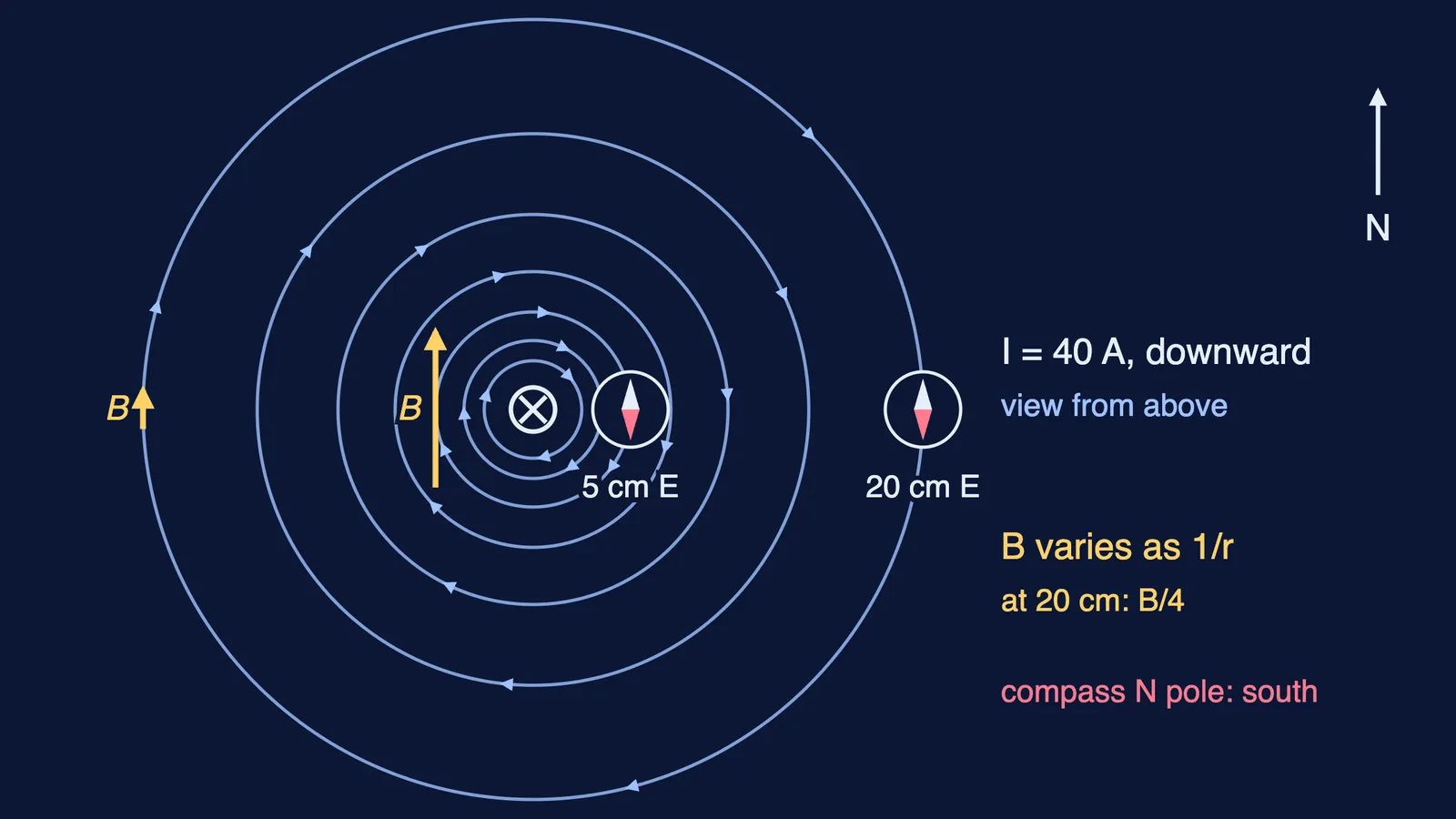
In a Kanpur inverter workshop, a thick vertical copper bar carries a steady 40 A direct current downwards, from a battery bank to a floor panel. It passes through a horizontal worktable. Ritika places a small compass on the table 5 cm due east of the bar, then moves it to 20 cm due east. Ignore the Earth's field. Later, a technician reverses the battery connections so the current flows upwards.
(i) In the plane of the table, the field lines around the bar are: (a) lines parallel to the bar (b) radial lines (c) concentric circles centred on the bar (d) parallel lines across the table
(ii) With the current downwards, which way does the compass's north pole point at 5 cm east of the bar?
(iii) What happens to the field when the compass moves from 5 cm to 20 cm, and by roughly what factor?
(iv) With the current reversed, Ritika puts the compass 10 cm due north of the bar. Which way does its north pole point? Name the rule you used.
Answers.
(i) (c). Field lines around a straight current-carrying conductor are concentric circles.
(ii) South. With your right thumb pointing down along the current, your fingers curl clockwise seen from above. On the east side, clockwise points south.
(iii) It weakens. NCERT says it depends inversely on distance, so at four times the distance it is about a quarter as strong (5/20 = 0.25).
(iv) West, by the right-hand thumb rule. Thumb up, the fingers curl anticlockwise seen from above; on the north side, anticlockwise points west.
Case 2: Which way does a rod on rails roll?
At a science fair in Pune, Kabir builds a rail exhibit. Two brass rails run east to west. A light copper rod lies across them, north to south, between the poles of a large U-shaped magnet held with its north pole above the rod and its south pole below. A 6 V battery is joined to the rails, and the circuit has a total resistance of 1.5 Ω. When he closes the switch, current flows through the rod from north to south and the rod rolls.
(i) The direction of the force on the rod is given by: (a) the right-hand thumb rule (b) Fleming's left-hand rule (c) Maxwell's corkscrew rule (d) the rule for a solenoid's poles
(ii) What current flows through the rod, and which way does it roll?
(iii) Kabir flips the magnet so its south pole is above, and also swaps the battery terminals. Which way does the rod roll now?
(iv) Which way would a beam of electrons moving north through the same downward field be pushed, and why?
Answers.
(i) (b). It gives the force when current and field are at right angles.
(ii) I = V/R = 6/1.5 = 4.0 A. The field points down (north pole above) and the current south. First finger down, second finger south: the thumb points east, so the rod rolls east.
(iii) Still east. Each reversal flips the force, so the two cancel.
(iv) East. Current is opposite to electron motion, so electrons moving north are a current flowing south, exactly like the rod.
Case 3: Will the kitchen fuse blow?
Supply values follow NCERT Section 12.4.
A Chennai flat gets 220 V AC at 50 Hz through two circuits. The 5 A circuit feeds six 12 W LED bulbs and three 75 W ceiling fans. The 15 A kitchen circuit feeds a 2,000 W induction cooktop, a 1,500 W electric kettle and a 1,200 W microwave oven. On a festival morning, all three run together and the kitchen fuse melts. A week later, a frayed live wire inside the kettle touches its steel body, which is connected to the green earth wire.
(i) Appliances on a circuit are connected in parallel so that: (a) total resistance increases (b) each gets the same potential difference (c) the fuse never melts (d) the same current flows through each
(ii) Find the lighting-circuit current with everything on. Is it within rating?
(iii) Why did the kitchen fuse melt, and which two appliances can the family run together safely?
(iv) What does the earth wire do when the kettle's live wire touches its body?
Answers.
(i) (b). Each appliance sits across the live and neutral wires and gets the full 220 V.
(ii) P = 6 × 12 + 3 × 75 = 297 W, so I = P/V = 297/220 = 1.35 A, well within 5 A.
(iii) Together they draw 4,700 W, so I = 4,700/220 = 21.4 A, more than 15 A. That overload makes Joule heating melt the fuse. Cooktop and kettle draw 3,500/220 = 15.9 A, still too much; cooktop and microwave (14.5 A) or kettle and microwave (12.3 A) stay under 15 A.
(iv) It gives a low-resistance path from the body to the earth, keeping the body at earth potential, so whoever touches the kettle does not get a severe shock.
How do you attack case-study questions on magnetic effects?
Sketch the passage with directions marked first.
Right-hand thumb rule for the field of a current; Fleming's left-hand rule for the force on it. Name the one you use.
For electrons, flip the direction first: current is opposite to electron motion.
In circuit parts, add the powers, use I = P/V, then compare with the rating.
If two things are reversed together, check whether they cancel.
If directions are hard to picture, the Fermi Simulation Lab has interactive simulations for ideas that are easier to see than to read. When you are done, try our assertion-reason questions on magnetic effects of current.


