On this page
These ten original questions cover Chapter 12 of the NCERT Class 10 Science textbook (Reprint 2026-27). The CBSE Class 10 Science sample paper for 2026-27 uses this assertion-reason format with the same options.
We left out the motor, electromagnetic induction and the generator, which the CBSE 2026-27 Class 10 Science syllabus assesses only formatively. For chapter notes, read our Class 10 guide to magnetic effects of current.
How do you answer assertion-reason questions?
Work in three steps:
Is the Assertion true on its own?
Is the Reason true on its own?
Only if both are true: is R the textbook's own cause of A?
More step-3 practice is in our assertion-reason strategy guide.
Keys for Q1 to Q6:
(A) Both A and R are true and R is the correct explanation of A.
(B) Both A and R are true but R is NOT the correct explanation of A.
(C) A is true but R is false.
(D) A is false but R is true.
Keys for Q7 to Q10:
(A) Both statements are correct.
(B) Both statements are incorrect.
(C) Statement I is correct, Statement II is incorrect.
(D) Statement I is incorrect, Statement II is correct.
Assertion-reason questions on magnetic effects of current
Q1 (easy). Assertion (A): No two lines in the field pattern of a magnet ever intersect. Reason (R): A compass needle placed at any point in a magnetic field settles in only one direction.
Answer: (A). Both are true. NCERT's reason in Section 12.1: at a crossing, the needle would point two ways.
Trap: treating R as a separate fact rather than the cause.
Q2 (easy). Assertion (A): The magnetic field lines of a bar magnet are closed curves. Reason (R): Outside a bar magnet, field lines run from its south pole to its north pole.
Answer: (C). A is true. R is false: outside the magnet lines run north to south; only inside do they run south to north.
Trap: mixing up inside and outside directions.
Q3 (medium). Assertion (A): The magnetic field at a fixed point near a straight wire gets stronger when the current in the wire is increased. Reason (R): The field lines around a straight current-carrying wire are concentric circles centred on the wire.
Answer: (B). Both are true. R describes the field's shape, not its strength; A holds because the field depends directly on the current.
Trap: choosing (A) because both are about the same wire.
Q4 (medium). Assertion (A): The magnetic field inside a long current-carrying solenoid is strongest near its ends. Reason (R): The field lines inside a long solenoid are parallel straight lines.
Answer: (D). A is false: NCERT says the field is the same at all points inside, that is, uniform. R is true, and it is the evidence for that uniformity.
Trap: thinking "poles are at the ends, so the field is strongest there".
Q5 (medium). Assertion (A): A circular coil of n turns carrying a current produces a magnetic field n times as large as a single turn carrying the same current. Reason (R): The current in every turn flows in the same direction, so the fields due to the turns add up.
Answer: (A). Both are true, and R is the cause NCERT gives in Section 12.2.3.
Trap: thinking more turns weaken the field.
Q6 (hard). Assertion (A): When the current through a rod placed in a magnetic field is reversed, the force on the rod is also reversed. Reason (R): The force on a current-carrying rod in a magnetic field is largest when the current is at right angles to the field.
Answer: (B). Both are true (Activity 12.7), but R is about the size of the force, while A is about its direction.
Trap: picking (A) because both come from one activity.
Statement I and II questions on magnetic effects of current
Q7 (medium). Statement I: In Indian homes, the potential difference between the live and neutral wires is 220 V. Statement II: The earth wire usually has red insulation.
Answer: (C). Statement I matches NCERT Section 12.4. Statement II is wrong: red marks the live wire; earth is green.
Trap: knowing the colours but not which wire gets which.
Q8 (medium). Statement I: A short circuit happens when the earth wire touches the metal body of an appliance. Statement II: A fuse breaks the circuit because Joule heating melts its wire when the current becomes too large.
Answer: (D). Statement I is wrong: NCERT defines short-circuiting as the live and neutral wires touching directly. Statement II is correct.
Trap: confusing a short circuit with the earth wire's safety job.
Q9 (hard). Statement I: A 1.5 kW room heater run at 220 V draws more current than a circuit rated at 5 A can safely carry. Statement II: High-power appliances such as geysers are usually connected to the 15 A circuit in a home.
Answer: (A). Using P = VI, the heater draws I = 1500 W ÷ 220 V ≈ 6.8 A, which is more than 5 A. NCERT says homes often use a 15 A circuit for high-power appliances like geysers.
Trap: computing 220 ÷ 1500 instead.
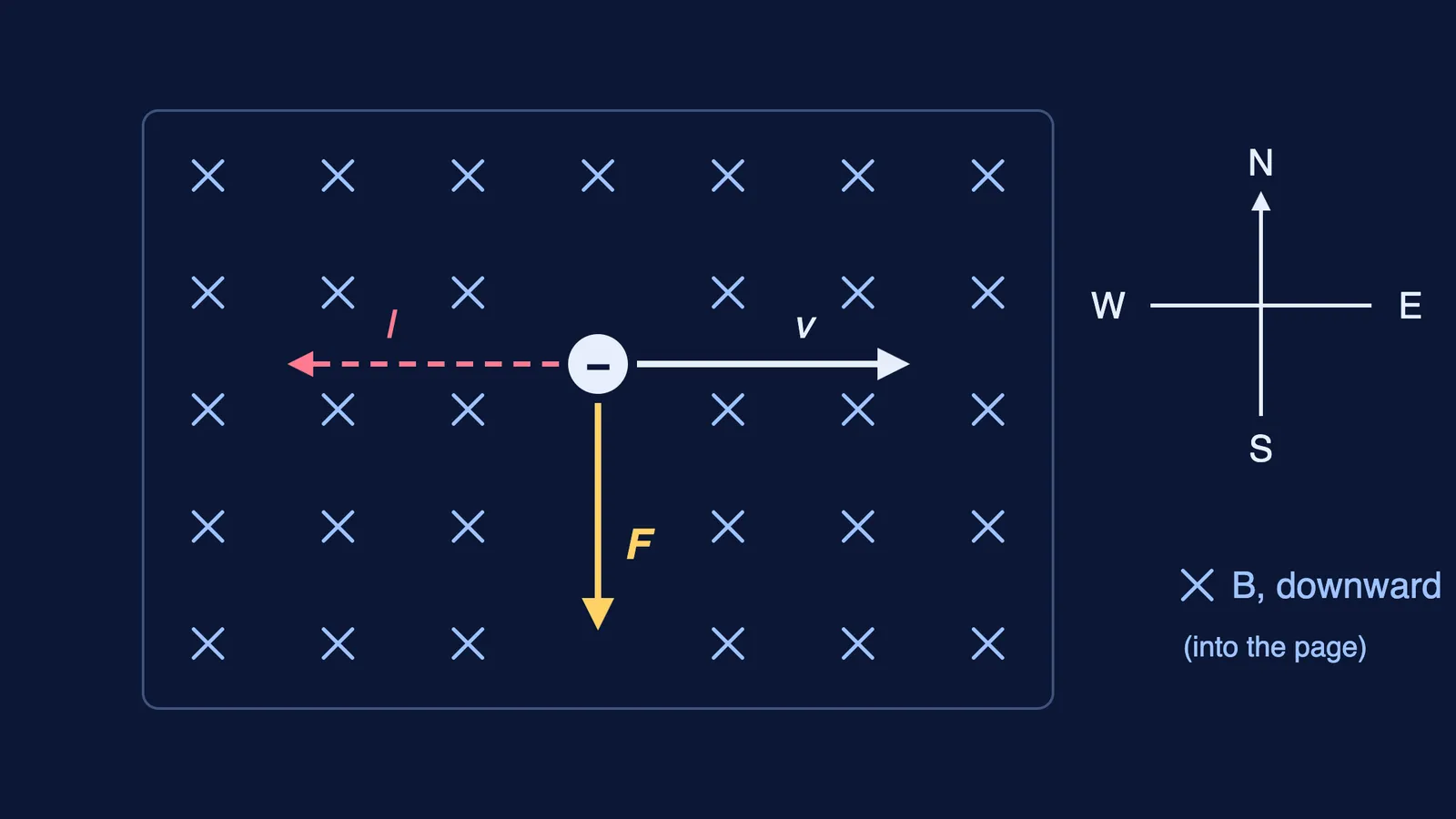
Q10 (hard). Statement I: An electron moving east through a magnetic field that points vertically downward is pushed towards the north. Statement II: A proton moving at right angles to a magnetic field keeps the same velocity.
Answer: (B). Statement I is wrong: current is opposite to the electron's motion, so it flows west, and Fleming's left-hand rule gives a force towards the south. Statement II is wrong: the force is perpendicular to the motion, so the direction, and hence the velocity, changes.
Trap: pointing the middle finger along the electron's motion instead of opposite to it.
If 3D directions are hard to picture, the Fermi Simulation Lab has interactive simulations for ideas that are easier to see than to read.
How should you use this set?
Do all ten without notes, writing a key and a one-line reason for each.
Sort misses into "fact wrong" (re-read the NCERT section) or "link wrong" (practise the because test).
For Fleming's rule, say it aloud: first finger field, middle finger current, thumb force. For electrons, reverse the current first.
A week later, redo Q4, Q6, Q8 and Q10.