On this page
Here are three original cases, each with four questions that get harder. Class 11 exams are set by your school, so treat these as practice, not a prediction. Every case stays inside the CBSE 2026-27 Class XI Mathematics syllabus, which says the chain rule will be assessed only formatively, so no case here needs it, and the rationalised NCERT Chapter 12, Limits and Derivatives. Revise shaky steps in our Limits and Derivatives Class 11 guide.
Case 1: How fast is a cyclist at one instant?
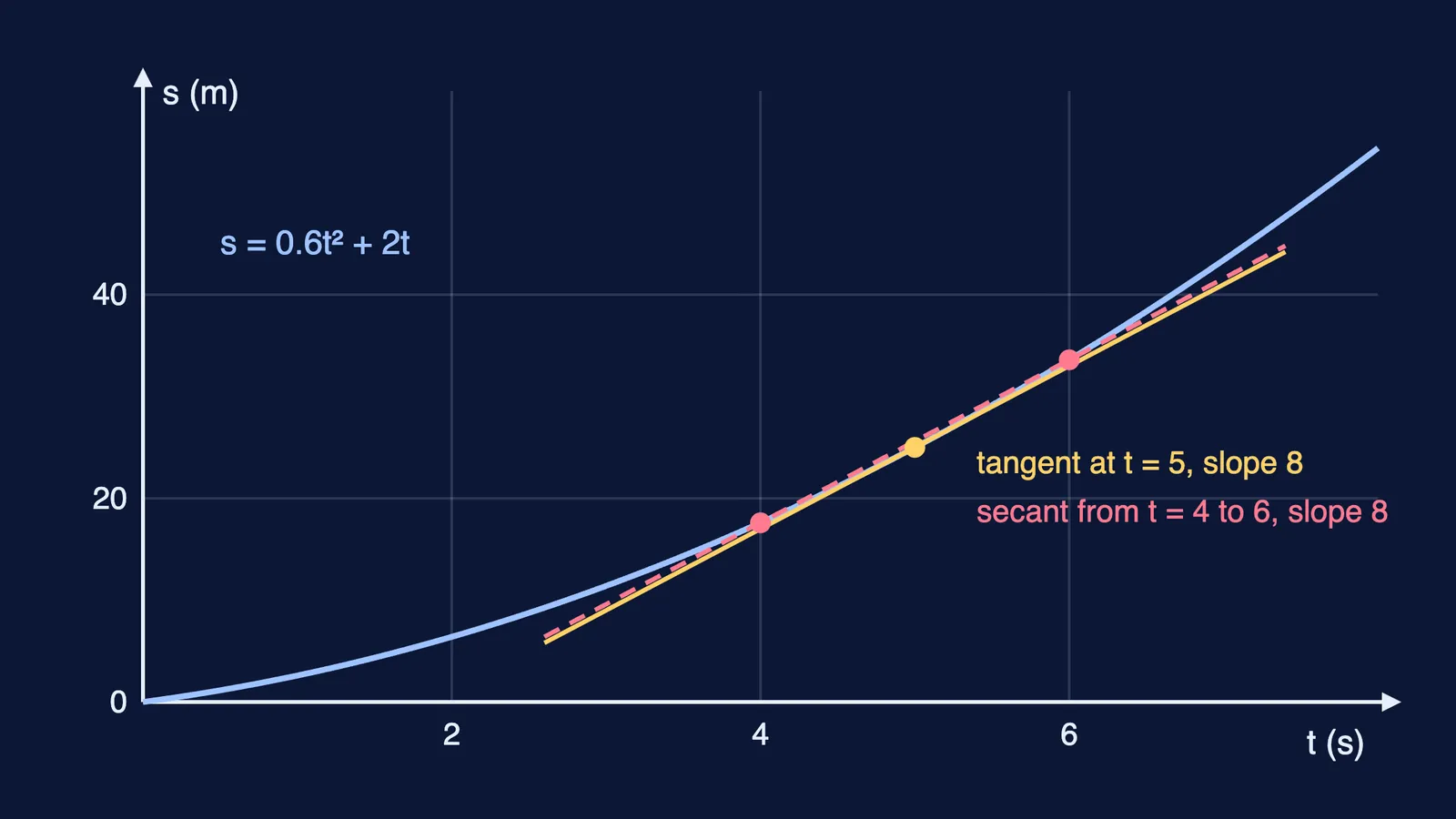
Meera trains on a flat cycling track in Pune. For the first 8 seconds of a timed sprint, the distance she has covered from the start line fits the formula s(t) = 0.6t² + 2t, where s is in metres and t is in seconds. Her coach's sensor reads her position at t = 4 s and at t = 6 s, and he divides the distance covered by the time taken. Meera wants her speed at the exact moment t = 5 s, when she passes him.
(i) Her average speed between t = 4 s and t = 6 s is: (a) 6 m/s (b) 8 m/s (c) 16 m/s (d) 33.6 m/s
(ii) Write ds/dt.
(iii) Find her instantaneous speed at t = 5 s.
(iv) Find the speed at t = 5 s from the first principle, and say why it equals the answer to (i).
Answers.
(i) (b). s(6) = 21.6 + 12 = 33.6 m and s(4) = 9.6 + 8 = 17.6 m, so the average is (33.6 − 17.6)/2 = 8 m/s.
(ii) ds/dt = 1.2t + 2, using d/dx(xⁿ) = nxⁿ⁻¹ and the sum rule.
(iii) 1.2(5) + 2 = 8 m/s.
(iv) [s(5 + h) − s(5)]/h = [0.6(10h + h²) + 2h]/h = 8 + 0.6h → 8 m/s as h → 0. For a quadratic, the secant slope over an interval equals the tangent slope at its midpoint, and 5 is midway between 4 and 6.
Case 2: Does a courier rate card have a limit at the slab?
A courier counter in Jaipur charges by parcel weight w (in kg). The charge is C(w) = 30 + 12w rupees for 0 < w ≤ 2.5, and 45 + 10w rupees for w > 2.5. A student sending books home notices that a parcel just over 2.5 kg costs ₹10 more than a 2.5 kg one, though the weights are almost equal. The manager asks the billing team to fix the second slab's fixed fee so the charge has no jump.
(i) The left hand limit of C(w) as w → 2.5 is: (a) ₹55 (b) ₹60 (c) ₹70 (d) ₹75
(ii) Does the limit of C(w) as w → 2.5 exist? Give a reason.
(iii) If the second slab is changed to k + 10w, find k so that the limit at 2.5 exists.
(iv) With that k, find the left and right hand limits of [C(w) − C(2.5)]/(w − 2.5) as w → 2.5. Does C have a derivative at 2.5?
Answers.
(i) (b). 30 + 12(2.5) = ₹60.
(ii) No. The right hand limit is 45 + 10(2.5) = ₹70, and a limit exists only when the left and right hand limits are equal.
(iii) k + 25 = 60, so k = 35.
(iv) From the left, (30 + 12w − 60)/(w − 2.5) = 12(w − 2.5)/(w − 2.5) = 12. From the right, (35 + 10w − 60)/(w − 2.5) = 10. Since 12 ≠ 10, the derivative at 2.5 does not exist, even though the jump is gone: the charge per extra kilogram changes from ₹12 to ₹10 at the slab.
Case 3: How fast does a giant wheel seat rise?
At a mela in Kolkata, a giant wheel has radius 8 m, and its centre is 9 m above the ground. A seat starts at the lowest point. When the wheel has turned through an angle θ radians, the seat's height above the ground is h(θ) = 9 − 8 cos θ metres. One full turn takes about a minute. The operator notices that riders barely rise in the first few seconds and then climb quickly, and wonders why this happens.
(i) The height of the seat at θ = π/3 is: (a) 1 m (b) 5 m (c) 9 m (d) 13 m
(ii) Find dh/dθ and its value at θ = π/6.
(iii) Evaluate the limit of [h(θ) − h(0)]/θ as θ → 0, and say what it means for the rider.
(iv) Show that the limit of [h(θ) − h(0)]/θ² as θ → 0 is 4, and use it to estimate the rise after turning 0.1 rad.
Answers.
(i) (b). 9 − 8 cos(π/3) = 9 − 4 = 5 m.
(ii) dh/dθ = 8 sin θ, since the derivative of cos θ is −sin θ. At π/6 it is 8 × 0.5 = 4 m per radian.
(iii) h(0) = 1, so the quotient is 8(1 − cos θ)/θ, which tends to 8 × 0 = 0 by the standard limit (1 − cos x)/x → 0. At the bottom, the seat is moving sideways, not up.
(iv) 1 − cos θ = 2 sin²(θ/2), so 8(1 − cos θ)/θ² = 4[sin(θ/2)/(θ/2)]², which tends to 4 × 1² = 4 because sin x/x → 1. The rise after 0.1 rad is about 4 × 0.01 = 0.04 m; the exact value is 8(1 − cos 0.1) ≈ 0.03997 m.
How to attack case-study questions on limits and derivatives?
Turn the passage into one formula first, with its units (metres, rupees, metres per radian).
For a piecewise rule, find both one-sided limits; the case-based questions guide shows why careful reading of the passage matters.
Before cancelling a factor such as (w − 2.5), note that w ≠ 2.5 near the limit, as NCERT does in its worked examples.
When a trigonometric limit looks stuck, rewrite 1 − cos θ as 2 sin²(θ/2) and aim for sin x/x.
Check that each rate fits the story: 8 m/s on a bicycle is believable.
If you pick the right rule but slip in the middle of the working, the Fermi Problem Library has worked problems with a step-by-step solver that explains the reasoning rather than printing an answer.