

On this page
What do case-study questions on light test?
The CBSE Class 10 Science syllabus for 2026-27 lists the mirror formula and magnification, the laws of refraction and refractive index, the lens formula and the power of a lens for this chapter. The cases use only those ideas and the NCERT chapter, Reprint 2026-27, with its New Cartesian sign convention.
For theory and ray diagrams, start with our Light: reflection and refraction Class 10 guide.
Case 1: A solar cooker in a Jodhpur school
A science teacher in Jodhpur builds a solar cooker for the school's eco club. She mounts a concave mirror with a radius of curvature of 1.6 m and points it straight at the noon Sun, so the rays reaching it are parallel to its principal axis. The club must decide where to hang a small blackened pot so that it heats fastest. Later, a student takes the same mirror indoors, stands 0.40 m in front of it and is surprised to see a large, upright picture of her face.
(i) Where should the pot be hung? (a) at the pole (b) at the principal focus (c) at the centre of curvature (d) beyond the centre of curvature
(ii) Find the focal length of the mirror.
(iii) Describe the image of the Sun that the mirror forms.
(iv) Find the position and magnification of the student's image, and state its nature.
Answers.
(i) (b). Rays parallel to the principal axis meet at the principal focus after reflection, so the heat concentrates there.
(ii) f = R/2 = 1.6/2 = 0.80 m, in front of the mirror, so f = −0.80 m.
(iii) Real, inverted and highly diminished (point-sized), at the focus, 0.80 m from the pole.
(iv) u = −0.40 m, f = −0.80 m. 1/v = 1/f − 1/u = −1.25 + 2.5 = +1.25, so v = +0.80 m, behind the mirror. m = −v/u = −(0.80)/(−0.40) = +2. Virtual, erect, twice the size: she is between the pole and the focus.
Case 2: Sorting gems at a Jaipur testing lab
A gem-testing lab in Jaipur receives two polished stones that look alike. A technician sends a thin beam of light from air onto a flat face of each stone at an angle of incidence of 45°, and measures the angle of refraction inside. For stone X, sin r comes out as 0.400; for stone Y, 0.414. She takes sin 45° = 0.707 and the speed of light in air as 3 × 10^8 m/s, and compares her results with NCERT's table, which lists ruby at 1.71 and sapphire at 1.77.
(i) Inside each stone, the refracted ray: (a) bends away from the normal (b) bends towards the normal (c) goes on undeviated (d) reflects back
(ii) Find the refractive index of stone X and identify it.
(iii) Find the speed of light in stone X.
(iv) Identify stone Y. If light passes from stone Y into stone X across a flat join, find the refractive index of X with respect to Y and say which way the ray bends.
Answers.
(i) (b). Each stone is optically denser than air.
(ii) By Snell's law, n = sin i/sin r = 0.707/0.400 ≈ 1.77, so stone X is sapphire.
(iii) v = c/n = (3 × 10^8)/1.77 ≈ 1.69 × 10^8 m/s.
(iv) n = 0.707/0.414 ≈ 1.71, so Y is ruby. n(X w.r.t. Y) = n(X)/n(Y) = 1.77/1.71 ≈ 1.035. Greater than 1, so the ray bends slightly towards the normal.
Case 3: A watch-repair lens in Kolkata
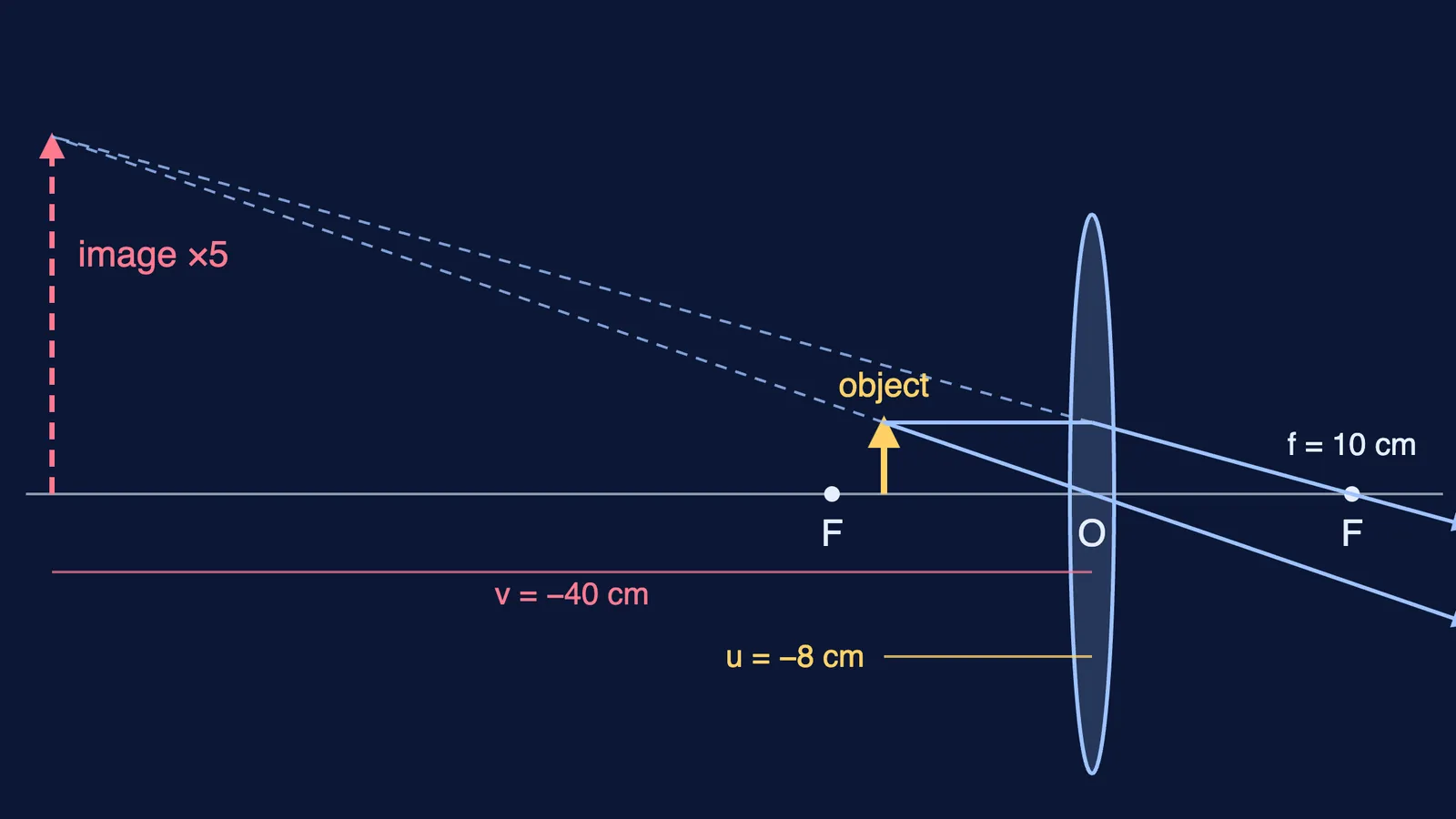
Mr Sen repairs wristwatches in a small shop in Kolkata. His eyepiece is a single lens marked +10 D. He holds a gear wheel 2.0 mm across at 8.0 cm from the lens and looks through it. One evening he clips on a second thin lens of +2.5 D in contact with the first, hoping to see more detail, but keeps the gear at the same 8.0 cm and wonders where the image now forms. Both lenses are thin.
(i) A lens of power +10 D is: (a) concave, focal length 10 cm (b) convex, focal length 10 cm (c) convex, focal length 1 cm (d) concave, focal length 1 m
(ii) Find the focal length of his eyepiece in metres and in centimetres.
(iii) Find the position and size of the image of the gear with one lens, and state its nature.
(iv) Find the power and focal length of the two-lens combination. Explain what happens to the image at 8.0 cm, and find the image if he moves the gear to 6.0 cm.
Answers.
(i) (b). Positive power means converging; f = 1/P.
(ii) f = 1/10 m = 0.10 m = 10 cm.
(iii) u = −8.0 cm, f = +10 cm. 1/v = 1/f + 1/u = 1/10 − 1/8 = −1/40, so v = −40 cm, on the same side as the gear. m = v/u = (−40)/(−8.0) = +5: a virtual, erect image 10 mm across.
(iv) P = +10 + 2.5 = +12.5 D, so f = 1/12.5 m = 8.0 cm. The gear now sits at the focus, so the image is at infinity. At u = −6.0 cm: 1/v = 1/8 − 1/6 = −1/24, so v = −24 cm and m = (−24)/(−6.0) = +4, a virtual, erect image 8.0 mm across.
How do you attack case-study questions on light?
Write the signs before any formula. u is negative for a real object; f is negative for a concave mirror, positive for a convex lens.
Use the right formula. Mirrors: 1/v + 1/u = 1/f and m = −v/u. Lenses: 1/v − 1/u = 1/f and m = v/u.
Convert to metres for power. P = 1/f gives dioptres only with f in metres; powers in contact add.
Read the sign of v and m as a sentence. Negative m means real and inverted; positive m means virtual and erect.
Check against the story. A make-up mirror should magnify; the denser stone should slow light more.
Next, try our assertion-reason questions on light and revise convex lens image positions for Class 10. If ray diagrams are hard to picture, the Fermi Simulation Lab has interactive simulations for the ideas that are easier to see than to read.


