On this page
This set has 10 original questions on Chapter 9 of the NCERT Class 10 Science textbook, Light: Reflection and Refraction: 6 assertion-reason items and 4 Statement I / Statement II pairs, easy to hard. Every statement was checked against the 2026-27 reprint of the NCERT chapter, and every number was recalculated. To revise first, read our Class 10 guide to Light: Reflection and Refraction.
How do you answer assertion-reason questions?
Use these keys for every assertion-reason item:
(A) Both A and R are true and R is the correct explanation of A.
(B) Both A and R are true but R is NOT the correct explanation of A.
(C) A is true but R is false.
(D) A is false but R is true.
Judge A alone, then R alone. Only if both are true, ask whether R is the reason the chapter gives for A.
Assertion-reason questions on light, with answers
Q1 (easy). Assertion (A): A driver sees a wider stretch of road behind in a convex wing mirror than in a plane mirror of the same size. Reason (R): A convex mirror is curved outwards, which gives it a wider field of view.
Answer: (A). Both are true, and NCERT gives the outward curve as the reason convex mirrors have a wider field of view.
Trap: Treating the diminished image as a drawback.
Q2 (easy). Assertion (A): For a spherical mirror of small aperture, the focal length is half the radius of curvature. Reason (R): The principal focus of a spherical mirror lies at its centre of curvature.
Answer: (C). A is true: NCERT states R = 2f for small-aperture mirrors. R is false: the focus lies midway between the pole and the centre of curvature, not at it.
Trap: Mixing up F and C.
Q3 (medium). Assertion (A): Light travels more slowly in kerosene than in water. Reason (R): Kerosene has a greater mass density than water.
Answer: (C). A is true: in the NCERT table kerosene has a refractive index of 1.44 and water 1.33, so kerosene is optically denser and light is slower in it. R is false: kerosene's mass density is lower than water's.
Trap: Linking the speed of light to mass density instead of optical density.
Q4 (medium). Assertion (A): A ray of light going obliquely from air into glass bends away from the normal. Reason (R): Light travels more slowly in glass than in air.
Answer: (D). A is false: going from a rarer to a denser medium, light slows down and bends towards the normal. R is true.
Trap: Forgetting which way it bends.
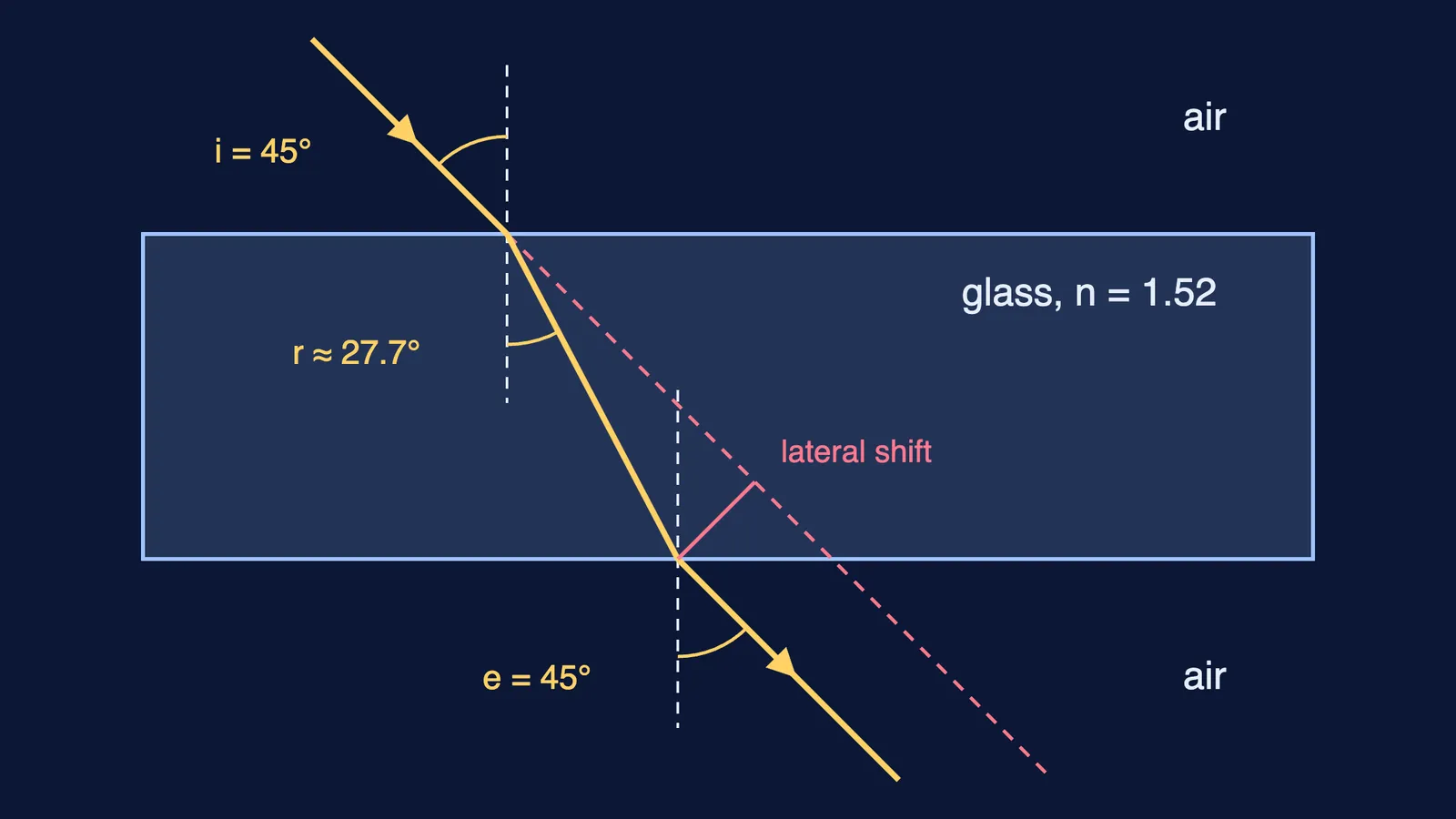
Q5 (medium). Assertion (A): A ray passing obliquely through a rectangular glass slab comes out parallel to the incident ray. Reason (R): The ray is shifted sideways as it passes through the slab.
Answer: (B). Both are true. The ray emerges parallel because the bending at the two parallel faces is equal and opposite; the sideways shift does not cause it.
Trap: Picking (A) because both describe the same diagram.
Q6 (hard). Assertion (A): Light going obliquely from water (n = 1.33) into crown glass (n = 1.52) bends away from the normal. Reason (R): The refractive index of crown glass with respect to water is about 1.14.
Answer: (D). R is true: 1.52 ÷ 1.33 ≈ 1.14. A is false: an index greater than 1 means glass is optically denser than water, so the ray bends towards the normal.
Trap: Assuming only air-to-glass counts as rarer-to-denser.
Statement I and Statement II questions on light
Use these keys for every statement pair:
(A) Both statements are correct.
(B) Both statements are incorrect.
(C) Statement I is correct, Statement II is incorrect.
(D) Statement I is incorrect, Statement II is correct.
Q7 (easy). Statement I: A convex lens of focal length 0.25 m has a power of +4 D. Statement II: Of two convex lenses, the one with the shorter focal length has less power.
Answer: (C). I is correct: P = 1/f = 1/0.25 m = +4 D, positive for a convex lens. II is incorrect: shorter focal length means more power.
Trap: Reading "shorter" as "weaker".
Q8 (medium). Statement I: A convex mirror forms a real image when the object is between its pole and focus. Statement II: When an object is at the centre of curvature of a concave mirror, the image forms at infinity.
Answer: (B). I is incorrect: a convex mirror gives a virtual, erect, diminished image for every object position. II is incorrect: an object at C gives a real, inverted image of the same size, also at C.
Trap: Swapping the "object at C" and "object at F" rows.
Q9 (hard). Statement I: Under the New Cartesian sign convention, a real image formed by a concave mirror has a negative magnification. Statement II: An object 20 cm from a convex lens of focal length 10 cm forms an image 20 cm on the other side, of the same size.
Answer: (A). I is correct: NCERT takes the height of a real image as negative, so m is negative. II is correct: 1/v = 1/10 − 1/20, so v = +20 cm and m = v/u = −1, inverted and same size.
Trap: Dropping the sign of u, which gives v = 20/3 cm and a wrong "diminished" image.
Q10 (hard). Statement I: A ray falling on a glass slab at normal incidence (angle of incidence 0°) bends towards the normal. Statement II: Light travels through diamond (n = 2.42) at about 1.24 × 10^8 m/s.
Answer: (D). I is incorrect: a ray along the normal enters the glass without changing direction, though it slows. II is correct: v = c/n = (3 × 10^8 m/s) ÷ 2.42 ≈ 1.24 × 10^8 m/s, using NCERT's values.
Trap: Thinking every change of medium bends the ray.
How should you use this set?
Sort each miss into a bin: a fact you lacked (Q2, Q8), a direction or sign you flipped (Q4, Q6, Q9), or a false "because" (Q5).
If the slab in Q5 still feels abstract, the Fermi Simulation Lab has interactive simulations for ideas easier to see than read.
The chapter returns in Class 12 with harder pairs; see our ray optics assertion-reason traps for JEE and NEET. For a general method, read a three-check method for assertion-reason questions.