

On this page
These three original case passages follow the rationalised NCERT Class 10 Science chapter 5, Life Processes (Reprint 2026-27). They run easy to hard. Try every part before reading the answers; for theory, see our Life Processes Class 10 guide.
Case 1: Why do stomata close on a hot afternoon?
Ritika peels the epidermis from a leaf of a potted plant in her rooftop garden in Jaipur and looks at it under the school microscope. She counts stomata in five fields of view on each surface. Lower surface: 22, 25, 19, 24 and 20. Upper surface: 4, 6, 5, 3 and 7. A peel she takes at 2 pm on a hot May afternoon shows most pores shut. Her teacher notes that a desert plant on the same roof opens its stomata only at night, yet still makes food.
(i) Which cells open and close a stomatal pore? (a) epidermal cells (b) guard cells (c) palisade cells (d) root hair cells
(ii) Find the mean count on each surface and how many times more stomata the lower surface shows.
(iii) Why are most pores shut at 2 pm on a hot afternoon?
(iv) How can the desert plant photosynthesise if its stomata take in carbon dioxide only at night?
Answers.
(i) (b) guard cells. They swell when water flows into them and the pore opens; the pore closes when they shrink.
(ii) Lower: (22 + 25 + 19 + 24 + 20) ÷ 5 = 110 ÷ 5 = 22. Upper: (4 + 6 + 5 + 3 + 7) ÷ 5 = 25 ÷ 5 = 5. The lower surface shows 22 ÷ 5 = 4.4 times as many.
(iii) Large amounts of water can be lost through open stomata. In heat the guard cells lose water and shrink, so the pores close and save water.
(iv) The steps of photosynthesis need not happen one after another immediately. The plant takes in carbon dioxide at night and stores it as an intermediate; by day, energy absorbed by chlorophyll acts on that intermediate to make carbohydrate.
Case 2: How does an artificial kidney clean blood?
A patient whose kidneys have failed comes to a district hospital in Kerala for haemodialysis. Her blood is pumped through the tubes of the artificial kidney at 250 mL per minute for a 4-hour session. The tubes have a semi-permeable lining and sit in a tank of dialysing fluid. The fluid has the same osmotic pressure as blood but contains no nitrogenous waste. A blood test shows urea at 120 mg/dL before the session and 42 mg/dL after it.
(i) Urea passes from the blood into the dialysing fluid by: (a) osmosis (b) diffusion (c) active transport (d) reabsorption
(ii) What volume of blood passes through the machine in one session, in litres?
(iii) By what percentage does her blood urea fall during the session?
(iv) Why must the fluid contain no urea but match blood's osmotic pressure? Name the nephron's step that the machine leaves out.
Answers.
(i) (b) diffusion, from blood into fluid that has no urea.
(ii) 250 mL/min × 240 min = 60,000 mL = 60 L.
(iii) (120 − 42) ÷ 120 × 100 = 78 ÷ 120 × 100 = 65%.
(iv) With no urea in the fluid, urea keeps diffusing out of the blood. Matching osmotic pressure stops water from moving across in large amounts. The machine has no reabsorption: a nephron selectively takes back glucose, amino acids, salts and much of the water from the filtrate, which is why NCERT says the kidneys' initial filtrate of about 180 L a day becomes only a litre or two of urine (NCERT, Life Processes).
Case 3: How much blood does the heart pump in a race?
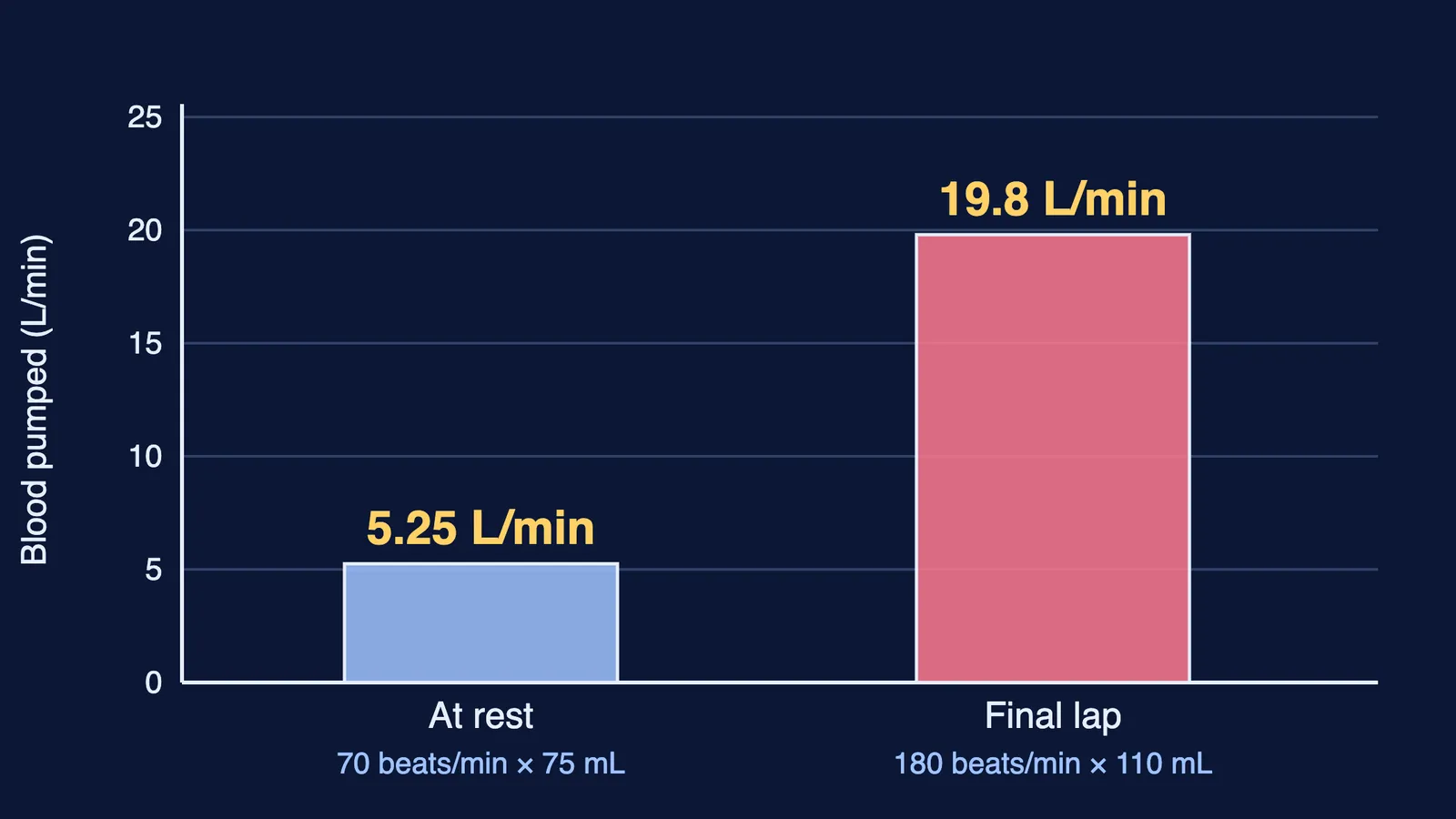
Arjun, 17, runs the 1,500 m at a district athletics meet in Bhopal. At rest his heart beats 70 times a minute and each beat of a ventricle pushes out about 75 mL of blood. On the final lap his rate climbs to 180 beats a minute and each beat pushes out about 110 mL. Minutes after finishing he gets painful cramps in his calves. His coach reminds him that blood passes through the heart twice in each full circuit.
(i) Which chamber pumps oxygen-rich blood to the leg muscles? (a) right atrium (b) right ventricle (c) left atrium (d) left ventricle
(ii) Calculate the blood pumped per minute at rest and on the final lap. How many times larger is the second figure?
(iii) Explain the calf cramps in terms of how his muscle cells break down pyruvate.
(iv) Suppose oxygenated and deoxygenated blood could mix in his heart, as in a three-chambered heart. Explain why his muscles would run short of oxygen sooner.
Answers.
(i) (d) left ventricle, which pumps blood out to the body.
(ii) Rest: 70 × 75 mL = 5,250 mL = 5.25 L/min. Final lap: 180 × 110 mL = 19,800 mL = 19.8 L/min. Ratio: 19.8 ÷ 5.25 ≈ 3.8 times.
(iii) When oxygen runs short in muscle cells, pyruvate is converted into lactic acid instead of being broken down in mitochondria. Its build-up during sudden activity causes cramps.
(iv) Keeping the right (deoxygenated) and left (oxygenated) sides apart gives a highly efficient oxygen supply, which mammals need for their high energy demands. If they mixed, some deoxygenated blood would reach the blood pumped to the body, so each litre would carry less oxygen and his muscles would switch to lactic acid sooner.
How do you answer case-study questions?
Read the questions first; underline the numbers and units you need.
Write the formula in words first ("blood per minute = beats per minute × volume per beat") and keep units in every line.
Name the structure or process exactly: guard cells, nephron, left ventricle, lactic acid. Vague words like "the pores" or "the kidney part" lose credit.
For "why" parts, link cause to effect using the passage's own detail.
One case can join transport, respiration and excretion, so revise them as one system. If a single idea such as double circulation still feels shaky, the Fermi Concept Library gives every biology concept its own lesson.
For the general method, read how to answer case-based questions in CBSE board exams, then test the same chapter another way with our Life Processes assertion-reason questions.


