On this page
Ten original questions on digestion, the heart, the kidney and transport in plants, built around true facts that are not the reason.
How do you answer assertion-reason questions in Life Processes?
The CBSE Class 10 Science sample paper for 2026-27 has assertion-reason questions of 1 mark each, two of them in the Biology section (Q8 and Q9). Every item below stays inside the CBSE 2026-27 Class 10 Science syllabus and the NCERT Life Processes chapter (Reprint 2026-27). For the full chapter, start with our Class 10 Life Processes guide.
Keys for Q1 to Q6:
(A) Both A and R are true and R is the correct explanation of A.
(B) Both A and R are true but R is NOT the correct explanation of A.
(C) A is true but R is false.
(D) A is false but R is true.
Keys for Q7 to Q10:
(A) Both statements are correct.
(B) Both statements are incorrect.
(C) Statement I is correct, Statement II is incorrect.
(D) Statement I is incorrect, Statement II is correct.
Judge each statement alone first; only then ask whether R makes A happen.
Assertion-reason questions with answers
Q1 (easy). Assertion (A): Under normal conditions, the inner lining of the stomach is not damaged by the hydrochloric acid it releases. Reason (R): Hydrochloric acid creates an acidic medium that helps the enzyme pepsin act.
Answer: (B). Both are true, but R is about digestion, not protection. NCERT says mucus from the gastric glands protects the lining.
Trap: picking (A) because R mentions the acid.
Q2 (easy). Assertion (A): Veins have valves. Reason (R): Blood in veins flows under high pressure.
Answer: (C). A is true. R is false: NCERT says blood in veins is no longer under pressure, so veins have valves to keep it flowing one way.
Trap: swapping the features of arteries and veins.
Q3 (medium). Assertion (A): The ventricles of the human heart have thicker muscular walls than the atria. Reason (R): The ventricles pump blood out of the heart to the lungs and the rest of the body.
Answer: (A). Both are true, and NCERT gives R as the direct reason for the thicker walls.
Trap: picking (B) because R reads like a general fact about the heart rather than the cause of the thick walls.
Q4 (medium). Assertion (A): Carnivores such as tigers have a longer small intestine than grass-eating herbivores. Reason (R): Cellulose in grass takes longer to digest than meat.
Answer: (D). A is reversed. NCERT says herbivores need a longer small intestine so cellulose can be digested, and meat is easier to digest, so tigers have a shorter one. R is true.
Trap: assuming a predator needs the longer gut.
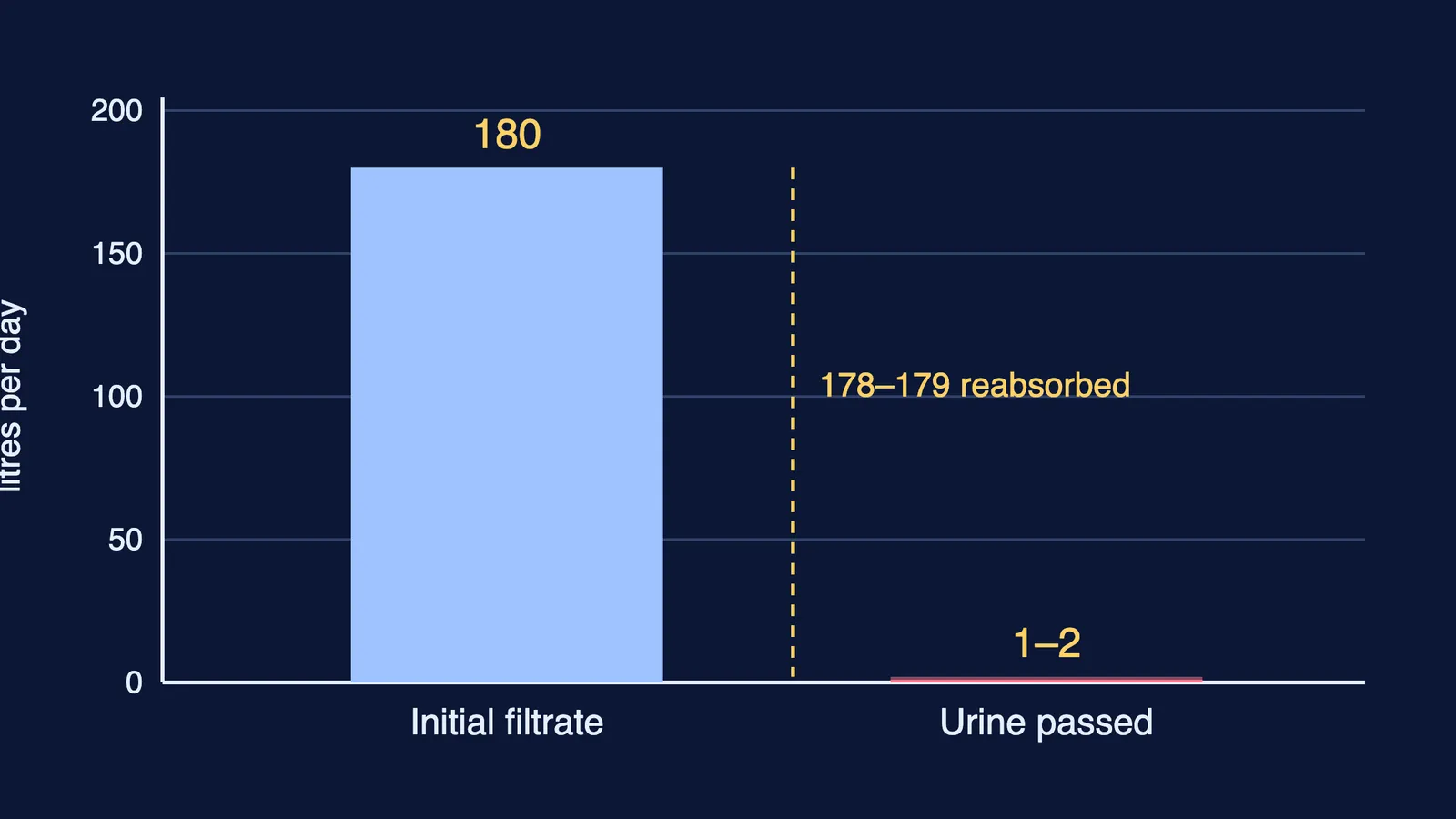
Q5 (medium). Assertion (A): A healthy adult passes far less urine in a day than the volume of filtrate the kidneys first make. Reason (R): Most of the filtrate, including a major amount of water, is reabsorbed as it flows along the kidney tubules.
Answer: (A). The NCERT chapter puts the initial filtrate at about 180 L a day against only a litre or two of urine, because the rest is reabsorbed in the tubules. R is exactly that cause.
Trap: thinking the urinary bladder removes the extra water.
Q6 (hard). Assertion (A): During the day, root pressure is the main force that moves water up the xylem of a tall tree. Reason (R): Root cells take up ions from the soil, so water moves into the root to reduce the difference in concentration.
Answer: (D). A is false: NCERT says root pressure matters more at night; by day, with stomata open, transpiration pull is the main force. R is true.
Trap: knowing the root-pressure mechanism and assuming it does the heavy lifting.
Statement I and II questions with answers
Q7 (easy). Statement I: A fish heart has two chambers, and blood passes through it only once in each cycle through the body. Statement II: Amphibians have a four-chambered heart that keeps oxygenated and deoxygenated blood fully apart.
Answer: (C). Statement I matches NCERT. Statement II is wrong: NCERT says amphibians and many reptiles have three-chambered hearts and tolerate some mixing.
Trap: assuming every land vertebrate has double circulation with four chambers.
Q8 (medium). Statement I: Xylem carries food made in the leaves to other parts of the plant. Statement II: Translocation in phloem happens only downwards, from leaves to roots.
Answer: (B). Both are wrong. Xylem carries water and minerals; phloem carries food, and NCERT says translocation runs both upwards and downwards, such as stored sugar moving to buds in spring.
Trap: picturing food only travelling down to the roots.
Q9 (medium). Statement I: Lymph is colourless and contains less protein than blood plasma. Statement II: Lymph carries digested and absorbed fat from the intestine.
Answer: (A). Both lines are in NCERT's account of lymph.
Trap: thinking all digested food goes straight into blood capillaries.
Q10 (hard). Statement I: Most oxygen in human blood is carried dissolved in plasma, because oxygen is more soluble in water than carbon dioxide. Statement II: Haemoglobin, present in red blood corpuscles, has a very high affinity for oxygen.
Answer: (D). Statement I gets both halves backwards. NCERT says carbon dioxide is the more soluble gas and travels mostly dissolved, while oxygen is carried by haemoglobin. Statement II is true.
Trap: reading "plasma carries dissolved substances" and extending it to oxygen.
How should you use this set?
Cover the answers and mark a key for all ten in one sitting.
For each miss, write which part failed: A, R, or the link between them.
Find the NCERT line that settles it and copy it into your notes under that heading.
A week later, rewrite two items so the key changes.
If most misses are "true but not the reason" errors, slow down on the link step; if they are misremembered facts, go back to the chapter. Our assertion-reason strategy guide has more on the link step, and NEET aspirants can try harder items in the photosynthesis and respiration set.
If the path of blood or water still feels like a list of words, the Fermi Concept Library gives each biology concept its own lesson and its place in the map, so you can see where one idea connects to the next.