On this page
What do case-study questions on How do organisms reproduce? look like?
The CBSE Science sample paper for 2026-27 has 39 questions in three sections, and each section carries one 4-mark case-based question. Its Biology case, Q15, is on Mendel's pea crosses. Reproduction is on the 2026-27 syllabus. Every fact below matches the NCERT Class 10 Science chapter 7 text, Reprint 2026-27. The scenarios and numbers are our own.
Case 1: Why did only some watermelon flowers set fruit?
Sunita grows watermelons near Jodhpur. Each vine carries two kinds of flowers: some have only stamens, dusted with yellow pollen, and others have only a pistil, with a small swollen ovary below the petals. Few bees visited this season. On one row she tagged 40 pistil-bearing flowers and left them alone; 12 set fruit. On the next row she picked stamen-bearing flowers each morning and rubbed them gently on the stigmas of 50 pistil-bearing flowers, some on the same vine and some on neighbouring vines. 41 of these set fruit.
(i) Watermelon flowers are: (a) bisexual, like Hibiscus (b) unisexual, like papaya (c) bisexual, like mustard (d) without reproductive parts
(ii) Name the process Sunita did by hand, and the agent that normally does it in her field.
(iii) Sunita calls her same-vine transfers self-pollination. Using NCERT's definitions, is she right?
(iv) Find the fruit set in each row as a percentage. Which part became the fruit, and what will become the seeds?
Answers.
(i) (b). Each flower has either stamens or a pistil, never both.
(ii) Pollination, the transfer of pollen from stamen to stigma. Here bees (animal agents) normally carry it.
(iii) No. NCERT calls transfer within the same flower self-pollination and transfer from one flower to another cross-pollination. A watermelon flower lacks either stamens or pistil, so every transfer here is from one flower to another.
(iv) Untouched row: 12 ÷ 40 × 100 = 30%. Hand-pollinated row: 41 ÷ 50 × 100 = 82%. After fertilisation the ovary ripens into the fruit, and each fertilised ovule develops a tough coat and becomes a seed.
Case 2: Banana plantlets from a tissue-culture lab
A Jalgaon lab supplies banana plantlets. Technician Imran removes 5 tiny growing tips from one healthy, high-yielding mother plant and places them on an artificial medium, where the cells divide into small masses. On a hormone medium, each mass forms one shoot. Every 4 weeks he splits the shoots onto fresh medium, and in this lab each 4-week cycle multiplies the shoot count by 4. A farmer has ordered 3,000 plantlets for one planting. The district agriculture officer warns the farmer that planting all 3,000 from one mother plant carries a hidden risk.
(i) Banana is grown by such methods because it: (a) has lost the capacity to produce seeds (b) cannot form roots (c) flowers only in water (d) reproduces by spores
(ii) Name the mass of dividing cells formed on the first medium.
(iii) What is the least number of 4-week cycles Imran needs for 3,000 shoots, and how many weeks is that?
(iv) Explain the officer's warning using what the chapter says about variation.
Answers.
(i) (a). NCERT lists banana, orange, rose and jasmine as plants that have lost the capacity to produce seeds.
(ii) Callus.
(iii) After n cycles there are 5 × 4ⁿ shoots. Four cycles give 5 × 256 = 1,280, too few; five give 5 × 1,024 = 5,120. So 5 cycles, or 5 × 4 = 20 weeks.
(iv) Plants raised by vegetative propagation are genetically similar enough to the parent to have all its characteristics, so the planting has almost no variation. A drastic change, such as a disease the mother plant cannot resist, could wipe out the whole crop.
Case 3: Did the heat make the yeast tougher?
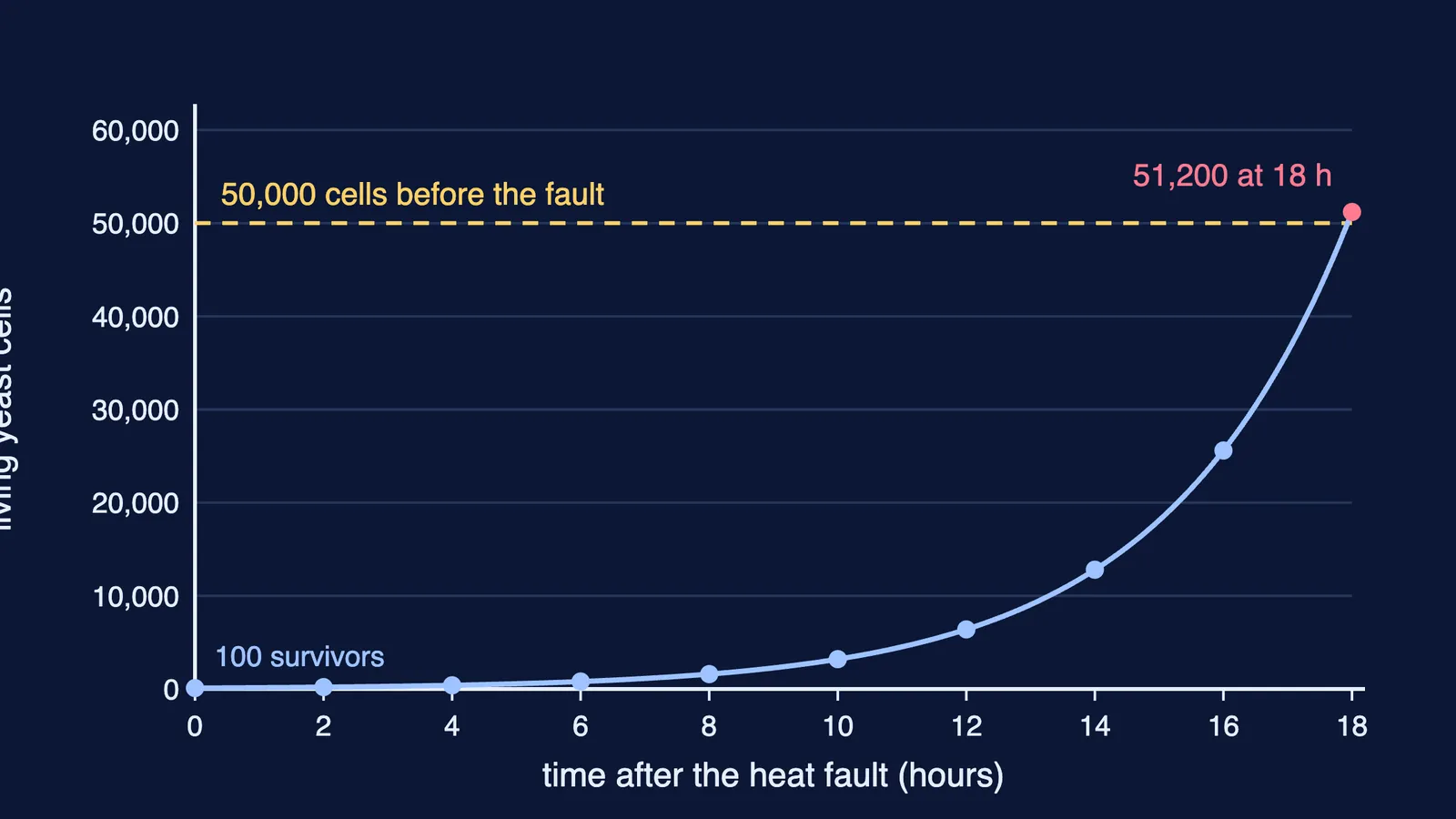
A bakery in Pune keeps a flask of yeast culture for its pav dough. One May afternoon the proofing cabinet's thermostat fails and the flask overheats for an hour. Aarav, the baker's son in Class 10, tests a sample with a stain at school: of about 50,000 cells in it, only about 100 are alive. Some survivors already show small outgrowths. He puts the sample in a warm, sugary medium, where the number of living cells doubles every 2 hours. "The heat has made our yeast tougher," says the baker. Aarav is not so sure.
(i) The small outgrowths show yeast reproducing by: (a) binary fission (b) multiple fission (c) budding (d) spore formation
(ii) What percentage of the cells survived?
(iii) The survivors and the dead cells came from the same culture. Where did the difference between them come from?
(iv) Is the baker right? Also find how many hours the survivors need to reach at least 50,000 cells again.
Answers.
(i) (c). Yeast buds separate and grow further.
(ii) 100 ÷ 50,000 × 100 = 0.2%.
(iii) From DNA copying. No biochemical reaction is absolutely reliable, so each copy can carry small variations, and the cells are similar but not identical.
(iv) Not in the way he means. The heat did not make any cell tougher; it killed most cells, and a few variants that could survive it already existed. A culture regrown from them may cope better with heat, but only because they existed before the fault. Variation helps the species survive even when most individuals die. Count: 100 × 2ⁿ ≥ 50,000 needs 2ⁿ ≥ 500; 2⁸ = 256 is too small and 2⁹ = 512 works, so 9 doublings × 2 hours = 18 hours (51,200 cells).
How to attack case-study questions
Name the mode first. The passage describes fission, budding, spores, vegetative propagation or pollination, often without naming it.
Use NCERT's exact definitions. Self- versus cross-pollination turns on one phrase.
Track each part's fate. Ovary to fruit, ovule to seed, zygote to embryo.
Link variation to survival. Start from inaccurate DNA copying; end with the species, not the individual.
Show the working. For doubling counts, test the step below and the step that works.
If a term like meiosis or callus still feels shaky, the Fermi Concept Library has every concept in physics, chemistry, biology, mathematics and computing, each with its own lesson and its place in the map. For the whole paper, read how the CBSE Class 10 Science sample paper is built, then see how to answer case-based questions in board exams and try the How do organisms reproduce? assertion-reason questions.