On this page
This chapter is full of statements that sound right but hide one wrong word. Below are 10 original practice items, easy to hard, built only from the NCERT Class 10 Science chapter 7 text, Reprint 2026-27. Each has the answer, a reason and the trap.
How do you answer assertion-reason questions?
Use one fixed set of options for every assertion-reason item in this set:
(A) Both A and R are true and R is the correct explanation of A.
(B) Both A and R are true but R is NOT the correct explanation of A.
(C) A is true but R is false.
(D) A is false but R is true.
For the statement pairs, use these options:
(A) Both statements are correct.
(B) Both statements are incorrect.
(C) Statement I is correct, Statement II is incorrect.
(D) Statement I is incorrect, Statement II is correct.
Judge each statement alone first. Only when both are true do you ask the last question: does R give the direct reason for A, or is it just another true fact about the same topic? See how to solve assertion-reason questions with a three-check method.
Assertion-reason questions on How do organisms reproduce?
Q1 (easy). Assertion (A): A man's testes are held in the scrotum, outside the abdominal cavity. Reason (R): Sperms are formed at a temperature lower than normal body temperature.
Answer: (A). Both are true, and the NCERT chapter gives the lower temperature as the reason. R explains A.
Trap: thinking the scrotum is there for protection, and marking (B).
Q2 (easy). Assertion (A): Yeast can reproduce asexually by budding. Reason (R): In yeast, the bud stays permanently attached to the parent cell.
Answer: (C). A is true. R is false: yeast puts out small buds that separate and grow further.
Trap: imagining buds as permanent branches.
Q3 (medium). Assertion (A): Regeneration is the normal way in which Hydra reproduces. Reason (R): Regeneration is carried out by specialised cells that multiply and then change into different cell types.
Answer: (D). A is false: Hydra reproduces by budding, and NCERT says regeneration is not the same as reproduction because most organisms do not depend on being cut up to reproduce. R is true.
Trap: Hydra appears under both regeneration and budding.
Q4 (medium). Assertion (A): Banana and jasmine plants have to be multiplied by vegetative propagation rather than grown from seeds. Reason (R): Banana and jasmine have lost the capacity to produce seeds.
Answer: (A). Both are true, and NCERT says vegetative propagation makes it possible to propagate plants that have lost the capacity to produce seeds.
Trap: choosing (B) by recalling other advantages, such as earlier flowering, instead of this one.
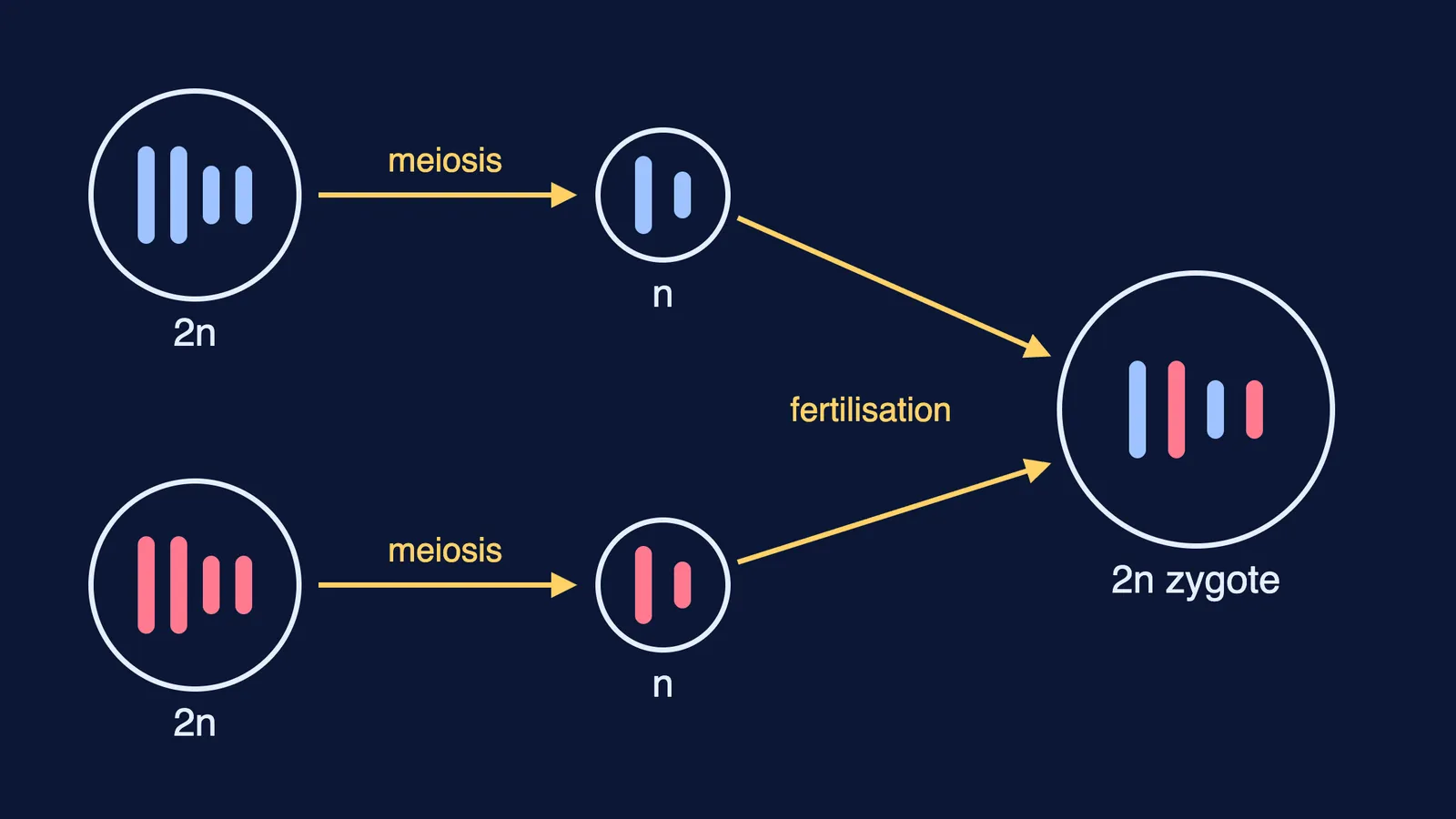
Q5 (hard). Assertion (A): In sexual reproduction, the zygote has the same number of chromosomes as the body cells of its parents. Reason (R): Germ cells are made by meiosis and carry only half the number of chromosomes of non-reproductive body cells.
Answer: (A). Both are true. Because each germ cell carries half, fusion of two germ cells restores the full number in the zygote, which is exactly why the count stays the same.
Trap: thinking DNA doubles each generation; meiosis prevents this.
Q6 (hard). Assertion (A): Variation in a population can help the species survive when its niche changes drastically. Reason (R): Consistent DNA copying during reproduction maintains the body design features that let an organism use its niche.
Answer: (B). Both are true. R explains why populations stay stable in an unchanged niche, not why variation helps when the niche changes: a few variants, such as heat-resistant bacteria in warming water, may survive when the rest die.
Trap: marking (A) because both lines mention niches and reproduction; R is about consistency, while A is about variation.
Statement I and Statement II questions
Q7 (easy). Statement I: Stamens and pistil are the reproductive parts of a flower. Statement II: Papaya flowers are bisexual because they contain both stamens and pistil.
Answer: (C). Statement I is correct. Statement II is incorrect: NCERT gives papaya and watermelon as unisexual flowers, and Hibiscus and mustard as bisexual ones.
Trap: remembering the examples but swapping the two lists.
Q8 (medium). Statement I: In bread mould (Rhizopus), the thread-like hyphae are the structures that produce spores. Statement II: Rhizopus spores have thin walls so that they can start growing on dry surfaces.
Answer: (B). Both are incorrect. The hyphae are not reproductive; the sporangia (blobs on stalks) hold the spores. The spores have thick walls that protect them until they reach a moist surface.
Trap: assuming thread-like means reproductive.
Q9 (medium). Statement I: Pollination is the fusion of the male and female germ cells inside the ovule. Statement II: After fertilisation, the ovule develops into a seed and the ovary ripens into a fruit.
Answer: (D). Statement I is incorrect: pollination is the transfer of pollen from the stamen to the stigma, and the fusion of germ cells is fertilisation. Statement II is correct.
Trap: treating pollination and fertilisation as the same event.
Q10 (hard). Statement I: As body designs become more complex, one germ cell becomes large and stores food while the other becomes smaller and likely to be motile. Statement II: If DNA copying were much less accurate, variation would build up faster and more of the new cells would survive.
Answer: (C). Statement I is correct as written in NCERT. Statement II is incorrect: with less accurate copying, many new DNA copies would not work with the cellular apparatus and the cells would die.
Trap: assuming more errors always means more useful variation.
How should you use this practice set?
Cover the answers and attempt all 10.
For each miss, note the word that fooled you.
Reread that paragraph in the NCERT chapter and write one statement that changes only that word.
Redo the set after three days.
If one idea keeps slipping, the Fermi Concept Library gives every concept in biology its own lesson, so you can fix the gap first.
For the full paper, read how the CBSE Class 10 science sample paper is built, and for more on this question type, see assertion-reason questions in CBSE papers.