On this page
Is Heredity assessed in the CBSE Class 10 board exam in 2026-27?
CBSE's own documents disagree, so confirm with your school. The CBSE Class X Science syllabus for 2026-27 lists "Heredity; Mendel's contribution- Laws for inheritance of traits: Sex determination; brief introduction" under Unit II, and names only Evolution as a topic to be "assessed only formatively". But its Note for Teachers says: "The topics Periodic Classification of Elements; Heredity and Evolution; and Electric Effects of Electric Current will not be assessed in the year-end examination." The same note adds that such topics "may be for Internal Assessment and credit may be given for Periodic Assessment/Portfolio".
The CBSE 2026-27 Science sample paper still includes a 4-mark Heredity case, Q15, on Mendel's pea crosses. Use these cases for school and internal assessment, and as board practice in case the chapter is tested.
What do Heredity case-study questions test?
Each case tests Mendel's crosses or sex determination from Chapter 8 of the NCERT Class 10 Science textbook (Reprint 2026-27). The scenarios and numbers are ours. For the concepts first, read our Heredity Class 10 guide to Mendel's experiments and sex determination.
Case 1: Three daughters and a family argument
Kavya's aunt in Jaipur has three daughters. An elderly relative blames the aunt, and her diet, for having "only girls". Kavya writes XX for her aunt and XY for her uncle. Her cousin asks: after three girls in a row, isn't a boy now "due"?
(i) The sex chromosome carried by every human egg is: (a) X (b) Y (c) either X or Y (d) both X and Y
(ii) Apart from the sex chromosomes, how many pairs of chromosomes do human cells have?
(iii) What is the chance that the aunt's fourth child is a boy? Do the three daughters change it?
(iv) Using a cross, explain why the relative's blame is misplaced.
Answers.
(i) (a) X. Women have a perfect pair of sex chromosomes, XX, so every egg carries an X.
(ii) 22 pairs, each with a maternal and a paternal copy.
(iii) 1/2, or 50%. Each birth is a fresh draw of X or Y from the father.
(iv) XX × XY: every egg carries X; sperm carry X or Y. X egg with X sperm gives XX, a girl; X egg with Y sperm gives XY, a boy. The father's chromosome decides, and human sex is largely genetically determined, so blaming the mother or her diet has no basis.
Case 2: A packet of tall pea seeds
Tanvi runs her school's eco-club garden in Pune. She grows one plant from a packet of "tall pea" seeds; it turns out tall. She lets it self-pollinate, collects all 120 seeds from its pods and sows them in trays. Of the seedlings, 91 are tall and 29 are short. The club had expected every plant to be tall.
(i) The gene pair of Tanvi's parent plant is: (a) TT (b) Tt (c) tt (d) cannot be told
(ii) Find the ratio of tall to short seedlings, to the nearest whole number.
(iii) About how many of the 91 tall seedlings would you expect to be TT? Show your working.
(iv) Using genes, enzymes and hormones, explain why a tt plant is short.
Answers.
(i) (b) Tt. A TT plant gives only tall offspring; short seedlings show the parent carries t.
(ii) 91 ÷ 29 = 3.14, so about 3 tall : 1 short.
(iii) Tt × Tt gives 1 TT : 2 Tt : 1 tt, so one in three tall plants is TT: 91 ÷ 3 ≈ 30.
(iv) A gene is a section of DNA that provides information for one protein. The t version makes a less efficient enzyme, so less growth hormone is made. A tt plant has no T copy, so it stays short; a single T copy is enough for tallness.
Case 3: Sorting seeds at a farm college
At a farm college in Ludhiana, Harpreet works on a pea plot. Her mentor crosses a pure-breeding plant with round, yellow seeds (RRYY) with one that has wrinkled, green seeds (rryy). All the F1 seeds are round and yellow. The F1 plants are self-pollinated, and Harpreet sorts 640 F2 seeds on a tray: 357 round yellow, 123 round green, 118 wrinkled yellow and 42 wrinkled green. Her lab partner assumed each parent passes on its genes as one unit, so "round" should always travel with "yellow".
(i) The dominant traits here are: (a) round and yellow (b) wrinkled and green (c) round and green (d) wrinkled and yellow
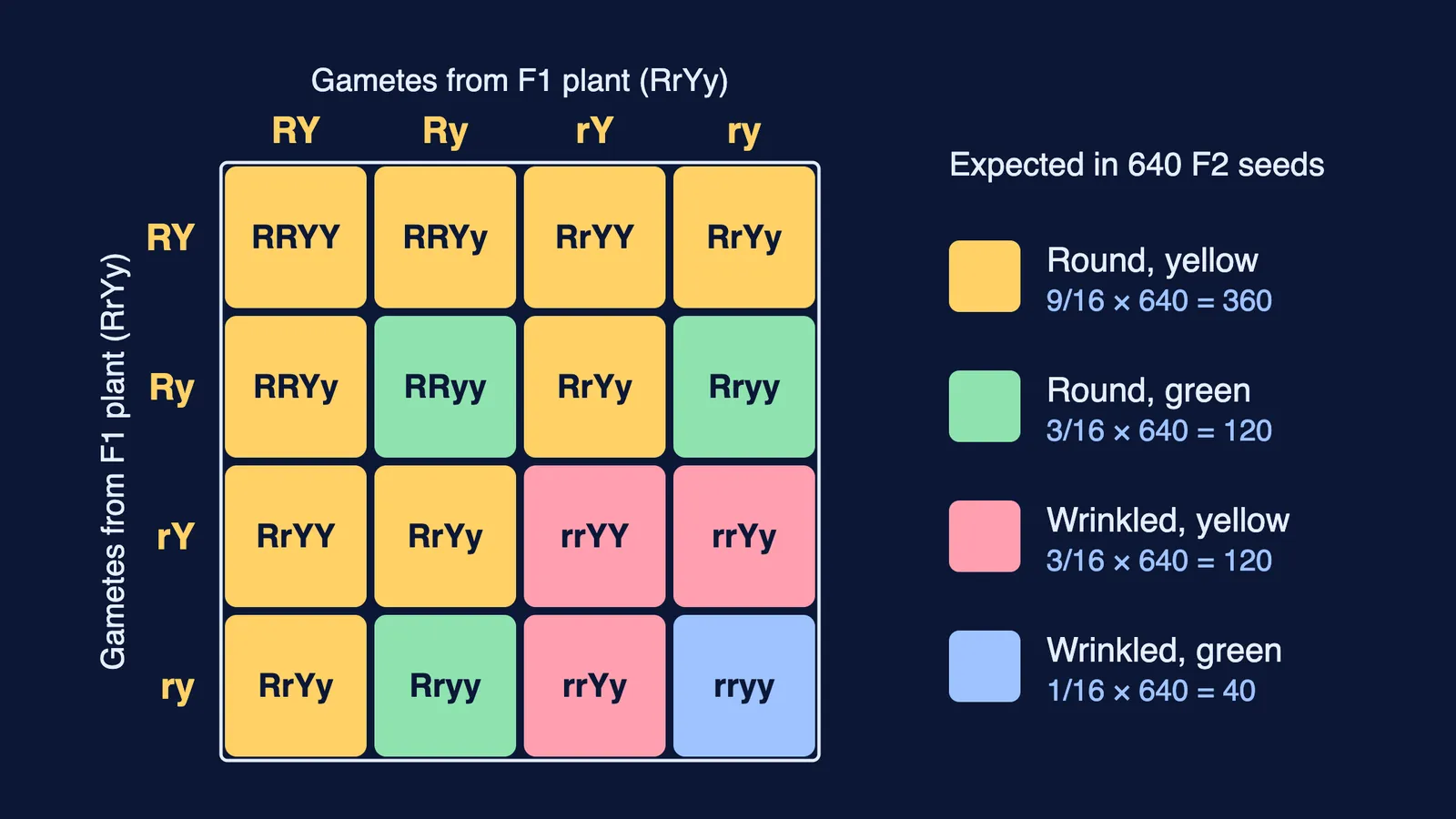
(ii) Write the kinds of gametes an F1 plant makes.
(iii) Using 9 : 3 : 3 : 1, find the expected number of each kind among 640 seeds. Compare the expected new combinations with Harpreet's count.
(iv) Use Harpreet's data to show why her partner is wrong, and explain how chromosomes make this possible.
Answers.
(i) (a). Every F1 seed is round and yellow, so these traits show even when the other version is present.
(ii) An RrYy plant makes four kinds of gametes: RY, Ry, rY and ry, in equal numbers.
(iii) 640 ÷ 16 = 40. Expected: 9 × 40 = 360 round yellow, 3 × 40 = 120 round green, 120 wrinkled yellow and 40 wrinkled green. New combinations: 120 + 120 = 240 expected; counted 123 + 118 = 241, a close match.
(iv) If R stayed linked to Y and r to y, F2 would show only the parental types, round yellow and wrinkled green. The 241 new-combination seeds show the traits are inherited independently. This works because the genes for seed shape and seed colour sit on separate chromosomes, and each germ cell takes one chromosome from each pair, of either maternal or paternal origin.
How to attack case-study questions on Heredity
Write the gene pairs first, capital letter for the dominant version.
Turn counts into a ratio by dividing by the smallest class: 91 ÷ 29, or 357 ÷ 42.
Expect close, not exact. Real counts sit near 3 : 1 or 9 : 3 : 3 : 1.
For sex determination, draw XX × XY. The father's X or Y decides.
Explain mechanisms as a chain: gene, enzyme, hormone, trait.
For the general method, read our guide to case-based questions in CBSE board exams, then try our Heredity assertion-reason questions. If Punnett squares keep slipping, the Fermi Problem Library has worked problems with a step-by-step solver that explains the reasoning rather than printing an answer.