On this page
These ten questions are written for Heredity, Chapter 8 of the current NCERT Class 10 Science textbook (Reprint 2026-27). Each item turns on a real mix-up. For the concepts first, read our Heredity Class 10 guide to Mendel's experiments and sex determination.
How do you answer assertion-reason questions?
Assertion-reason (A-R) items use these keys:
(A) Both A and R are true and R is the correct explanation of A.
(B) Both A and R are true but R is NOT the correct explanation of A.
(C) A is true but R is false.
(D) A is false but R is true.
Statement I / Statement II items use these:
(A) Both statements are correct.
(B) Both statements are incorrect.
(C) Statement I is correct, Statement II is incorrect.
(D) Statement I is incorrect, Statement II is correct.
Heredity assertion-reason questions with answers
Statements are checked against the NCERT Heredity chapter.
Q1 (easy). Assertion (A): When a pure tall pea plant is crossed with a short pea plant, all the F1 plants are tall. Reason (R): A single copy of the gene for tallness (T) is enough to make a pea plant tall.
Answer: (A). Both are true. Every F1 plant is Tt, and one copy of T is enough for tallness, which is exactly why A happens.
Trap: expecting medium-height F1 plants.
Q2 (easy). Assertion (A): A pea plant with the gene pair Tt is tall. Reason (R): A Tt plant does not carry the gene for shortness, so it cannot pass shortness on.
Answer: (C). A is true. R is false: a Tt plant carries t. One quarter of the F2 from tall F1 plants were short, so shortness was inherited, just not expressed.
Trap: reading "not seen" as "not present".
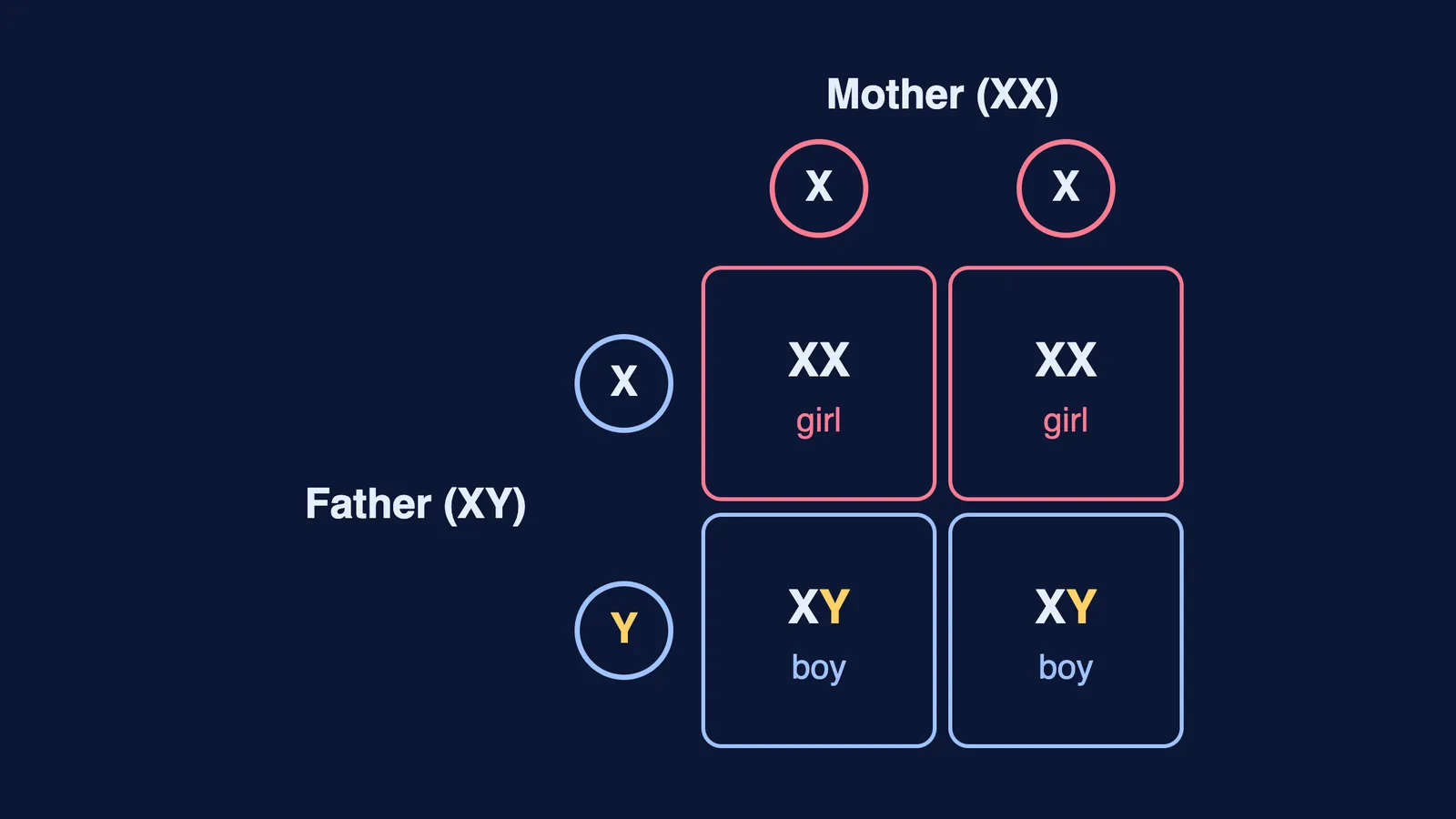
Q3 (easy). Assertion (A): In human beings, the sex of a child depends on the sex chromosome it gets from the father. Reason (R): Apart from the sex chromosomes, humans have 22 pairs of chromosomes, each with one maternal and one paternal copy.
Answer: (B). Both are true. But those 22 pairs are not sex chromosomes; A happens because the mother always passes on X and the father passes on X or Y.
Trap: choosing (A) because R is a correct line from the same paragraph.
Q4 (medium). Assertion (A): In snails, the sex of an individual is fixed by sex chromosomes at fertilisation. Reason (R): Individual snails can change their sex.
Answer: (D). A is false. NCERT gives snails as an example where sex is not genetically determined, because individuals can change sex. R is true.
Trap: assuming every animal uses the human XX/XY system. Some reptiles even use egg temperature.
Q5 (medium). Assertion (A): Each germ cell carries only one chromosome from each pair. Reason (R): Two germ cells fuse at fertilisation, and the offspring must end up with the normal two copies of each chromosome.
Answer: (A). Both are true, and R is the reason for A. Two germ cells combine at fertilisation, so each must carry a single set for the offspring to get back the normal two copies, keeping the species' DNA stable.
Trap: marking (B) because R talks about the offspring, not the germ cell.
Q6 (hard). Assertion (A): When a tall plant with round seeds is crossed with a short plant with wrinkled seeds, some F2 plants are tall with wrinkled seeds. Reason (R): Tallness and round seeds are dominant traits.
Answer: (B). Both are true. Dominance explains why every F1 plant is tall with round seeds. The new F2 combinations appear because the two traits are inherited independently.
Trap: a true, on-topic R that explains a different observation.
Statement I and Statement II questions on Heredity
Also checked against the NCERT Heredity chapter.
Q7 (medium). Statement I: A section of DNA that provides information for one protein is called a gene. Statement II: If the enzyme needed to make a plant growth hormone works efficiently, the plant is likely to be short.
Answer: (C). Statement I is the textbook definition of a gene. Statement II is reversed: an efficient enzyme makes more hormone and a tall plant.
Trap: matching "enzyme" with "short" without following the chain.
Q8 (medium). Statement I: Asexual reproduction produces as much variation as sexual reproduction. Statement II: Small differences among bacteria formed by division come from minor inaccuracies in DNA copying.
Answer: (D). Statement I is incorrect: sexual reproduction generates greater diversity. Statement II is correct.
Trap: treating "asexual reproduction produces some variation" as "the same amount".
Q9 (hard). Statement I: The mother decides the sex of a child, because every child receives an X chromosome from her. Statement II: A human germ cell carries both chromosomes of each pair.
Answer: (B). Statement I draws the wrong conclusion from a true fact: since the mother always gives X, the father's X or Y decides. Statement II is incorrect: a germ cell takes one chromosome from each pair.
Trap: accepting a whole statement because its first half is true.
Q10 (hard). A tall pea plant is self-pollinated, and about one quarter of its offspring are short. Statement I: The tall parent must have the gene pair Tt. Statement II: If this tall parent is crossed with a short plant, about half of the offspring will be short.
Answer: (A). A TT plant selfed gives only TT, so short offspring mean the parent carries t and is Tt (Tt selfed gives 1 TT : 2 Tt : 1 tt). Crossing Tt with tt gives 1 Tt : 1 tt, so about half are short.
Trap: assuming a tall plant must be TT.
How should you use this set?
Cover the answers and attempt all ten, writing one line of reasoning each.
For every miss, note which test failed: a false statement, or a true R that explained something else.
Redo only the missed items two days later.
Write two A-R items of your own, one with key (A) and one with key (B).
For a method that works across subjects, see how to approach assertion-reason questions. If dominance, gene pairs or sex chromosomes still feel shaky, the Fermi Concept Library gives each biology concept its own lesson and its place in the map. This chapter is also the base for Principles of Inheritance in the Class 12 board exam.