

On this page
Case-study questions give you a short real-life passage and ask several linked questions about it. On Electricity, almost every part comes down to Ohm's law, R = ρl/A, series and parallel rules, and P = VI.
What do Electricity case-study questions test?
In the CBSE Class 10 Science syllabus for 2026-27, Unit IV, Effects of Current, carries 13 of the 80 theory marks and covers Ohm's law, resistivity, series and parallel combinations, the heating effect and electric power, along with magnetic effects of current. Every fact below is checked against the NCERT Class 10 Electricity chapter (Reprint 2026-27). All three cases are new; the numbers are ours, not from NCERT or past papers. For the chapter itself, start with our Class 10 Electricity guide.
Case 1: Ananya's resistance coil
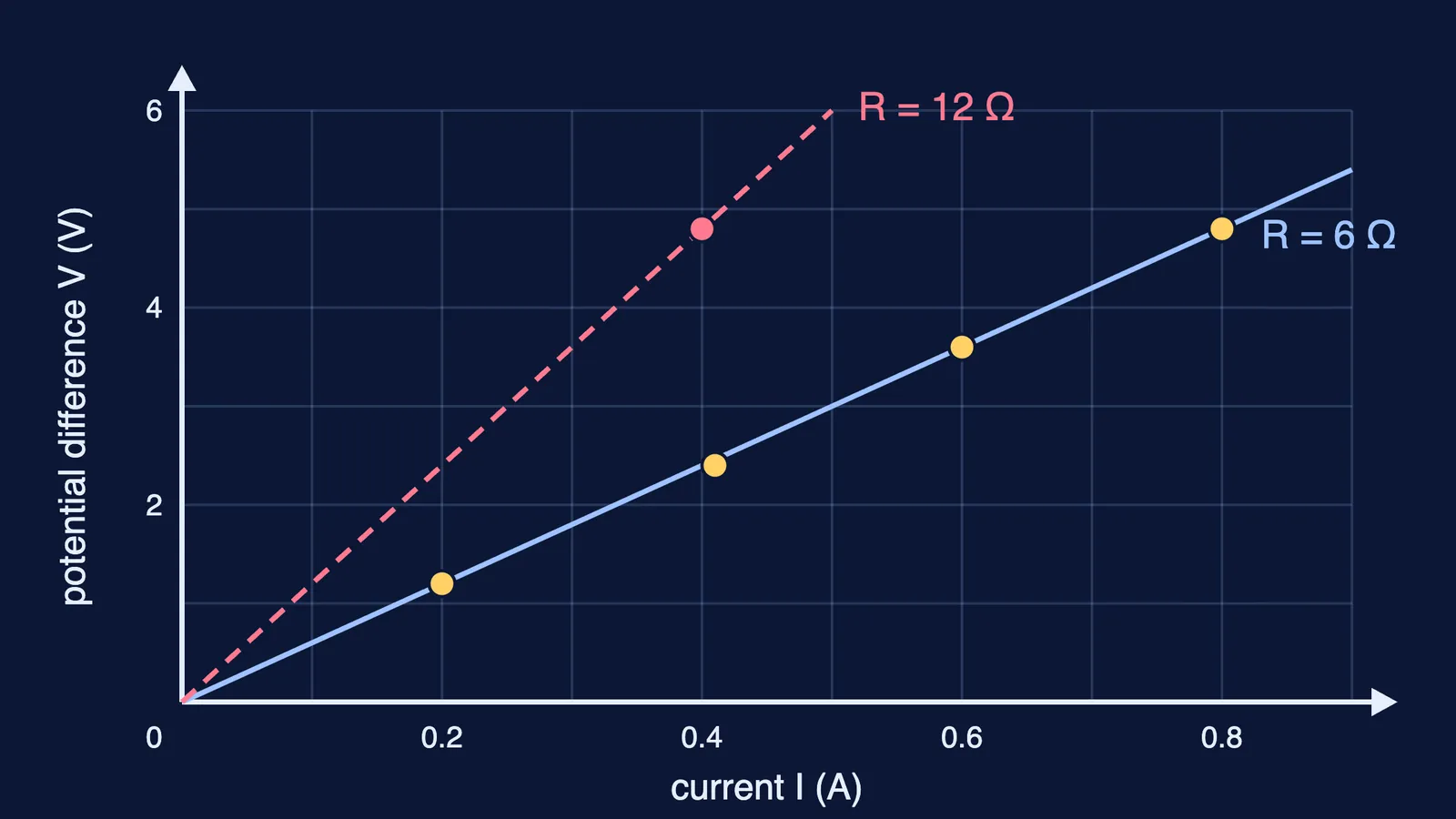
In her school lab in Bhopal, Ananya connects a coil of resistance wire, an ammeter, a plug key and a variable DC supply in series, with a voltmeter across the coil. She records four readings: 1.2 V and 0.20 A, 2.4 V and 0.41 A, 3.6 V and 0.60 A, and 4.8 V and 0.80 A. Her teacher reminds her to take the key out after every reading. Then the teacher hands her a second wire of the same material and length but half the cross-sectional area.
(i) The voltmeter is connected (a) in series with the coil (b) in parallel across the coil (c) in series with the ammeter only (d) anywhere in the circuit.
(ii) What is the resistance of the coil?
(iii) What current will the thinner wire draw at 4.8 V?
(iv) Why does the teacher want the key removed between readings?
Answers.
(i) (b). A voltmeter always goes in parallel across the part whose potential difference it measures.
(ii) V/I gives 6.0 Ω, 5.85 Ω, 6.0 Ω and 6.0 Ω, so R ≈ 6 Ω. On a V–I graph this is the slope of the straight line through the origin.
(iii) Since R ∝ 1/A, halving A doubles R to 12 Ω. I = 4.8/12 = 0.40 A, half the earlier current.
(iv) Current heats the wire. Ohm's law holds only while the temperature stays the same, so a warming coil would give a drifting V/I ratio.
Case 2: The Pune kitchen circuit
The Kulkarnis' kitchen in Pune has one 220 V circuit protected by a 10 A fuse. On it are a 2000 W induction cooktop and a 1500 W electric kettle. One morning both are switched on together and, within seconds, the fuse wire melts and the kitchen goes dark. The electrician says the fuse did its job.
(i) The cooktop and kettle are connected (a) in series, so they share 220 V (b) in parallel, so each gets 220 V (c) in series, so each gets 220 V (d) in parallel, so they share 220 V.
(ii) What current does the cooktop draw?
(iii) Find the resistance of the kettle's heating element.
(iv) Explain why the fuse melted.
Answers.
(i) (b). Household appliances are in parallel, so each gets the full supply voltage and can be switched on its own.
(ii) I = P/V = 2000/220 ≈ 9.09 A.
(iii) R = V²/P = 220²/1500 = 48400/1500 ≈ 32.3 Ω.
(iv) In parallel the currents add: (2000 + 1500)/220 ≈ 15.9 A, more than 10 A. The fuse is in series with the circuit, so this current heats its wire (H = I²Rt) until it melts and breaks the circuit. Never fit a thicker wire as a fix; ask an electrician.
Case 3: The cable to the borewell pump
A farmer near Nashik runs his borewell pump from a meter 45 m away using a two-core aluminium cable; each core has a cross-sectional area of 2.5 mm². Current goes out along one core and back along the other, so it travels through 90 m of wire. The pump draws 6.0 A and runs about 3 hours a day. NCERT's table gives aluminium a resistivity of 2.63 × 10⁻⁸ Ω m at 20°C.
(i) Cables are made of aluminium or copper rather than nichrome because these metals have (a) a high melting point (b) low resistivity (c) high resistivity (d) a shiny surface.
(ii) Calculate the resistance of the cable.
(iii) How much power is wasted as heat in the cable, and how much voltage is lost along it?
(iv) How much energy does the cable waste in 30 days, and what happens to the loss if he switches to 4 mm² aluminium cable?
Answers.
(i) (b). Low resistivity means low resistance, so less energy is lost as heat along the line.
(ii) R = ρl/A = (2.63 × 10⁻⁸ × 90)/(2.5 × 10⁻⁶) ≈ 0.95 Ω.
(iii) P = I²R = 6.0² × 0.9468 ≈ 34 W lost as heat. The drop is V = IR = 6.0 × 0.9468 ≈ 5.7 V, so the pump gets a little less than the supply voltage.
(iv) Energy = 34.08 W × 3 h × 30 = 3068 W h ≈ 3.1 kW h, about 3 units. With 4 mm², R falls to 2.5/4 of its value, about 0.59 Ω, and the loss to about 21 W at the same current.
How to attack case-study questions on Electricity?
Underline every number in the passage and write its unit beside it before reading the questions.
Decide series or parallel first. Series shares voltage and keeps current the same; parallel keeps voltage the same and adds currents.
Pick the power formula that uses what you are given: P = VI, P = I²R or P = V²/R.
For "what if" parts (thinner wire, longer cable, both appliances on), use ratios: R ∝ l and R ∝ 1/A save a full recalculation.
In explain parts, name the law (Ohm's law, Joule's law of heating) and link it to the case in one sentence.
Our guide on answering case-based questions in CBSE board exams covers timing and layout across subjects, and the Electricity assertion-reason set tests the same ideas in one-mark form.
If you keep slipping on the working, the Fermi Problem Library has worked problems with a step-by-step solver that explains the reasoning rather than printing an answer.


