

On this page
Assertion-reason questions ask two things: is each statement true, and does one cause the other?
How do assertion-reason questions work in Class 10 Science?
The CBSE Class 10 Science sample question paper for 2026-27 has 39 questions for 80 marks; four are one-mark assertion-reason items, one in Physics. In the CBSE 2026-27 syllabus, Unit IV, Effects of Current (Electricity and Magnetic effects), carries 13 of the 80 marks.
Keys for the assertion-reason items (CBSE's wording):
(A) Both A and R are true, and R is the correct explanation of A.
(B) Both A and R are true, and R is not the correct explanation of A.
(C) A is true but R is false.
(D) A is false but R is true.
Keys for the Statement I / II pairs:
(A) Both statements are correct.
(B) Both statements are incorrect.
(C) Statement I is correct, Statement II is incorrect.
(D) Statement I is incorrect, Statement II is correct.
Judge each statement alone first; only when both are true ask whether R explains A. Our assertion-reason question strategy guide covers that habit.
Assertion-reason questions on Electricity
Every item is checked against the NCERT Class 10 Electricity chapter (Reprint 2026-27). For the whole chapter, see our Electricity Class 10 chapter guide.
Q1 (easy). Assertion (A): When a nichrome wire alone is connected across a fixed 3 V supply, replacing it with one of equal cross-section but double length halves the current. Reason (R): The resistance of a uniform metallic conductor is directly proportional to its length.
Answer: (A). Both true. Double length means double resistance, so by I = V/R the current halves; R is the direct cause.
Trap: Thinking length changes nothing because the material is the same.
Q2 (easy). Assertion (A): In SI units, resistivity is measured in ohm metre (Ω m). Reason (R): A longer piece of the same copper wire has a higher resistivity.
Answer: (C). A is true. R is false: resistivity is a property of the material, so a longer wire has more resistance but the same resistivity.
Trap: Mixing up resistance with resistivity.
Q3 (medium). Assertion (A): Filaments of incandescent bulbs are made of tungsten. Reason (R): The resistivity of tungsten is lower than that of nichrome.
Answer: (B). Both true: NCERT lists tungsten at 5.20 × 10⁻⁸ Ω m and nichrome at 100 × 10⁻⁶ Ω m. But tungsten is chosen for its high melting point (3380°C), so it glows without melting.
Trap: Picking (A) because R is a true fact about tungsten.
Q4 (medium). Assertion (A): In a series combination, the largest resistor carries the smallest current. Reason (R): In a series combination, the total potential difference equals the sum of the potential differences across the individual resistors.
Answer: (D). A is false: in series the same current flows through every resistor. R is true; the largest resistor gets the largest share of voltage.
Trap: Carrying "more resistance, less current" from parallel into series.
Q5 (medium). Assertion (A): A 3 A fuse is not suitable for an 880 W electric kettle on a 220 V supply. Reason (R): The kettle normally draws 4 A, more than the fuse rating.
Answer: (A). Both true: I = P/V = 880/220 = 4 A. A fuse melts when current exceeds its rating, so a 3 A fuse would blow in normal use; R is why A holds.
Trap: Choosing the smallest fuse because "lower rating means safer".
Q6 (hard). Assertion (A): A 3 Ω resistor connected across a 6 V battery dissipates 12 W. Reason (R): The heat produced in a resistor is directly proportional to the time for which the current flows.
Answer: (B). Both true: P = V²/R = 36/3 = 12 W, and H = I²Rt makes heat proportional to time. But power is a rate; time does not decide it.
Trap: Treating any true line of Joule's law as the explanation.
Statement I and Statement II questions on Electricity
Decide each statement separately, using the NCERT chapter.
Q7 (medium). Statement I: The equivalent resistance of resistors joined in parallel is less than the smallest individual resistance. Statement II: Household appliances are connected in series so that each one gets the same current.
Answer: (C). Statement I is true, since 1/Rp exceeds each 1/R. Statement II is false: homes use parallel wiring so each appliance gets full voltage.
Trap: Attaching series-circuit "same current" to home wiring.
Q8 (medium). Statement I: Doubling the potential difference across a resistor doubles the heat produced in the same time. Statement II: If the current through a resistor is halved, the power dissipated becomes one-fourth.
Answer: (D). I is false: H = V²t/R, so doubling V gives four times the heat. II is true: P = I²R, so halving I gives 1/4 the power.
Trap: Forgetting the square on V.
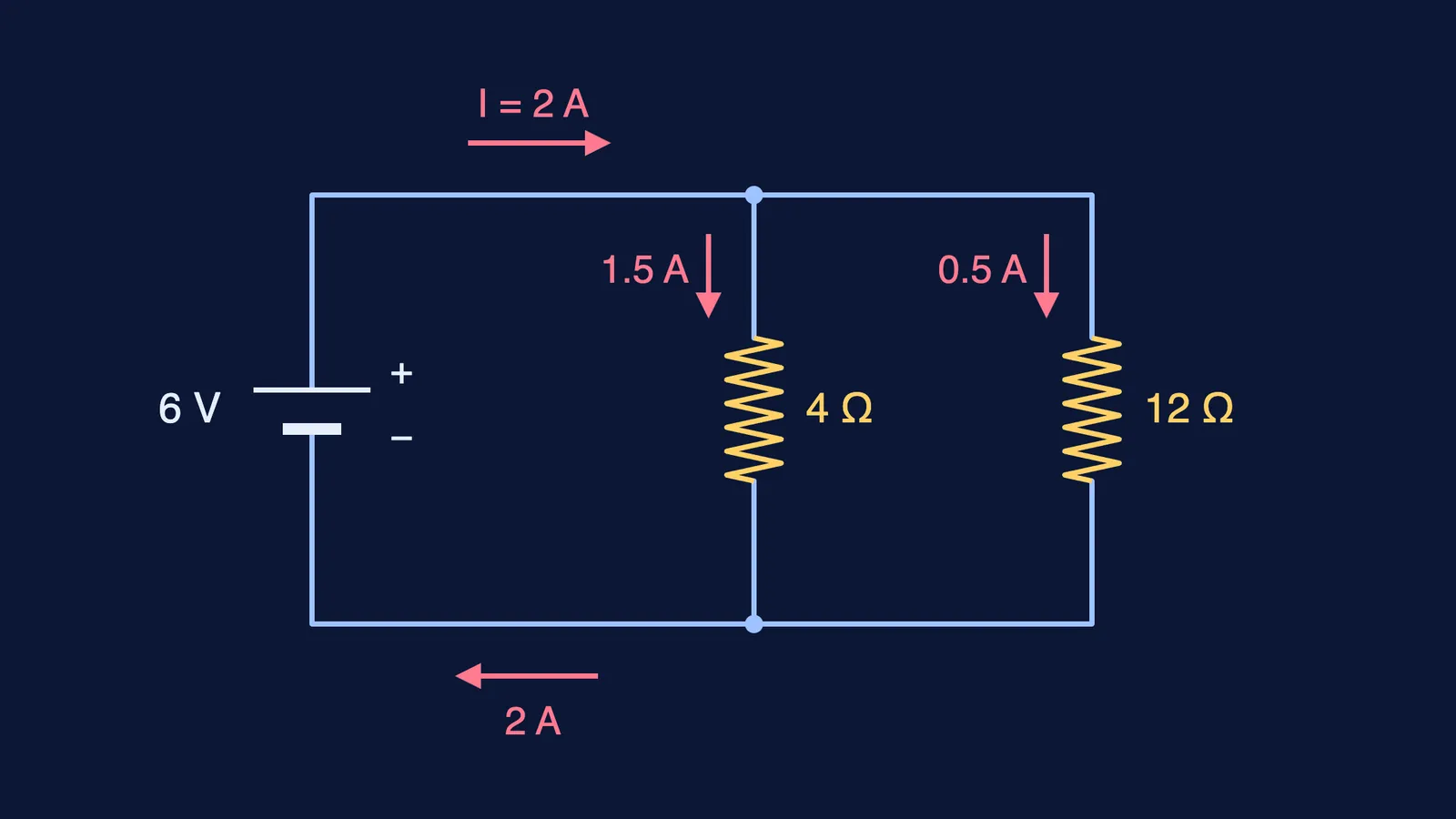
Q9 (hard). A 4 Ω and a 12 Ω resistor are connected in parallel across a 6 V battery. Statement I: The current through the 4 Ω resistor is 0.5 A. Statement II: The total current drawn from the battery is 0.375 A.
Answer: (B). Both false. Each resistor has the full 6 V, so the 4 Ω branch carries 6/4 = 1.5 A (0.5 A is the 12 Ω branch). Rp = 3 Ω, so the total is 2 A; 0.375 A comes from adding them in series.
Trap: Swapping branch currents or adding parallel resistances.
Q10 (hard). A 2 kW geyser runs for 30 minutes every day for 30 days. Statement I: It uses 30 units of electrical energy. Statement II: This energy equals 1.08 × 10⁸ J.
Answer: (A). Both correct. Energy = 2 kW × 0.5 h × 30 = 30 kW h = 30 units, and 30 × 3.6 × 10⁶ J = 1.08 × 10⁸ J.
Trap: Forgetting that one "unit" is one kilowatt hour.
How should you use this set before the board exam?
Attempt all ten, about a minute each, answers covered.
Tag each miss: wrong fact, wrong formula, or wrong link.
For each (B), write the real reason in one line.
Redo Q5, Q6, Q9 and Q10 on paper two days later.
If most misses are formula slips, the Fermi Problem Library has a step-by-step solver that explains the reasoning rather than printing an answer.
Later, the Class 12 current electricity assertion-reason set builds on these ideas.


