

On this page
Three new cases, each with four graded parts and worked answers. Every formula used is in NCERT Class 10 Mathematics, Chapter 7 Coordinate Geometry (Reprint 2026-27). To revise the chapter first, read our coordinate geometry Class 10 guide.
How are case-study questions set in CBSE Class 10 Maths?
The CBSE Class X Mathematics Standard sample question paper for 2026-27 has 3 case-study-based questions of 4 marks each, in Section E. Each has three sub-parts worth 1, 1 and 2 marks, with an internal choice in the 2-mark part; calculators are not allowed.
Ours carry four parts for extra practice; every number works by hand, checked in Python.
Case 1: Cones for a sports-day drill in Bhopal
A PE teacher in Bhopal lays out a drill, treating one corner of the ground as the origin, with the x-axis along the boundary wall and the y-axis along the side fence, and 1 unit = 1 m. Cones stand at A(4, 2), B(10, 10) and C(16, 2). Students sprint from A to B, then to C, then jog back along the ground from C to A. The first-aid table T is at (−4, 5), just outside the fence.
(i) How far is the first-aid table T from the y-axis? (a) 5 m (b) 4 m (c) −4 m (d) √41 m
(ii) Find the length of the sprint from A to B.
(iii) A water bottle sits halfway between A and B. Find its coordinates.
(iv) Show that triangle ABC is isosceles and find the length of one round A → B → C → A.
Answers.
(i) (b) Distance from the y-axis is the size of the x-coordinate: 4 m.
(ii) AB = √((10 − 4)² + (10 − 2)²) = √(36 + 64) = √100 = 10 m.
(iii) By the mid-point formula, ((4 + 10)/2, (2 + 10)/2) = (7, 6).
(iv) BC = √(6² + (−8)²) = 10 m = AB, so the triangle is isosceles. A and C share a y-coordinate, so AC = 16 − 4 = 12 m. One round is 10 + 10 + 12 = 32 m.
Case 2: A water pipeline outside Nagpur
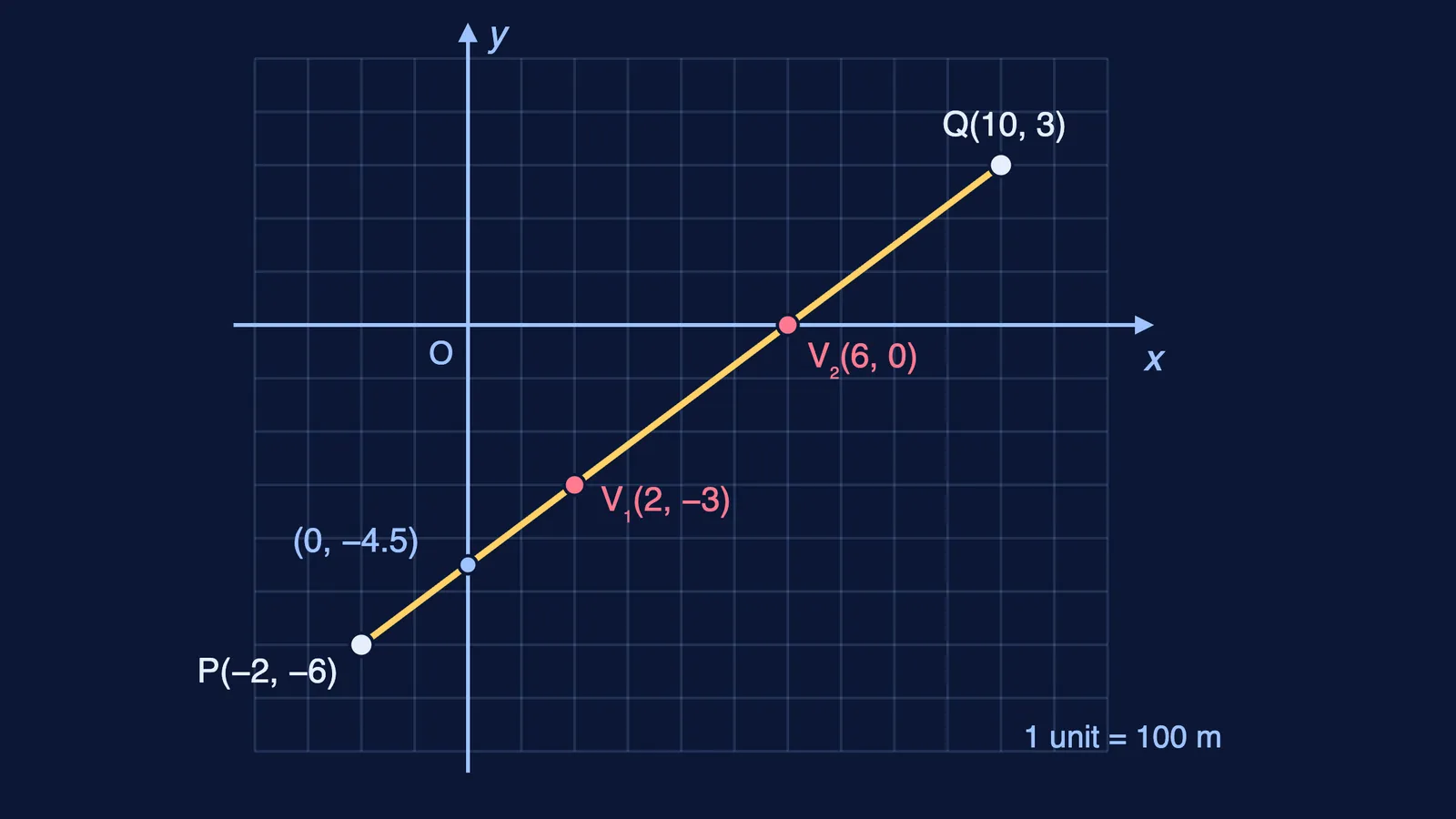
A municipal engineer near Nagpur plans a straight pipeline from a water tank at P(−2, −6) to a new housing colony at Q(10, 3). On her site map, 1 unit = 100 m. She wants two valves, V₁ and V₂, that split the pipeline into three equal lengths, with V₁ nearer the tank. A straight main road runs along the y-axis, and the pipe must pass under it, so the road crew needs to know exactly where to dig.
(i) The length of the pipeline is: (a) 1.5 km (b) 2.1 km (c) 0.9 km (d) 15 km
(ii) Find V₁.
(iii) Find V₂, and check it with the mid-point formula.
(iv) In what ratio does the main road (the y-axis) divide PQ? Find the point where the pipe crosses the road.
Answers.
(i) (a) PQ = √(12² + 9²) = √(144 + 81) = √225 = 15 units, and 15 × 100 m = 1,500 m = 1.5 km.
(ii) V₁ divides PQ in the ratio 1 : 2, so V₁ = ((1 × 10 + 2 × (−2))/3, (1 × 3 + 2 × (−6))/3) = (6/3, −9/3) = (2, −3).
(iii) Ratio 2 : 1 gives ((20 − 2)/3, (6 − 6)/3) = (6, 0). Check: the mid-point of V₁Q is ((2 + 10)/2, (−3 + 3)/2) = (6, 0).
(iv) Take the ratio k : 1. On the y-axis x = 0, so (10k − 2)/(k + 1) = 0 and k = 1/5: the ratio is 1 : 5. The y-coordinate is (3k − 6)/(k + 1) = (3/5 − 6)/(6/5) = −27/6 = −4.5, so the pipe crosses at (0, −4.5), 250 m from the tank.
Case 3: Fencing a garden plot in Mysuru
A family in Mysuru buys a four-sided garden plot. A surveyor marks three corners at A(4, 1), B(10, 3) and C(12, 9), in metres from a fixed post. The sale deed says the plot ABCD is a parallelogram, but the stone at the fourth corner D is missing. The family wants to find D, confirm the exact shape of the plot, and work out its area before ordering fencing and grass for the lawn. The surveyor's grid uses the same scale on both axes.
(i) Which property helps you find D? A parallelogram's diagonals (a) are equal (b) bisect each other (c) are perpendicular (d) are parallel
(ii) Find the mid-point of the diagonal AC.
(iii) Find the coordinates of the missing corner D.
(iv) Show that the plot is a rhombus but not a square, and find its area using area of a rhombus = ½ × product of its diagonals.
Answers.
(i) (b) So AC and BD share a mid-point.
(ii) M = ((4 + 12)/2, (1 + 9)/2) = (8, 5).
(iii) M is also the mid-point of BD: (10 + x)/2 = 8 and (3 + y)/2 = 5, so D = (6, 7).
(iv) AB = √(36 + 4), BC = √(4 + 36), CD = √(36 + 4) and DA = √(4 + 36) all equal √40 m, so it is a rhombus. The diagonals AC = √128 = 8√2 m and BD = √32 = 4√2 m are unequal, so it is not a square. Area = ½ × 8√2 × 4√2 = ½ × 64 = 32 m².
How do you attack coordinate geometry case-study questions?
Plot every point on rough axes before calculating; the sketch catches sign slips.
Convert map units (1 unit = 100 m) at the end, and write units on every answer.
Before using the section formula, say which end each ratio number goes with.
Where a segment meets an axis, take the ratio k : 1 and set x = 0 on the y-axis, or y = 0 on the x-axis.
Equal sides make a rhombus; a square also needs equal diagonals.
For one-mark practice, try our coordinate geometry assertion-reason questions, or read how to handle case-based questions in board exams. If the method is right but the number keeps going wrong, the Fermi Problem Library has worked problems with a step-by-step solver that explains the reasoning rather than printing an answer.


