

On this page
Three original cases, easy to hard, with worked answers. Shaky on the theorems? Read our Circles Class 10 guide to tangent theorems first.
What do case-study questions on Circles look like?
The CBSE Class 10 Maths (Standard) sample paper for 2026-27 has three case study-based questions of 4 marks each in Section E, each split into parts (i), (ii) and (iii) worth 1, 1 and 2 marks, and calculators are not allowed. Our cases carry four parts each for extra practice, and every number works out by hand.
Each case stays inside the CBSE 2026-27 Maths syllabus and the rationalised NCERT Class 10 Chapter 10, Circles (Reprint 2026-27), which rest on two theorems. Theorem 10.1: the tangent at any point of a circle is perpendicular to the radius through the point of contact. Theorem 10.2: the lengths of tangents drawn from an external point to a circle are equal.
Case 1: The Diwali rangoli
For Diwali, Tanvi draws a circular rangoli of radius 35 cm on her courtyard floor in Jaipur, with centre O. She places a diya at a point Q on the floor, 37 cm from O. To frame the design, she stretches a gold thread from the diya so that it just touches the rim of the rangoli at T, and tapes it down. Her cousin stretches a second thread from the diya, touching the rim at S. The threads and the radii OT and OS mark out a kite-shaped patch, which they fill with marigold petals.
(i) The angle OTQ is: (a) 45° (b) 60° (c) 90° (d) 180°
(ii) How many straight threads from Q can touch the rim of the rangoli at exactly one point?
(iii) How long is the thread QT?
(iv) Find the perimeter and the area of the petal patch OTQS.
Answers.
(i) (c). QT is a tangent and OT the radius at the point of contact, so they meet at 90° (Theorem 10.1).
(ii) Two: exactly two tangents can be drawn from a point outside a circle.
(iii) In right triangle OTQ, QT = √(37² − 35²) = √(1369 − 1225) = √144 = 12 cm.
(iv) QS = QT = 12 cm (Theorem 10.2), so the perimeter is 35 + 12 + 12 + 35 = 94 cm. Its area, two congruent right triangles, is 2 × ½ × 35 × 12 = 420 cm².
Case 2: The Chandigarh roundabout
Two straight roads leave a junction J in Chandigarh and each one just touches the edge of a circular roundabout, at A and B. The roundabout's centre is O, where a lamp post stands. An intern measures the angle between the roads at J as 72° and finds JA = 45 m. The traffic police want a straight pedestrian crossing painted from A to B, so she needs the angles that line makes with the roads and with the radii OA and OB.
(i) The length JB is: (a) 22.5 m (b) 45 m (c) 90 m (d) it cannot be found
(ii) Find ∠AOB.
(iii) Find ∠JAB.
(iv) Find ∠OAB, and show how it relates to the angle between the roads.
Answers.
(i) (b). Tangents from the external point J are equal, so JB = JA = 45 m.
(ii) In quadrilateral JAOB, ∠JAO = ∠JBO = 90°, so ∠AOB = 360° − 90° − 90° − 72° = 108°.
(iii) JA = JB, so triangle JAB is isosceles: ∠JAB = (180° − 72°) ÷ 2 = 54°.
(iv) ∠OAB = ∠JAO − ∠JAB = 90° − 54° = 36°, exactly half of 72°, as in NCERT Example 2: the angle between the tangents is twice ∠OAB.
Case 3: The fountain in the park
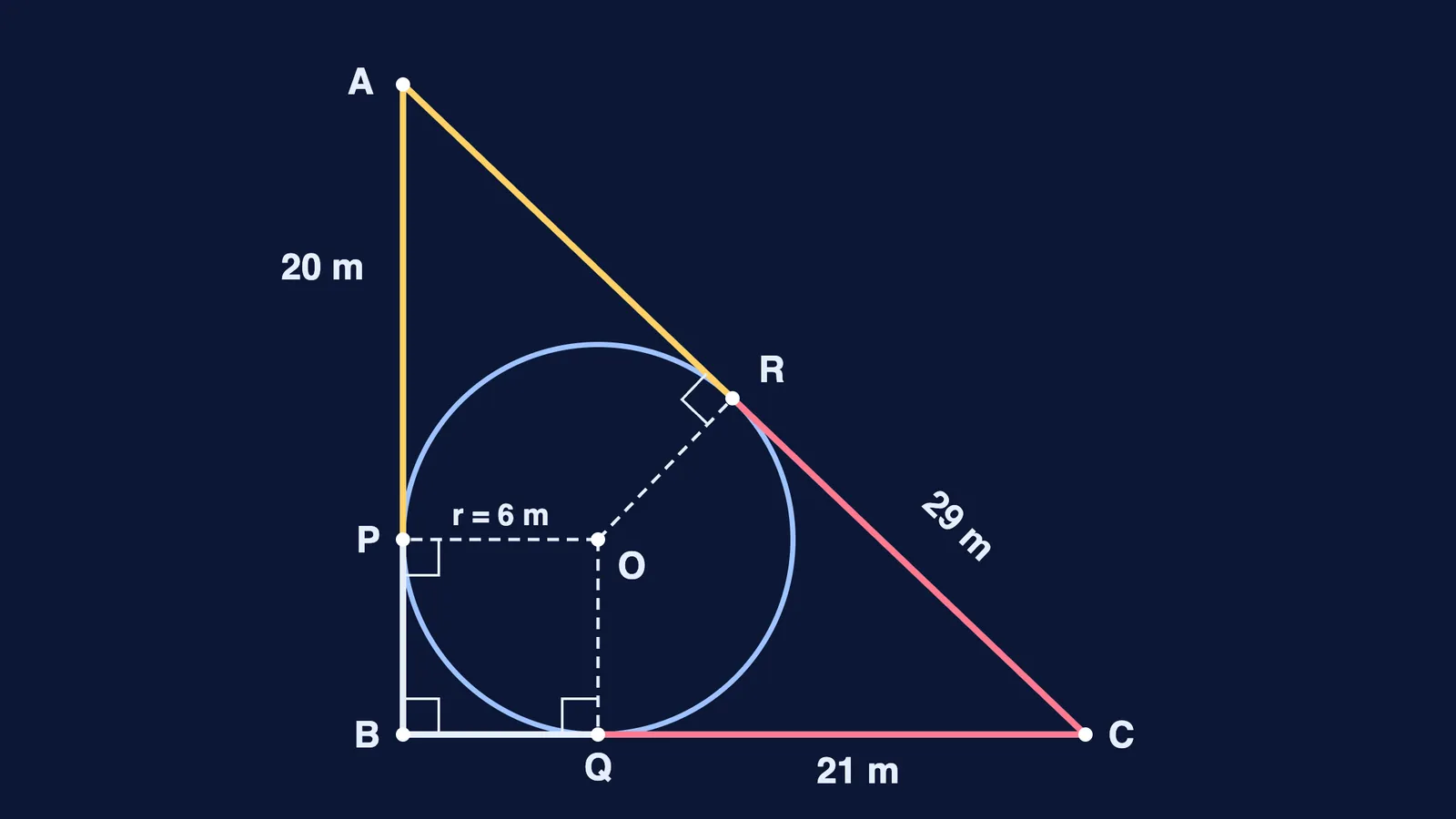
A housing society in Pune lays out a triangular lawn ABC, right-angled at B, with AB = 20 m and BC = 21 m. A circular fountain basin with centre O is built so that its rim touches all three edges: AB at P, BC at Q and the long edge CA at R. The landscaper needs the radius r before ordering stone, and the length of edging from A to R for a strip of flowering plants, using only a tape measure and the plan.
(i) The length of CA is: (a) 25 m (b) 29 m (c) 31 m (d) 41 m
(ii) Why is BPOQ a square?
(iii) Use equal tangents to find r.
(iv) How long is AR, and how can you check your answers?
Answers.
(i) (b). CA = √(20² + 21²) = √(400 + 441) = √841 = 29 m.
(ii) ∠B = 90°, and ∠OPB = ∠OQB = 90° because each radius meets a tangent at right angles, so BPOQ has four right angles. Its adjacent sides OP and OQ are both radii, so it is a square of side r, and BP = BQ = r.
(iii) Since BP = BQ = r, AP = 20 − r and CQ = 21 − r. Equal tangents give AR = AP and CR = CQ, so CA = (20 − r) + (21 − r) = 41 − 2r = 29, and r = 6 m.
(iv) AR = AP = 20 − 6 = 14 m, and CR = 21 − 6 = 15 m; 14 + 15 = 29 m checks. Area checks too: ½ × 20 × 21 = 210 m², and the three triangles OAB, OBC and OCA give ½ × 6 × (20 + 21 + 29) = 210 m².
How do you attack case-study questions on Circles?
Redraw the figure and mark every point of contact first.
Join the centre to each point of contact and mark 90°; most parts follow from that.
Where two tangents leave one point, mark them equal and label lengths with one unknown.
Write the theorem beside each step: tangent ⊥ radius, or equal tangents.
Check lengths a second way, by Pythagoras or an area sum.
See our guide to case-based questions in board exams and the Circles assertion-reason set for Class 10. If a step keeps slipping, the Fermi Problem Library has worked problems with a step-by-step solver that explains the reasoning rather than printing an answer.


