On this page
A case-study question gives you a short real-world passage and asks linked questions about it. In this set, each case has four. The chemistry is the same as in Chapter 1 of the NCERT Class 10 Science textbook; the skill is spotting which idea the story is testing. Below are three original cases, easiest first, with worked answers. For the chapter itself, start with our guide to chemical reactions and equations for Class 10.
Case 1: Why did the farmer's iron bucket turn brown inside?
Savita grows vegetables near Nashik. One evening she mixes 10 litres of a blue copper sulphate spray in an old iron bucket and leaves it overnight. Next morning, about 12 hours later, the solution has turned pale green and the inside of the bucket has a reddish-brown coating. Her neighbour kept the same spray in a plastic drum for two days, and it is still blue. Savita scrapes off some of the coating; it is soft, reddish-brown and metallic. She wonders whether the bucket has rusted or whether something has come out of the spray.
(i) The reaction in the iron bucket is a: (a) combination reaction (b) decomposition reaction (c) displacement reaction (d) double displacement reaction.
(ii) Name the reddish-brown coating.
(iii) Write the balanced equation, with state symbols, for the reaction in the bucket.
(iv) Explain why the colour changed in the iron bucket but not in the plastic drum.
Answers.
(i) (c) displacement reaction.
(ii) Copper metal, pushed out of the copper sulphate.
(iii) Fe(s) + CuSO4(aq) → FeSO4(aq) + Cu(s). Each side has 1 Fe, 1 Cu, 1 S and 4 O.
(iv) Iron is more reactive than copper, so it displaces copper from copper sulphate. As blue copper sulphate is used up, iron sulphate forms and the solution turns pale green. Plastic does not react, so the spray stays blue. The coating is not rust; it came out of the solution.
Case 2: Where does the limestone's mass go in a lime kiln?
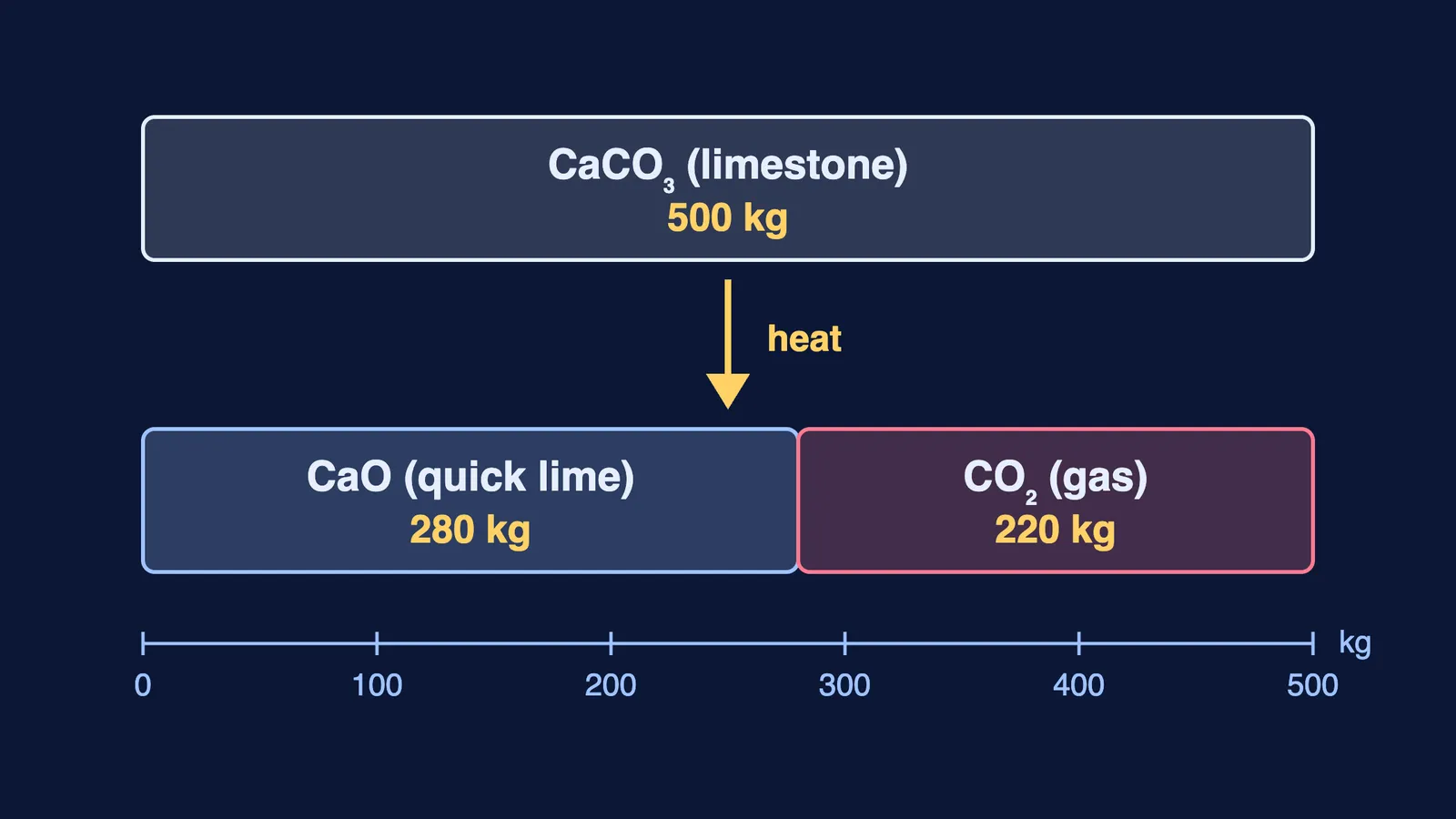
A small lime kiln in Rajasthan burns fuel day and night to keep its chamber very hot. One batch of 500 kg of pure limestone (calcium carbonate) comes out as 280 kg of white quick lime. A gas escapes from the chimney the whole time. A building contractor buys some of the quick lime for whitewashing. When his worker adds it to water in a steel drum, the water hisses and the drum becomes too hot to touch. After the walls are painted, they look dull at first and develop a shiny finish over the next two to three days.
(i) Heating limestone in the kiln is an example of: (a) combination (b) thermal decomposition (c) displacement (d) precipitation.
(ii) Is the reaction in the kiln exothermic or endothermic?
(iii) What mass of gas left the chimney from the 500 kg batch? Name the gas.
(iv) Classify the reaction in the drum in two ways, and find the mass of slaked lime formed if 56 kg of quick lime combines with exactly 18 kg of water.
Answers.
(i) (b) thermal decomposition: CaCO3(s) → CaO(s) + CO2(g) on heating.
(ii) Endothermic. The fuel supplies the heat that breaks calcium carbonate down.
(iii) Mass is conserved, so the gas = 500 kg − 280 kg = 220 kg of carbon dioxide.
(iv) CaO(s) + H2O(l) → Ca(OH)2(aq) + heat is a combination reaction (one product from two reactants) and exothermic (heat released). Mass of calcium hydroxide = 56 kg + 18 kg = 74 kg. The later shine comes from calcium hydroxide reacting with carbon dioxide in air to form calcium carbonate on the wall.
Case 3: Can oxidised copper be turned back into copper?
A chemist at a wire-recycling unit tests how much copper can be recovered from blackened scrap. She weighs 2.54 g of clean copper wire clippings into a crucible and heats them strongly in air until no brown is left. The product is a black powder weighing 3.18 g. She then heats this black powder in a tube while passing dry hydrogen gas over it. The powder slowly turns brown again, droplets of a colourless liquid collect on the cooler part of the tube, and the final solid weighs 2.54 g. Exactly 0.08 g of hydrogen reacted.
(i) The black powder is: (a) copper sulphate (b) copper(II) oxide (c) copper carbonate (d) copper chloride.
(ii) In the second step, which substance is reduced?
(iii) What mass of oxygen combined with the copper in the first step?
(iv) Find the mass of the colourless liquid formed in the second step, write balanced equations for both steps, and explain why the second step is called a redox reaction.
Answers.
(i) (b) copper(II) oxide.
(ii) Copper(II) oxide is reduced, because it loses oxygen.
(iii) Oxygen gained = 3.18 g − 2.54 g = 0.64 g.
(iv) Step 1: 2Cu + O2 → 2CuO. Step 2: CuO + H2 → Cu + H2O. By conservation of mass, water = (3.18 g + 0.08 g) − 2.54 g = 0.72 g. Step 2 is redox because one reactant is reduced (CuO loses oxygen) while another is oxidised at the same time (hydrogen gains oxygen to become water). A common slip: copper in step 1 gains oxygen, so it is oxidised, not reduced.
How to attack case-study questions
Underline every observation word in the passage: colour change, gas, heat, precipitate. Each one maps to a reaction type or an energy change from the chapter.
Write the balanced equation before answering anything else. Most sub-parts, including the numeric one, read straight off it.
For oxidation and reduction, track oxygen and hydrogen for each substance separately; never label a whole reaction "oxidised".
For numeric parts, use conservation of mass: add what went in, subtract what you know came out.
Keep "exothermic" and "endothermic" tied to evidence in the story, such as a hot drum or a kiln that needs constant fuel.
For more on how these questions are built across subjects, read our explainer on case-based questions in board exams, and practise the next chapter with our Class 10 acids, bases and salts guide. If an equation still will not balance after these steps, the Fermi Problem Library has worked problems with a step-by-step solver that explains the reasoning rather than printing an answer.