On this page
Three original cases follow, easiest first, with worked answers.
What do case-study questions on carbon compounds look like?
The CBSE Class 10 Science sample paper for 2026-27 has 39 questions in three sections, and Section B is Chemistry. Its chemistry section includes a 4-mark question built on an experiment passage (Q28), with two short parts and a choice between two longer ones. The chapter is in the CBSE 2026-27 Class 10 Science syllabus and is Chapter 4 of the NCERT Class 10 Science textbook (Reprint 2026-27); every fact below matches that text. The scenarios and numbers are our own (C = 12, H = 1, O = 16, Na = 23).
Case 1: Why is the kadhai turning black?
In a Lucknow kitchen, the bottom of the family kadhai keeps turning black, and the gas stove burns with a yellow, smoky flame instead of the usual blue one. A mechanic cleans the blocked air holes, and the flame turns clean blue again. Next door, charcoal in an angithi glows red and gives out heat without any flame. The family car runs on CNG and uses about 3.2 kg of fuel on a typical day. Take CNG as pure methane, burning completely.
(i) A blackened vessel bottom means: (a) the gas contains sulphur (b) the air holes are blocked and fuel is being wasted (c) the flame is too hot (d) the fuel is saturated
(ii) Write the balanced equation for the complete combustion of methane.
(iii) Why does the stove give a flame while the glowing charcoal does not?
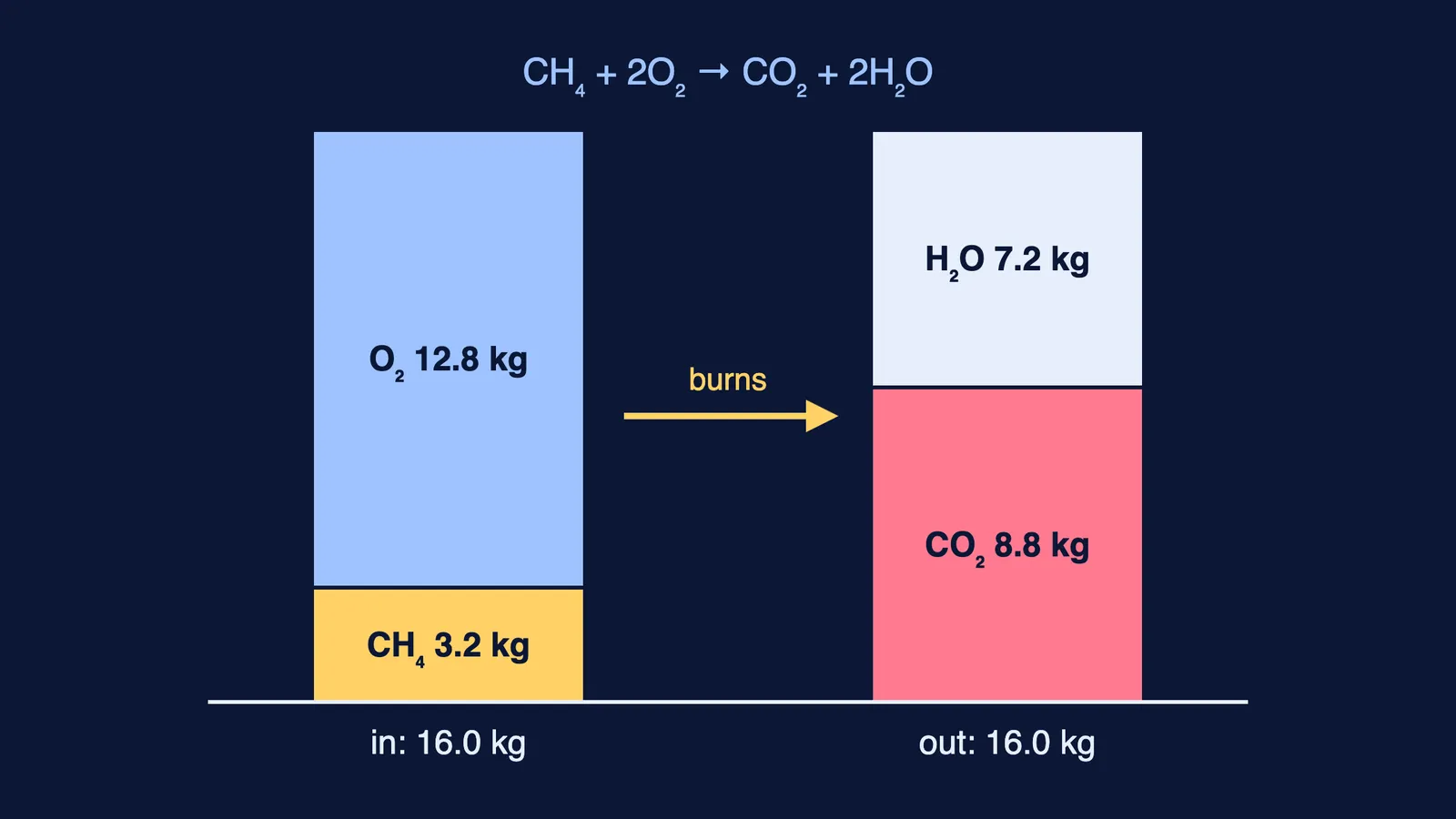
(iv) Find the mass of oxygen used and of carbon dioxide formed when the car burns its 3.2 kg of methane.
Answers.
(i) (b). With too little air, fuel burns incompletely, giving a sooty flame and soot on the vessel.
(ii) CH₄ + 2O₂ → CO₂ + 2H₂O, with heat and light released.
(iii) A flame is produced only when gaseous substances burn. The stove burns gas; the charcoal's volatile substances have already burnt off, so it just glows.
(iv) By the equation, 16 parts of methane by mass use 64 of oxygen and give 44 of carbon dioxide. Oxygen: 3.2 × 64 ÷ 16 = 12.8 kg. Carbon dioxide: 3.2 × 44 ÷ 16 = 8.8 kg.
Case 2: Which bottle is which?
A lab assistant in Bengaluru finds four bottles whose labels have peeled off. The stock register lists their condensed formulas only: P is CH₃CH₂CH₂OH, Q is CH₃CH₂CHO, R is CH₃COCH₃ and S is CH₃CH₂CH₂CH₂OH. Her student helper, Kavya, says two of the bottles must be the same compound because they have the same molecular formula. The assistant also notices that S boils at a higher temperature than P.
(i) The functional group in R is: (a) alcohol (b) aldehyde (c) ketone (d) carboxylic acid
(ii) Name the compounds in bottles Q and R.
(iii) P and S belong to one homologous series. Find the difference in their molecular masses and say why S boils higher.
(iv) Is Kavya right? Explain which bottles share a formula and what they are called.
Answers.
(i) (c). The C=O group sits between two carbon atoms, so R is a ketone.
(ii) Q is propanal (suffix -al) and R is propanone (suffix -one).
(iii) P (C₃H₈O) is 60 u and S (C₄H₁₀O) is 74 u, a difference of 14 u, one -CH₂- unit. Melting and boiling points increase with molecular mass along a homologous series.
(iv) No. Q and R are both C₃H₆O (58 u) but have different structures, so they are structural isomers, not the same compound. P is C₃H₈O, so it is not an isomer of either.
Case 3: How much gas does the vinegar give off?
Meera's family in Nagpur makes pickles. Their vinegar label says 6.0% acetic acid by mass. For a science project she takes 20.0 g of this vinegar, adds baking soda (sodium hydrogencarbonate) a little at a time until the fizzing stops, and bubbles the gas through lime water. She also tests the vinegar and a dilute hydrochloric acid of the same concentration with universal indicator. In January, an uncle reports that a sealed bottle of pure ethanoic acid in their Shimla storeroom, where the thermometer reads 12 °C, has turned solid.
(i) The gas that turns lime water milky here is: (a) hydrogen (b) oxygen (c) carbon dioxide (d) chlorine
(ii) Why is the pure ethanoic acid solid in the storeroom?
(iii) Which sample shows the lower pH on universal indicator, and why?
(iv) Write the equation, then find the minimum mass of baking soda used and the mass of gas released.
Answers.
(i) (c). Ethanoic acid reacts with hydrogencarbonates to give a salt, carbon dioxide and water.
(ii) Pure ethanoic acid melts at 290 K (17 °C). The storeroom is at 285 K, below that, so it freezes, which is why it is called glacial acetic acid.
(iii) Hydrochloric acid. It is completely ionised, while ethanoic acid, a carboxylic acid, is a weak acid.
(iv) CH₃COOH + NaHCO₃ → CH₃COONa + H₂O + CO₂. Acid: 6.0% of 20.0 g = 1.20 g. Masses react as 60 : 84 : 44, so baking soda = 1.20 × 84 ÷ 60 = 1.68 g and carbon dioxide = 1.20 × 44 ÷ 60 = 0.880 g.
How to attack case-study questions
Name the reaction type first. The observation in the passage (soot, fizzing, a smell) usually tells you which.
Write the balanced equation before any number. Every numerical here is one mass ratio from that equation.
Convert temperatures to kelvin. NCERT gives melting and boiling points in K, so compare like with like.
Count carbons, then read the ending. -ol, -al, -one, -oic acid, -ene and -yne decide the name; the same formula with a different structure means isomers.
Use the textbook's words. "Incomplete combustion", "weak acid" and "same functional group" earn marks.
If a numerical went wrong, the Fermi Problem Library has worked problems with a step-by-step solver that explains the reasoning rather than printing an answer. For where these questions sit in the paper, read our CBSE Class 10 Science paper strategy, then see how to answer case-based questions in board exams and try the Carbon and its Compounds assertion-reason questions.