On this page
Three original cases, easy to hard. Formulas first? Read our arithmetic progressions Class 10 guide.
What do case-study questions on arithmetic progressions look like?
The CBSE 2026-27 Class 10 Mathematics Standard sample paper has three case study-based questions of 4 marks each in Section E, and calculators are not allowed. Each has three parts, of 1, 1 and 2 marks; ours have four parts for extra practice, and every number works out by hand.
The cases stay inside the CBSE 2026-27 Class 10 Mathematics syllabus. You need two results from the NCERT chapter on arithmetic progressions: an = a + (n − 1)d, and Sn = (n/2)[2a + (n − 1)d] = (n/2)(a + l), where l is the last term.
Case 1: The school amphitheatre
A school in Jaipur is building an open-air amphitheatre for its annual day. The architect's plan has 15 curved rows of fixed seats. The front row, nearest the stage, has 18 seats, and every row behind it has 3 more seats than the row in front, so the rows hold 18, 21, 24, ... seats. The principal expects 400 guests. Guests will be seated from the front, and a row is opened only when every row in front of it is full.
(i) The number of seats in the 6th row is: (a) 30 (b) 33 (c) 36 (d) 21
(ii) Which row has 54 seats?
(iii) How many seats does the amphitheatre have in all?
(iv) What is the least number of rows needed for 400 guests, and how many seats stay empty in the last row opened?
Answers.
(i) (b). a6 = 18 + 5 × 3 = 33.
(ii) 18 + (n − 1) × 3 = 54 gives n − 1 = 12, so row 13.
(iii) The back row has 18 + 14 × 3 = 60 seats, so S15 = (15/2)(18 + 60) = 15 × 39 = 585 seats.
(iv) S11 = (11/2)(36 + 30) = 363, short of 400; S12 = 6(36 + 33) = 414. So 12 rows. Row 12 has 51 seats and takes 400 − 363 = 37 guests, leaving 14 empty.
Case 2: Training for a 10 km run
Meera, a Class 10 student in Bengaluru, is training for a 10 km run in the winter. On her coach's advice she runs every morning and adds the same distance to each day's run. Her fitness app shows 3.1 km on day 4 and 4.9 km on day 10. She plans to keep adding the same amount until a single morning's run is exactly 10 km, then rest before the race. Her father wants her total by then.
(i) If a is the day-1 distance and d the daily increase, which pair of equations fits? (a) a + 4d = 3.1, a + 10d = 4.9 (b) a + 3d = 3.1, a + 9d = 4.9 (c) 4a + d = 3.1, 10a + d = 4.9 (d) a + 3d = 4.9, a + 9d = 3.1
(ii) How far did she run on day 1, and how much does she add each day?
(iii) On which day does she run exactly 10 km?
(iv) What total distance does she run from day 1 to that day?
Answers.
(i) (b). Day n is n − 1 steps of d after day 1.
(ii) Subtracting the equations gives 6d = 1.8, so d = 0.3 km. Then a = 3.1 − 3 × 0.3 = 2.2 km.
(iii) 2.2 + 0.3(n − 1) = 10 gives 0.3(n − 1) = 7.8, so n − 1 = 26: day 27.
(iv) S27 = (27/2)(2.2 + 10) = 27 × 6.1 = 164.7 km.
Case 3: Paying back a supplier
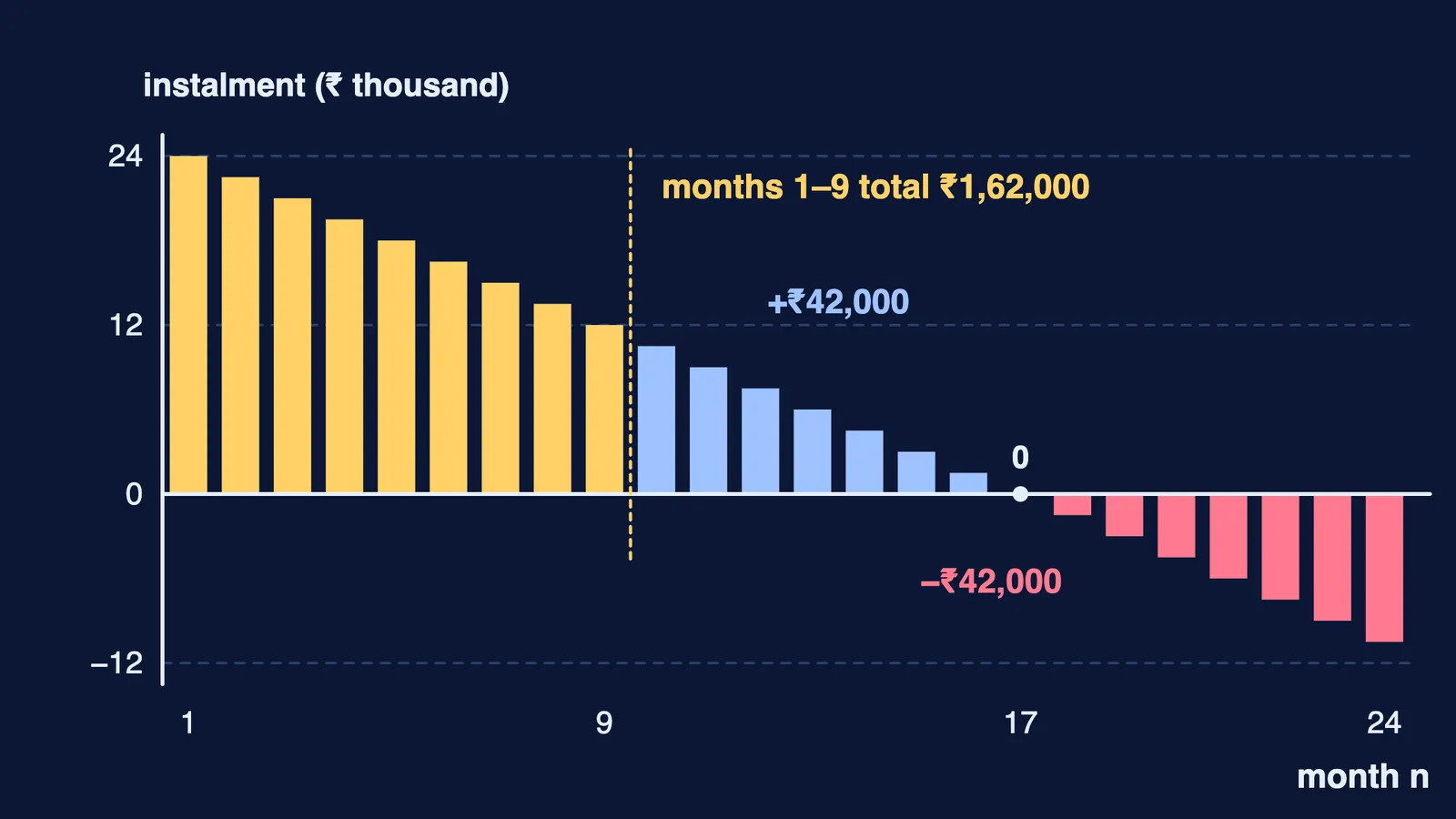
A furniture workshop in Kochi owes a timber supplier ₹1,62,000. The supplier charges no interest and agrees to monthly instalments: ₹24,000 in the first month, with each later instalment ₹1,500 less than the one before. The workshop's accountant works out the month in which the debt is cleared. Her equation for the number of months gives two answers, and she must decide which one makes sense for real payments.
(i) The instalments form an AP with common difference: (a) ₹1,500 (b) −₹1,500 (c) ₹24,000 (d) −₹24,000
(ii) How much is the 5th instalment?
(iii) In how many months is the debt cleared? Explain why one root of your equation is rejected.
(iv) The supplier now wants the debt cleared in exactly 12 months, still with each instalment ₹1,500 less than the one before. What should the first and last instalments be?
Answers.
(i) (b).
(ii) a5 = 24,000 + 4 × (−1,500) = ₹18,000.
(iii) (n/2)[48,000 − 1,500(n − 1)] = 1,62,000 gives n(49,500 − 1,500n) = 3,24,000. Dividing by 1,500, n(33 − n) = 216, so n² − 33n + 216 = 0 and (n − 9)(n − 24) = 0. For n = 24 the 24th instalment would be 24,000 − 23 × 1,500 = −₹10,500, money flowing back to the workshop, so reject it. The debt is cleared in 9 months, with a last instalment of ₹12,000; check: (9/2)(24,000 + 12,000) = 1,62,000.
(iv) Let the first instalment be x. S12 = 6[2x − 11 × 1,500] = 1,62,000, so 2x − 16,500 = 27,000 and x = ₹21,750. The last is 21,750 − 11 × 1,500 = ₹5,250.
How should you attack AP case-study questions?
Write a, d and n with units first; d is the next term minus the previous one, negative when values fall.
Turn "the 6th row" or "on day 10" into a + (n − 1)d, and "in all", "total" or "altogether" into Sn.
When two terms are given, write two equations and subtract them to get d first.
If n comes from a quadratic, test each root: n must be a positive whole number and every term must make sense.
When a target sum is crossed rather than hit, work out S for the two neighbouring n and say which the question wants.
See our guide to case-based questions in board exams and the assertion-reason set on arithmetic progressions. If a step keeps slipping, the Fermi Problem Library has worked problems with a step-by-step solver that explains the reasoning rather than printing an answer.