

On this page
Here are 10 original questions on arithmetic progressions, easy to hard, each with the answer, a short explanation and its trap. They stay inside the CBSE 2026-27 Class 10 Mathematics syllabus, which covers the nth term and the sum of n terms of an AP. Need the concepts first? Read our arithmetic progressions Class 10 guide.
How do you answer assertion-reason questions on APs?
For assertion-reason (Q1 to Q6):
(A) Both A and R are true and R is the correct explanation of A.
(B) Both A and R are true but R is NOT the correct explanation of A.
(C) A is true but R is false.
(D) A is false but R is true.
For Statement I and Statement II (Q7 to Q10):
(A) Both statements are correct.
(B) Both statements are incorrect.
(C) Statement I is correct, Statement II is incorrect.
(D) Statement I is incorrect, Statement II is correct.
Check A alone, then R alone; only if both are true, ask whether R is the reason A holds. Here most checks are quick sums, so write the numbers down.
In the NCERT Class 10 chapter on arithmetic progressions, each term after the first is the previous term plus a fixed common difference d, which can be positive, negative or zero. The same chapter gives an = a + (n – 1)d, Sn = (n/2)[2a + (n – 1)d] and an = Sn – Sn–1.
Assertion-reason questions on arithmetic progressions
Q1 (easy). Assertion (A): The list 5, 5, 5, 5, ... is an AP. Reason (R): The common difference of an AP can be any real number, including zero.
Answer: (A). The list is an AP with d = 0, and R is exactly the rule that allows it.
Trap: thinking an AP must change.
Q2 (easy). Assertion (A): The 12th term of the AP 4, 7, 10, ... is 37. Reason (R): The nth term of an AP is a + nd.
Answer: (C). A is true: 4 + (12 – 1) × 3 = 37. R is false; the formula is a + (n – 1)d, and a + nd would give 40.
Trap: forgetting that the first term takes no step.
Q3 (medium). Assertion (A): The list 1, 4, 9, 16, ... is not an AP. Reason (R): Every term of the list is a perfect square.
Answer: (B). Both are true, but the list fails because the differences 3, 5, 7 are unequal, not because the terms are squares.
Trap: ticking (A) because R sounds related.
Q4 (medium). Assertion (A): The 3rd term from the end of the AP 6, 13, 20, ..., 104 is 83. Reason (R): The kth term from the end of an AP with last term l and common difference d is l – (k – 1)d.
Answer: (D). R is true and gives 104 – 2 × 7 = 90, so A is false; 83 is 4th from the end.
Trap: subtracting k steps instead of k – 1.
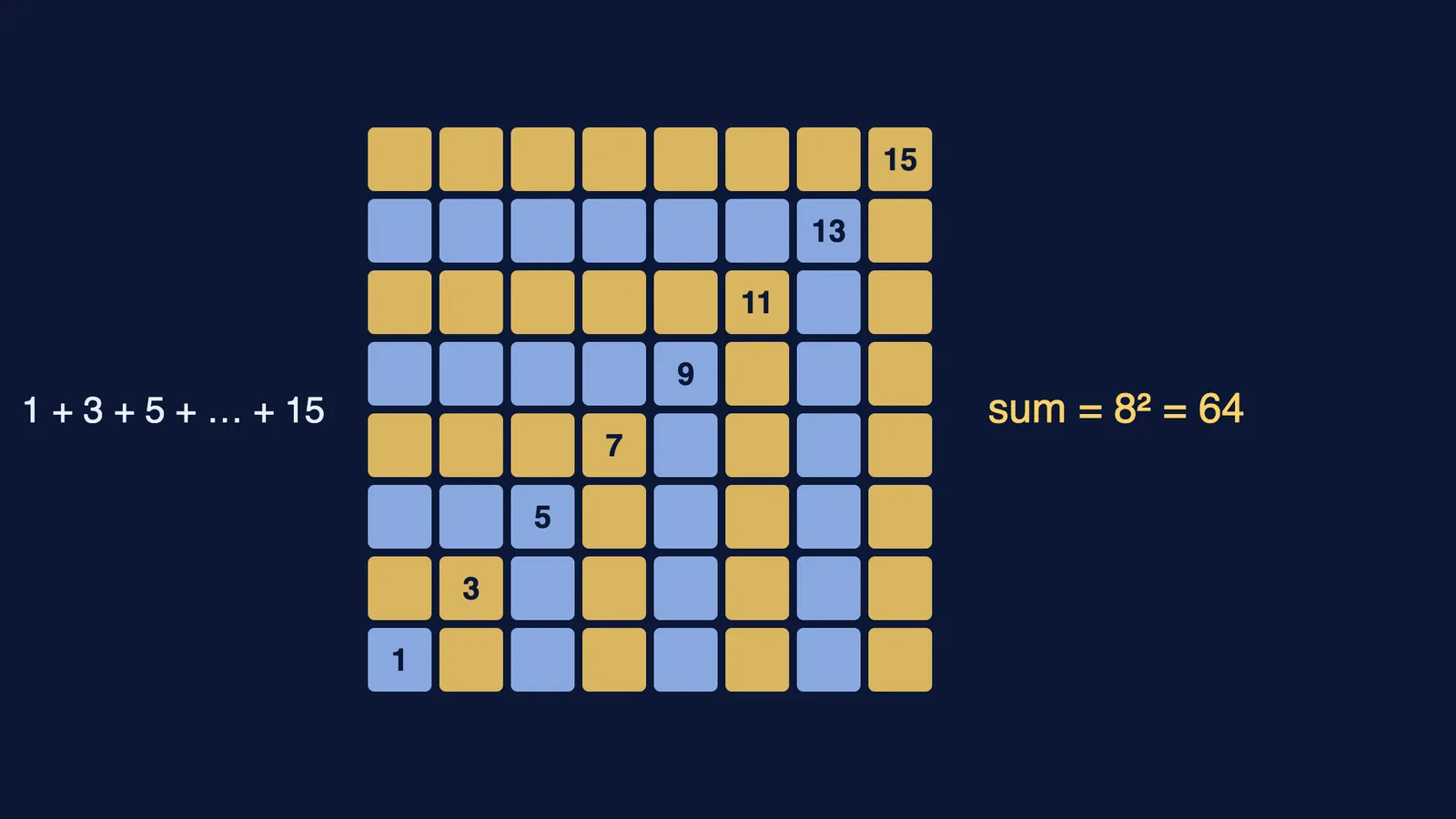
Q5 (medium). Assertion (A): The sum of the first 20 odd natural numbers is 400. Reason (R): The sum of the first n odd natural numbers is n².
Answer: (A). R is true: with a = 1 and d = 2, (n/2)[2 + 2(n – 1)] = n². Putting n = 20 gives 400, so R explains A.
Trap: taking the 20th odd number, 39, as n.
Q6 (hard). Assertion (A): If the sum of the first n terms of an AP is Sn = 5n² + 2n, its common difference is 5. Reason (R): The nth term of an AP is an = Sn – Sn–1.
Answer: (D). R is true. It gives an = 10n – 3, so the AP is 7, 17, 27, ... with d = 10, and A is false.
Trap: reading the n² coefficient as d; it is d/2.
Statement I and Statement II questions on APs
Q7 (medium). Statement I: The common difference of the AP 15, 9, 3, –3, ... is 6. Statement II: An AP can have a negative common difference.
Answer: (D). d = 9 – 15 = –6, so Statement I is wrong; Statement II matches NCERT.
Trap: subtracting in the wrong order.
Q8 (medium). Statement I: There are 11 numbers between 50 and 150 that leave remainder 2 when divided by 9. Statement II: The number of terms in an AP from a to l with common difference d is (l – a)/d.
Answer: (C). The list is 56, 65, ..., 146, so n = (146 – 56)/9 + 1 = 11. Statement II drops the + 1 and gives 10.
Trap: counting gaps instead of terms.
Q9 (hard). Statement I: If k + 3, 11 and 3k – 1 are three consecutive terms of an AP, then k = 5. Statement II: Three numbers a, b, c are consecutive terms of an AP exactly when 2b = a + c.
Answer: (A). Statement II holds because b – a = c – b. It gives 22 = 4k + 2, so k = 5: the terms are 8, 11, 14.
Trap: setting the two outer terms equal to each other.
Q10 (hard). Statement I: The sum of the first 15 terms of the AP 7, 3, –1, ... is positive. Statement II: If an = 2n + 5, the sum of the first n terms is 2n² + 5n.
Answer: (B). S15 = (15/2)[14 + 14 × (–4)] = –315. For Statement II, Sn = (n/2)(7 + 2n + 5) = n² + 6n, not 2n² + 5n.
Trap: checking only n = 1, where both formulas give 7; n = 2 exposes it.
How should you use this set?
Answer key at a glance: 1-A, 2-C, 3-B, 4-D, 5-A, 6-D, 7-D, 8-C, 9-A, 10-B.
Attempt all 10 cold, writing a one-line reason for each choice.
Mark each miss as a fact error (a statement misjudged) or a link error (wrong explanation call).
For fact errors, redo the sum in full; most slips are the "– 1".
For link errors, write one item of your own where R does explain A.
If your misses are method slips, the Fermi Problem Library has worked problems with a step-by-step solver that explains the reasoning. For a method across subjects, see how to solve assertion-reason questions with three checks.


