On this page
Three original cases, easy to hard, with worked answers: two on sectors and segments, one on a combined solid. For formulas and solved examples, start with our guide to areas related to circles for Class 10.
What do case-study questions on areas and volumes look like?
The CBSE 2026-27 Class 10 Maths (Standard) sample paper has three case study-based questions of 4 marks each in Section E, each with three sub-parts, and calculators are not allowed. Our cases have four parts each for extra practice.
The CBSE 2026-27 Class 10 Maths syllabus restricts segment problems to central angles of 60°, 90° and 120°, and limits solids to combinations of any two of cubes, cuboids, spheres, hemispheres, cylinders and cones. The formulas follow the rationalised NCERT chapters on areas related to circles and surface areas and volumes (Reprint 2026-27). Take π = 22/7 and √3 = 1.73.
Case 1: Pizza night in Indiranagar
A pizzeria in Bengaluru bakes a round pizza 21 cm across and cuts it into 4 equal slices, each cut running from the centre to the edge. Kavya orders one for her study group and notices that every slice is a sector of the circle, with a curved crust along the outside edge. She does not like crust, so she trims each slice with one straight cut joining the two ends of its crust, and eats only the triangle that is left.
(i) The central angle of each slice is: (a) 45° (b) 60° (c) 72° (d) 90°
(ii) What is the perimeter of one slice?
(iii) What is the area of one slice?
(iv) How much pizza does Kavya trim off one slice?
Answers.
(i) (d). 360° ÷ 4 = 90°.
(ii) r = 10.5 cm. Arc = (90/360) × 2 × (22/7) × 10.5 = 16.5 cm, so the perimeter = 10.5 + 10.5 + 16.5 = 37.5 cm.
(iii) (90/360) × (22/7) × 10.5² = 86.625 cm².
(iv) She trims the minor segment. Two radii at 90° make a right isosceles triangle, of area ½ × 10.5 × 10.5 = 55.125 cm². Segment = 86.625 − 55.125 = 31.5 cm².
Case 2: The footbridge over the society pond
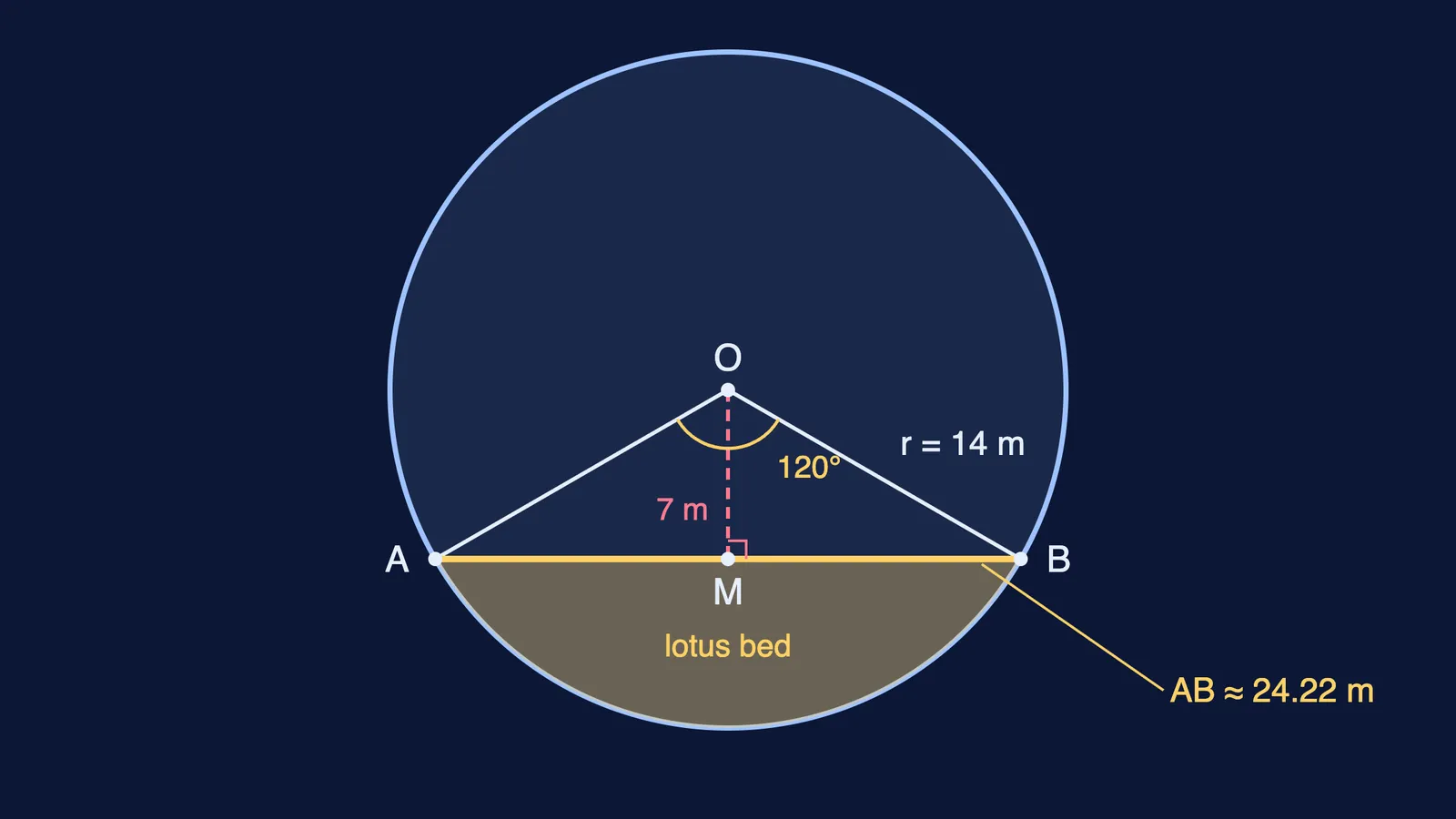
A housing society in Pune has a circular pond of radius 14 m with centre O. Engineers lay a straight wooden footbridge AB across it, with both ends on the edge, so that AB subtends an angle of 120° at O. The smaller part of the pond, between the bridge and the edge, will become a lotus bed; the larger part is kept for children's paddle boats. M is the foot of the perpendicular from O to the bridge. The committee needs the bridge length, both areas and a fence around the lotus bed.
(i) The distance OM from the centre to the bridge is: (a) 7 m (b) 7√3 m (c) 14 m (d) 3.5 m
(ii) How long is the footbridge AB?
(iii) Find the area of the lotus bed.
(iv) Find the area left for the boats, and the length of fencing that goes all round the lotus bed (bridge side included).
Answers.
(i) (a). OM bisects ∠AOB, so ∠AOM = 60° and OM = 14 cos 60° = 7 m.
(ii) AM = 14 sin 60° = 7√3 m, so AB = 14√3 ≈ 14 × 1.73 = 24.22 m.
(iii) Sector = (120/360) × (22/7) × 14² ≈ 205.33 m². Triangle OAB = ½ × AB × OM = ½ × 14√3 × 7 = 49√3 ≈ 84.77 m². Lotus bed = 205.33 − 84.77 = 120.56 m².
(iv) Pond = (22/7) × 14² = 616 m², so the boats get 616 − 120.56 = 495.44 m². Arc AB = (120/360) × 2 × (22/7) × 14 ≈ 29.33 m, so fencing = 29.33 + 24.22 = 53.55 m.
Case 3: The grain bin on a Punjab farm
Harpreet's family stores wheat in a metal bin shaped like a cylinder with a conical roof. The cylinder has radius 1.4 m and height 3 m; the cone has the same radius and a vertical height of 1.05 m. The bin stands on a concrete floor, so only the curved wall and the roof are made of metal sheet. After harvest the family pours wheat in through a hatch at the top until the grain fills the cylinder and is heaped right up to the apex of the roof.
(i) The slant height of the roof is: (a) 1.05 m (b) 1.4 m (c) 1.75 m (d) 2.45 m
(ii) How much wheat fills the cylindrical part alone?
(iii) How much metal sheet was used for the wall and the roof?
(iv) How much wheat does the full bin hold, and what fraction of it lies inside the roof?
Answers.
(i) (c). l = √(1.4² + 1.05²) = √3.0625 = 1.75 m.
(ii) πr²h = (22/7) × 1.96 × 3 = 18.48 m³.
(iii) Curved surface of cylinder + curved surface of cone = πr(2h + l) = (22/7) × 1.4 × (6 + 1.75) = 4.4 × 7.75 = 34.1 m². The floor and the hidden joint are not counted.
(iv) Cone = (1/3) × (22/7) × 1.96 × 1.05 = 2.156 m³, so the bin holds 18.48 + 2.156 = 20.636 m³. The roof holds 2.156/20.636 = 7/67, about 10.4%.
How do you solve case-study questions on areas and volumes?
Underline the radius, not the diameter. Case 1 gives 21 cm across; every formula needs 10.5 cm.
For a segment, draw OM first: the triangle's area is ½ × AB × OM.
For surface area, list the faces you can touch. Joined faces and the floor drop out; volumes simply add.
Keep π = 22/7 and √3 = 1.73 to the last line, and round only the final answer.
Write the unit with every answer: cm, cm² or m³.
For more on combined solids, see our worked guide to surface area and volume in Class 10 and our guide to case-based questions in board exams. If a step keeps slipping, the Fermi Problem Library has worked problems with a step-by-step solver that explains the reasoning rather than printing an answer.