On this page
Ozone is a popular way to disinfect packaged drinking water. It kills germs fast, leaves no taste, and breaks down to oxygen soon after treatment. But ozone is such a strong oxidising agent that it also attacks any bromide ion already in the source water, and the end product is bromate, BrO₃⁻. Bromate is not a germ and not a taste problem. It is a by-product that drinking-water standards limit in micrograms per litre, and the chemistry behind it is straight out of your NCERT p-block chapter.
Where does bromate in drinking water come from?
Almost all natural water carries a little bromide, Br⁻, often tens to a few hundred micrograms per litre. Groundwater near the coast, or water touched by seawater, can carry more. Bromide itself is harmless at these levels.
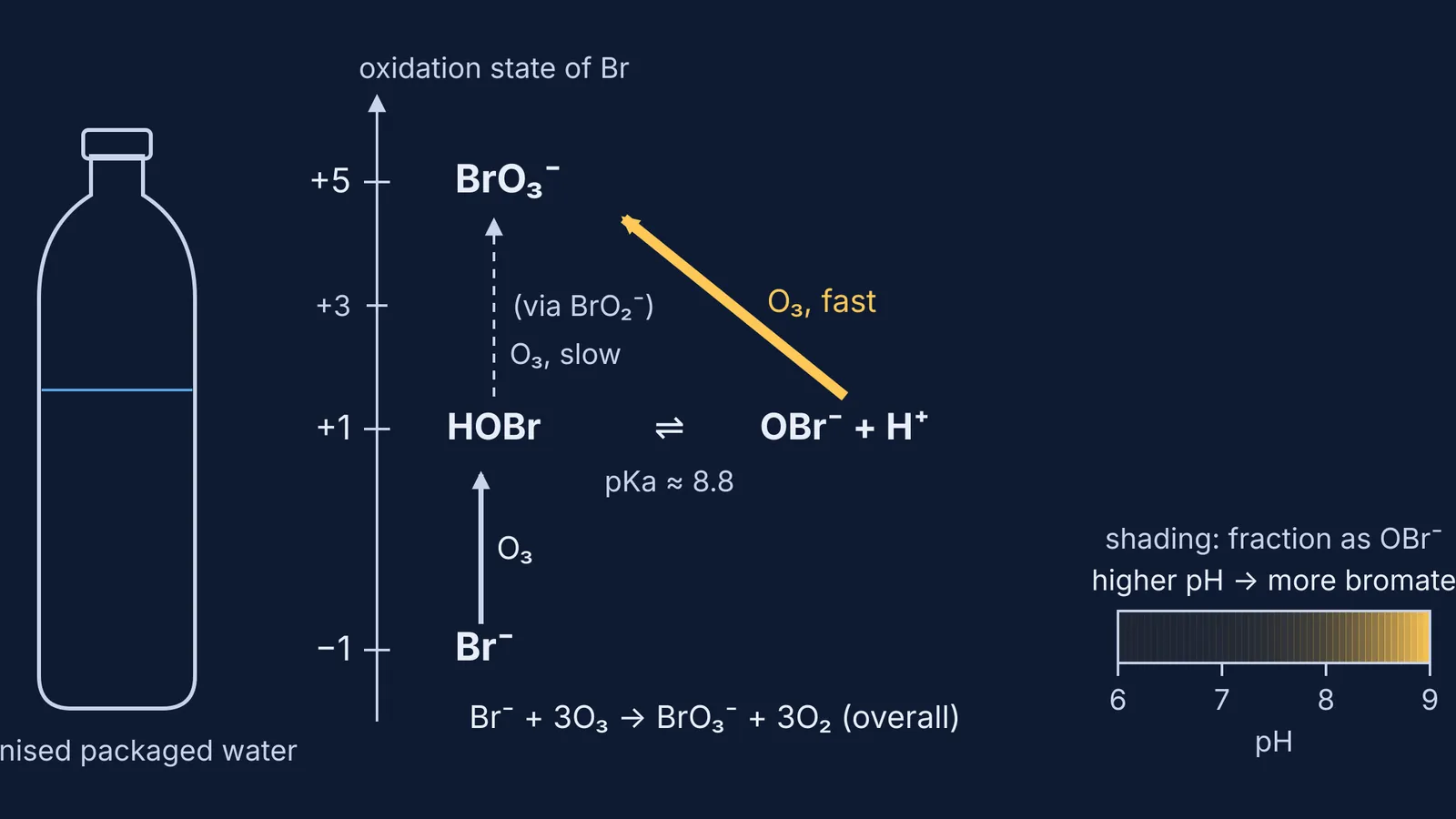
Ozone changes that. You already know from why ozone is a strong oxidising agent that O₃ oxidises iodide to iodine. Bromide is harder to oxidise than iodide, but ozone manages it, and it does not stop at bromine. A simplified two-step scheme is:
O₃ + Br⁻ → OBr⁻ + O₂
OBr⁻ + 2O₃ → BrO₃⁻ + 2O₂
Adding them gives the overall equation Br⁻ + 3O₃ → BrO₃⁻ + 3O₂. Check it: one Br and nine O on each side, charge −1 on each side.
The real mechanism is messier. Step 2 goes through bromite (BrO₂⁻, bromine +3), and part of the oxidation is done by hydroxyl radicals that form when ozone decomposes in water. The two-step scheme is a fair model for students, but treat it as a summary, not the whole story.
What are the oxidation states of bromine along the way?
Count them as you would for any oxoanion:
Br⁻: −1.
HOBr / OBr⁻ (hypobromous acid and hypobromite): O is −2, H is +1, so Br is +1.
BrO₂⁻ (bromite): +3.
BrO₃⁻ (bromate): x + 3(−2) = −1, so x = +5.
So bromine climbs from −1 to +5, a loss of 6 electrons per bromide. Each O₃ that becomes O₂ passes one oxygen atom from 0 to −2, a gain of 2 electrons. Six electrons lost, three ozone molecules needed: the electron count agrees with the overall equation. The structures and acid strengths of the matching chlorine oxoacids are in acidity of chlorine oxoacids; here the point is how the +1 and +5 states are reached.
Why do water standards limit bromate?
Bromate caused tumours in long-term animal studies, and potassium bromate is classed by IARC as possibly carcinogenic to humans. The WHO Guidelines for drinking-water quality set a guideline value of 10 µg/L for bromate. In India, the BIS standard for packaged drinking water, IS 14543:2024, lists bromate among the toxic substances that must be tested, by ion chromatography, as shown in the BIS product manual for IS 14543. Check the current edition of the standard for the exact Indian limit.
These are limits for water drunk every day over a lifetime, set with a wide safety margin. Their existence does not mean bottled water is unsafe; it means plants must control the process. The worked example below uses 10 µg/L as the limit.
How much bromide can turn into too much bromate?
Here is the step students miss: when bromide becomes bromate, the mass goes up, because three oxygen atoms are added. Molar masses: Br⁻ = 79.90 g/mol, BrO₃⁻ = 127.90 g/mol. So each microgram of bromide converted gives 127.90/79.90 = 1.60 µg of bromate.
Worked example. A plant's source water has 150 µg/L bromide. Suppose 8% of it becomes bromate during ozonation (an illustrative figure; the real conversion depends on ozone dose, contact time, pH, ammonia and organic matter).
Bromide converted. 0.08 × 150 = 12.0 µg/L.
Moles. 12.0/79.90 = 0.150 µmol/L of bromide, which gives 0.150 µmol/L of bromate (1 : 1 from the equation).
Mass of bromate. 0.150 × 127.90 = 19.2 µg/L.
Compare. 19.2 µg/L is almost twice the 10 µg/L limit.
Now turn it round. What is the largest conversion this water can tolerate?
Limit in moles. 10 µg/L ÷ 127.90 = 0.0782 µmol/L of bromate.
Matching bromide. 0.0782 × 79.90 = 6.25 µg/L of bromide.
Fraction. 6.25/150 × 100 = 4.2%.
So only about 4% of the bromide may be oxidised all the way. That is why bromide-rich water is hard to ozonate safely.
Why does pH control how much bromate forms?
The middle species, hypobromous acid, is a weak acid:
HOBr ⇌ H⁺ + OBr⁻, pKa about 8.8 at 25 °C (sources quote roughly 8.6 to 8.8).
Ozone attacks the anion OBr⁻ far faster than the neutral HOBr. So the more of the +1 bromine sits as OBr⁻, the faster bromate forms. The fraction present as the anion follows from the pKa, the same way you find the degree of ionisation of any weak acid:
fraction as OBr⁻ = 1 / (1 + 10^(pKa − pH))
At pH 8.0: 10^(8.8 − 8.0) = 10^0.8 = 6.31, so the fraction is 1/7.31 = 0.137.
At pH 6.5: 10^(8.8 − 6.5) = 10^2.3 = 199.5, so the fraction is 1/200.5 = 0.0050.
Ratio. 0.137/0.0050 ≈ 27.
Lowering the pH from 8.0 to 6.5 cuts the fast-reacting form about 27-fold. This is one reason plants lower the pH before ozonation when bromide is high. Other controls include using the smallest ozone dose that still disinfects and adding a little ammonia, which ties up hypobromous acid. Once bromate forms it is stable and hard to remove, so prevention matters more than cleanup. Where ozone fits among the other treatment stages is covered in steps in water purification.
If the weak-acid fraction formula still feels shaky, the Concept Library covers ionisation of weak acids and pH alongside the rest of chemistry.
Quick checklist
Ozone oxidises bromide: Br⁻ + 3O₃ → BrO₃⁻ + 3O₂ (simplified; bromite and OH radicals are also involved).
Bromine goes −1 (Br⁻) → +1 (HOBr/OBr⁻) → +5 (BrO₃⁻), losing 6 electrons.
WHO guideline value for bromate: 10 µg/L; IS 14543 requires bromate testing in packaged water.
Convert bromide to bromate through moles: mass rises by a factor of 1.60.
HOBr pKa is about 8.8; ozone reacts much faster with OBr⁻ than with HOBr.
Lower pH, careful ozone dose and ammonia reduce bromate formation.