

On this page
Water from a river or reservoir looks brown because of fine clay and plant matter, and it also carries germs. A city water works removes these in a fixed order, and the order matters: each step makes the next one work.
What are the steps in purification of drinking water supply?
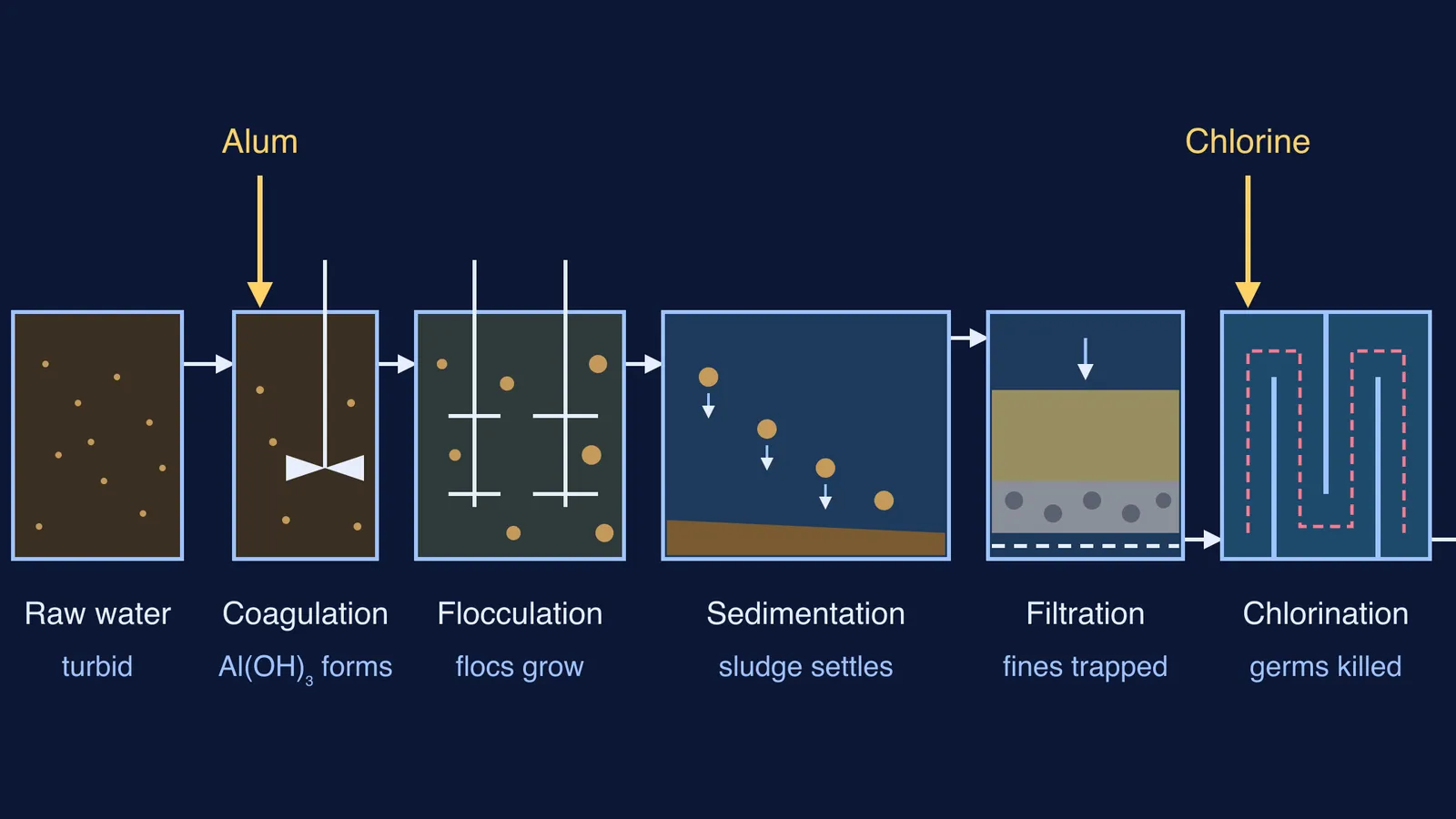
The US Centers for Disease Control and Prevention lists the standard treatment train as coagulation, flocculation, sedimentation, filtration and disinfection. Indian textbooks often group the first two together as "loading with alum". In order:
Loading with alum (coagulation and flocculation): alum is mixed in fast, then the water is stirred gently so tiny particles stick together into larger clumps called flocs.
Sedimentation: the water sits still in a large tank and the heavy flocs sink to the bottom as sludge.
Filtration: the clearer water passes down through beds of sand and gravel, which trap the fine floc that did not settle.
Chlorination: chlorine is added to kill the germs that got through, and a little is left in the water to protect it in the pipes.
What does loading with alum actually do?
Muddy water stays cloudy because its clay particles are too small to sink on their own and carry like electric charges, so they repel each other. Alum (aluminium sulphate) fixes this. Australia's national drinking water guidelines describe alum as a general-purpose coagulant used to remove turbidity, natural organic matter (including colour), microorganisms and many inorganic chemicals.
The same guidelines explain that the aluminium ion reacts with the water's natural alkalinity, such as bicarbonate, to form aluminium hydroxide. A balanced version you can write in an exam is:
Al2(SO4)3 + 3Ca(HCO3)2 → 2Al(OH)3 + 3CaSO4 + 6CO2
The aluminium hydroxide is a sticky, jelly-like solid that sweeps fine particles into flocs big enough to settle. We explain the household version, a piece of fitkari swirled in a bucket, in how alum clears muddy water.
Dose matters too. India's drinking water standard, IS 10500:2012, sets an acceptable limit of 0.03 mg/l for aluminium, and the Australian guidelines note that leftover aluminium can form floc again inside the pipes, so the dose has to be controlled.
What do sedimentation and filtration remove?
Sedimentation removes the flocs, and with them the mud they have trapped. According to the CDC, flocs are heavier than water, so they settle to the bottom during this step.
Filtration catches what is left. The CDC says filters remove germs, including parasites, bacteria and viruses, as well as small particles such as dust, and chemicals. The target is very clear water: IS 10500 sets an acceptable turbidity of 1 NTU, with 5 NTU as the upper limit when no other source is available.
Why is chlorine added last, and how much is enough?
The WHO technical note on measuring chlorine levels says chlorine needs at least 30 minutes of contact with the water to disinfect, at 18°C and above, and longer in colder water. It also advises keeping turbidity below 5 NTU for chlorine to work well, and never adding chlorine before slow sand filtration, because it would kill the helpful bacteria in the sand bed.
Some chlorine stays in the water after the germs are killed. This leftover, called free chlorine, keeps protecting the water in the pipes. IS 10500 asks for a minimum of 0.2 mg/l of free residual chlorine at the consumer end when water is chlorinated, and at least 0.5 mg/l when protection against viruses is needed. Our explainer on how bleaching powder is made and how it reacts covers the same chlorine chemistry used in smaller supplies.
What does treatment not remove?
The same WHO note is plain about the limits: chlorine does not remove chemical contaminants, and it is ineffective against the parasite Cryptosporidium, so filtration has to be used alongside it. It also warns that leaky pipes in an intermittent supply let dirty water in when the pressure drops. If you are unsure about your own supply, does boiling water kill all germs? explains what boiling does and does not fix.
How do you write this answer for full marks?
Use a step, removes, how frame for each stage. Examiners look for the reason, not just the name.
Loading with alum: removes fine suspended clay and colour; Al(OH)3 traps particles into flocs.
Sedimentation: removes the flocs and most of the mud; they are heavier than water and sink as sludge.
Filtration: removes the remaining fine floc and many germs; sand and gravel trap them.
Chlorination: kills the remaining bacteria and viruses; free chlorine stays to guard the pipes.
A quick self-test: if a tap sample shows 0.1 mg/l of free chlorine, is it within the Indian standard? No. It is below the 0.2 mg/l minimum that IS 10500 sets.
If colloids or coagulation feel shaky, the Fermi Concept Library gives each chemistry and biology concept its own lesson and its place in the map.


