On this page
Each question has one numerical answer and no options, so there is nothing to eliminate. Write your value on paper, without a calculator, before reading the solution.
How does the JEE Advanced numerical answer format work?
In the official JEE (Advanced) 2025 Paper 1 answer key, mathematics Section 3 had six questions whose answer is a numerical value, entered with an on-screen keypad. The instructions say that if the value has more than two decimal places, you truncate or round it off to two decimal places. A correct value earned 4 marks and anything else earned 0.
The JEE (Advanced) 2026 syllabus lists "binomial theorem for a positive integral index, properties of binomial coefficients" under Algebra. In this set, truncating and rounding give the same two places.
Questions 1 to 4: easy to medium
Q1 (easy). Find the coefficient of x⁴ in (2x − 1/x)⁸.
Answer: 1792 (enter 1792). The general term is ⁸Cᵣ(2x)⁸⁻ʳ(−1/x)ʳ = ⁸Cᵣ2⁸⁻ʳ(−1)ʳx⁸⁻²ʳ. Setting 8 − 2r = 4 gives r = 2, so the coefficient is 28 × 64 = 1792. Check: (−1)² is positive, so the sign is right. Where the mark goes: leaving 2⁶ out of the coefficient and entering 28.
Q2 (easy). Find the term independent of x in (x² + 1/(2x))⁹.
Answer: 21/16 (enter 1.31). The general term is ⁹Cᵣx¹⁸⁻²ʳ(1/2)ʳx⁻ʳ, so 18 − 3r = 0 and r = 6. The term is 84/64 = 21/16 = 1.3125. Check: the power of x is 18 − 12 − 6 = 0. Where the mark goes: forgetting the (1/2)⁶ and entering 84.
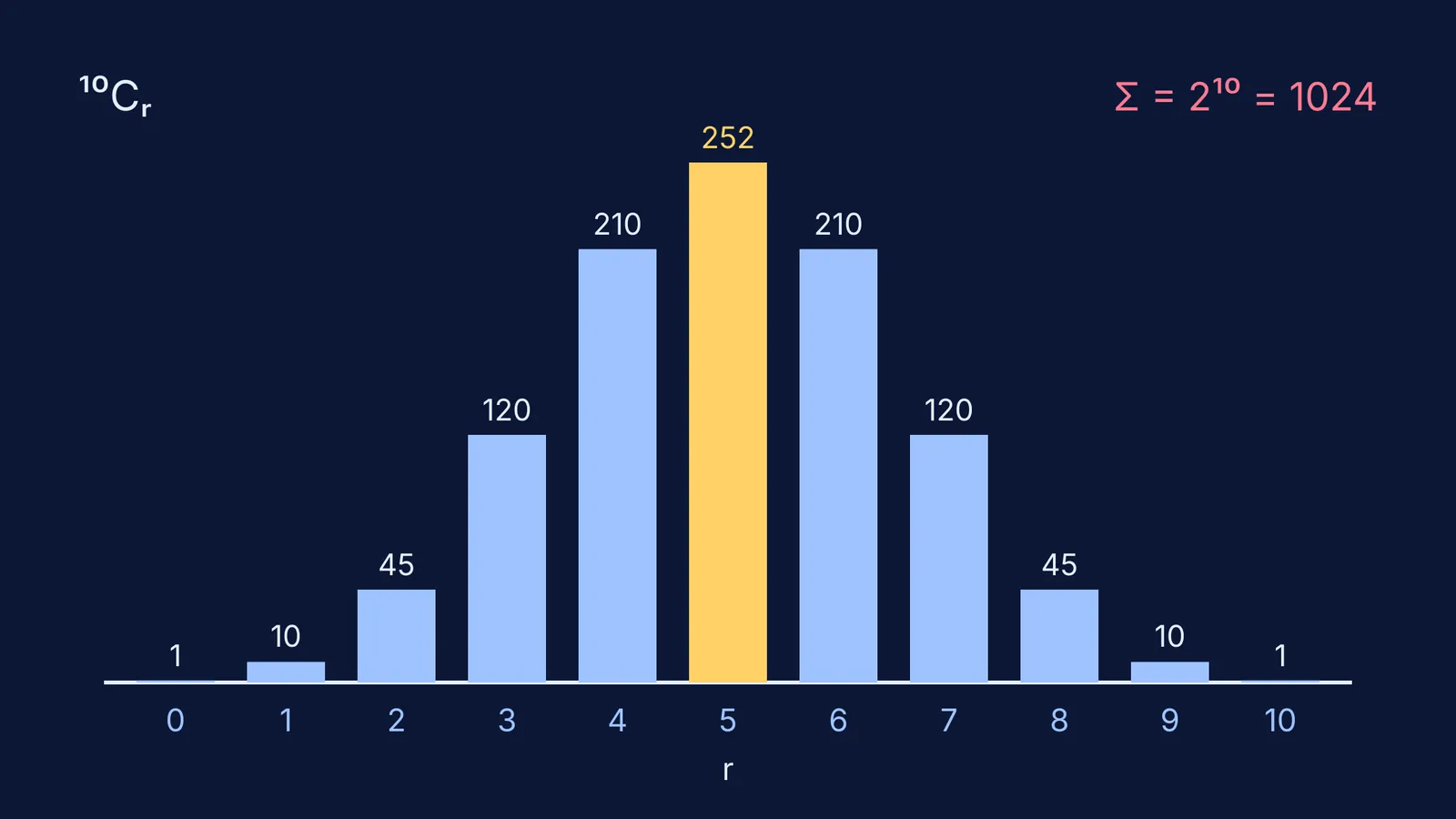
Q3 (medium). Find 1²·¹⁰C₁ + 2²·¹⁰C₂ + 3²·¹⁰C₃ + ... + 10²·¹⁰C₁₀.
Answer: 28160 (enter 28160). Split r² = r(r − 1) + r. Then Σr(r − 1)ⁿCᵣ = n(n − 1)2ⁿ⁻² and ΣrⁿCᵣ = n2ⁿ⁻¹, so the sum is 90 × 256 + 10 × 512 = 23040 + 5120 = 28160. Check: for n = 2 the same method gives 6, and 1²·2 + 2²·1 = 6. Where the mark goes: keeping only the r(r − 1) part and entering 23040.
Q4 (medium). Find ⁹C₀/1 + ⁹C₁/2 + ⁹C₂/3 + ... + ⁹C₉/10.
Answer: 1023/10 (enter 102.30). Since ⁹Cᵣ/(r + 1) = ¹⁰Cᵣ₊₁/10, the sum is (2¹⁰ − 1)/10 = 1023/10. Check: for n = 1 the formula gives 3/2, and 1 + 1/2 = 3/2. Where the mark goes: forgetting that ¹⁰C₀ is missing and entering 102.40.
Questions 5 to 8: medium to hard
Q5 (medium). Find the remainder when 7¹⁰³ is divided by 25.
Answer: 18 (enter 18). Write 7¹⁰³ = 7 × 49⁵¹ = 7(50 − 1)⁵¹. All terms but the last contain 50, so the remainder matches that of 7 × (−1)⁵¹ = −7, which is 25 − 7 = 18. Check: 7⁴ = 2401 leaves 1, so 7¹⁰³ behaves like 7³ = 343, which leaves 18. Where the mark goes: entering 7, from dropping the minus sign of (−1)⁵¹.
Q6 (medium to hard). Three consecutive coefficients in the expansion of (1 + x)ⁿ are in the ratio 1 : 7 : 42. Find n.
Answer: 55 (enter 55). Call them ⁿCᵣ₋₁, ⁿCᵣ, ⁿCᵣ₊₁. The ratio ⁿCᵣ/ⁿCᵣ₋₁ = (n − r + 1)/r = 7 gives n = 8r − 1, and ⁿCᵣ₊₁/ⁿCᵣ = (n − r)/(r + 1) = 6 gives n = 7r + 6. So r = 7 and n = 55. Check: ⁵⁵C₇/⁵⁵C₆ = 49/7 = 7 and ⁵⁵C₈/⁵⁵C₇ = 48/8 = 6. Where the mark goes: solving for r and entering 7.
Q7 (hard). Find the integer part of (√3 + 1)⁶.
Answer: 415 (enter 415). Let I = (√3 + 1)⁶ and f = (√3 − 1)⁶. Since (√3 ± 1)² = 4 ± 2√3, I + f = (4 + 2√3)³ + (4 − 2√3)³ = 2(64 + 144) = 416. As 0 < √3 − 1 < 1, f lies between 0 and 1, so I is just below 416. Check: (4 − 2√3)³ is about 0.154, so I is about 415.85. Where the mark goes: entering 416, the integer sum, without subtracting f. The same idea is behind why the integral part of (5 + 2√6)ⁿ is always odd.
Q8 (hard). Find ⁸C₀·¹²C₂ + ⁸C₁·¹²C₃ + ⁸C₂·¹²C₄ + ... + ⁸C₈·¹²C₁₀.
Answer: 184756 (enter 184756). Use symmetry first: ¹²Cₖ₊₂ = ¹²C₁₀₋ₖ. The sum Σ⁸Cₖ·¹²C₁₀₋ₖ is the coefficient of x¹⁰ in (1 + x)⁸(1 + x)¹² = (1 + x)²⁰, which is ²⁰C₁₀ = 184756. Check: after the swap, the lower indices in every product add to 10. Where the mark goes: entering ²⁰C₈ = 125970, the wrong lower index.
What should you do after this set?
Next to every miss, write the step where the mark went.
Redo the misses two days later with the solutions covered.
If this set felt hard, warm up with eight JEE Main numerical value questions on Binomial Theorem, then try the mixed-format JEE Advanced sequences, series and binomial theorem practice set.
If the method went wrong rather than the arithmetic, the Fermi Problem Library has a step-by-step solver that explains the reasoning rather than printing an answer. For JEE Main and Advanced preparation, start at Fermi Test Prep.