On this page
Every statement below was checked against NCERT Class 11 Physics Part II (Reprint 2026-27): Mechanical Properties of Solids, Mechanical Properties of Fluids and Thermal Properties of Matter. All three sit in Unit 7, Properties of Solids and Liquids, of the NMC's updated NEET (UG)-2026 syllabus. New to the unit? Read our guide on how to prepare Properties of Solids and Liquids for NEET.
How do you answer assertion-reason questions on solids and liquids?
Run three checks in order:
Is the Assertion (A) true? Test it with the formula.
Is the Reason (R) true? Check every factor, power and sign.
If both are true, read "A, because R". Pick (A) only if R is the direct cause NCERT gives.
Assertion-reason key, for Q1 to Q6:
(A) Both A and R are true and R is the correct explanation of A.
(B) Both A and R are true but R is NOT the correct explanation of A.
(C) A is true but R is false.
(D) A is false but R is true.
Statement pair key, for Q7 to Q10:
(A) Both statements are correct.
(B) Both statements are incorrect.
(C) Statement I is correct, Statement II is incorrect.
(D) Statement I is incorrect, Statement II is correct.
More method: answering assertion-reason questions.
Assertion-reason questions: is R the real cause?
Q1 (easy). Assertion (A): A steel wire is more elastic than a copper wire of the same length and cross-section. Reason (R): Steel's Young's modulus is larger than copper's, so under the same load the steel wire stretches less.
Answer: (A). NCERT calls the material that stretches less under a given load more elastic, and steel's larger Young's modulus is why it stretches less. Trap: reading "elastic" as "stretchy".
Q2 (easy). Assertion (A): A sample of water contracts when it is heated from 0 °C to 4 °C. Reason (R): Water has its maximum density at 0 °C.
Answer: (C). A is NCERT's anomalous expansion of water. R is false: the density maximum is at 4 °C. Trap: confusing freezing point with density maximum.
Q3 (medium). Assertion (A): When a metal washer is heated uniformly, the hole at its centre becomes smaller. Reason (R): When an isotropic solid is heated, every length in it, including the diameter of a hole, grows by the same fraction αΔT.
Answer: (D). R is true and makes A false: the hole expands as if it were filled with the same metal. Trap: picturing the metal "flowing into" the hole.
Q4 (medium). Assertion (A): Mercury in a narrow glass capillary stands lower than the mercury outside it. Reason (R): Mercury is much denser than water.
Answer: (B). Both are true, but the depression comes from the obtuse angle of contact between mercury and glass, which makes cos θ negative in h = 2S cos θ/(ρga). Density sets how far, not which way. Trap: grabbing a familiar fact about mercury.
Q5 (hard). Assertion (A): A soap bubble of radius 2r and a drop of the same soap solution of radius r have equal excess pressure inside. Reason (R): A soap bubble has two liquid-air surfaces, so its excess pressure is 4S/r, while a drop has one surface and an excess pressure of 2S/r.
Answer: (A). From R, the bubble gives 4S/(2r) = 2S/r and the drop gives 2S/r. Trap: using 2S/r for the bubble.
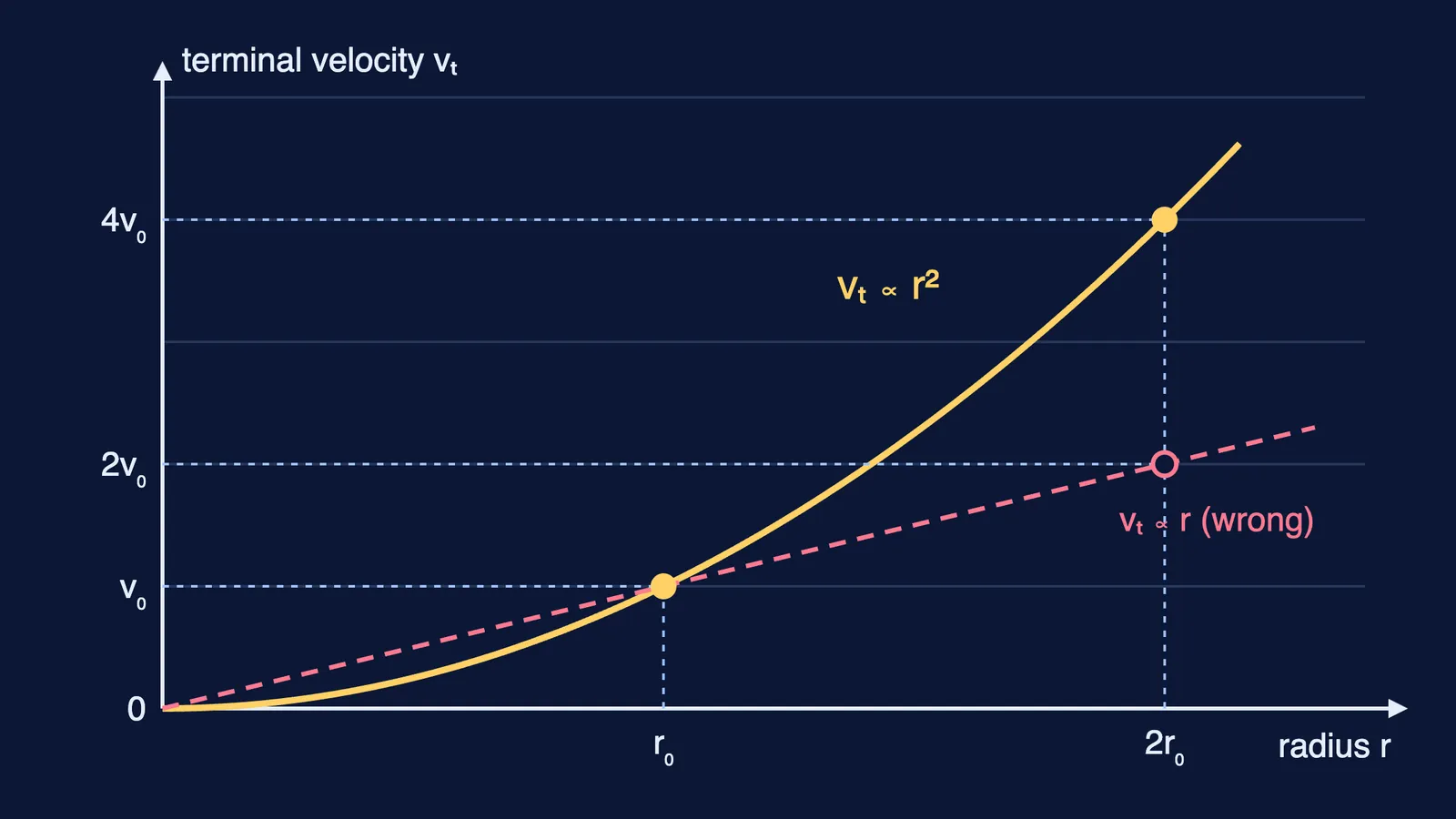
Q6 (hard). Assertion (A): If eight identical raindrops, each falling at terminal velocity v, merge into one drop, the new drop falls at a terminal velocity of 2v. Reason (R): The terminal velocity of a small sphere in a fluid is proportional to the square of its radius.
Answer: (D). Eight times the volume means twice the radius, so v_t becomes 4v (diagram above). R is NCERT's result from Stokes' law, v_t = 2a²(ρ − σ)g/(9η). Trap: treating v_t as proportional to r.
Statement I/II questions with answers
Q7 (easy). Statement I: For most materials, the shear modulus is less than Young's modulus. Statement II: Strain has the same SI unit as stress.
Answer: (C). NCERT notes that G is generally less than Y, roughly Y/3. Strain is a ratio, so it has no unit; stress is in N m⁻² (Pa). Trap: mixing up strain with stress.
Q8 (medium). Statement I: While water boils at constant pressure, the heat supplied keeps raising its temperature. Statement II: Vessels of different shapes filled with water to the same height have the greatest pressure at the base of the one holding the most water.
Answer: (B). During a change of state the temperature stays constant. Liquid pressure depends on depth, P = Pₐ + ρgh, not on the vessel's shape: NCERT's hydrostatic paradox. Trap: equating pressure with total weight.
Q9 (hard). Statement I: Water flows at 0.80 m/s through a horizontal pipe of cross-section 10 cm² that narrows to 4.0 cm²; in steady streamline flow, the pressure in the narrow part is lower by 1.68 kPa. Statement II: The equation of continuity, Av = constant, expresses conservation of mass for an incompressible fluid.
Answer: (A). Continuity gives v₂ = 0.80 × 10/4 = 2.0 m/s. With ρ = 1000 kg m⁻³, Bernoulli for a horizontal pipe gives ΔP = ½ρ(v₂² − v₁²) = 500 × (4.00 − 0.64) = 1680 Pa. Statement II is NCERT's description. Trap: forgetting to square the speeds.
Q10 (hard). Statement I: A steel rod (Y = 2.0 × 10¹¹ Pa, α = 1.2 × 10⁻⁵ K⁻¹) clamped rigidly at both ends and heated by 50 °C develops a compressive thermal stress of 1.2 × 10⁸ Pa, whatever its length. Statement II: If the same rod is free to expand, it develops a larger thermal stress.
Answer: (C). Stress = YαΔT = 2.0 × 10¹¹ × 6.0 × 10⁻⁴ = 1.2 × 10⁸ Pa, with no length in it. A free rod simply lengthens, so its thermal stress is zero. Trap: putting the rod's length into the stress formula.
How should you use this set?
Cover each answer, mark your key, then check.
For every miss, note which check failed: A, R or the link.
Redo missed items two days later.
For numericals on this unit, try our solved Properties of Solids and Liquids NEET practice questions.
If capillary rise still feels abstract, the Fermi Simulation Lab has interactive simulations for the ideas that are easier to see than to read.