On this page
You can count the roots of an equation inside a circle without solving it. Walk once round the circle, watch which way f points, and count its full turns. That is the argument principle, and it sits underneath Rouché's theorem and the Nyquist stability test.
What does the argument principle say?
Let f be meromorphic (analytic except for poles) inside and on a simple anticlockwise contour C, with no zeros or poles on C. The argument principle states that (1/2πi)∮ f′(z)/f(z) dz = Z − P, where Z is the number of zeros and P the number of poles inside C, each counted as many times as its multiplicity or order.
The proof is short once you know residues. Near a zero of multiplicity k, write f(z) = (z − a)ᵏ g(z) with g(a) ≠ 0; then f′/f = k/(z − a) + g′/g, so f′/f has residue k there. Near a pole of order m the same algebra gives residue −m. The residue theorem then adds them up to Z − P.
What is a winding number?
The winding number of a closed curve round a point is the net number of anticlockwise turns the curve makes about that point; clockwise turns count as negative. The key step is the substitution w = f(z): it turns ∮ f′/f dz into ∮ dw/w taken over the image curve f(C), which is 2πi times the winding number of f(C) round the origin. Since f′/f is the derivative of log f, the integral is also i times the total change in arg f round C, hence the name.
So the recipe is visual: Z − P = (total change in arg f round C) / 2π.
Worked example: how many times does z³ − 1 wind round 0 on |z| = 2?
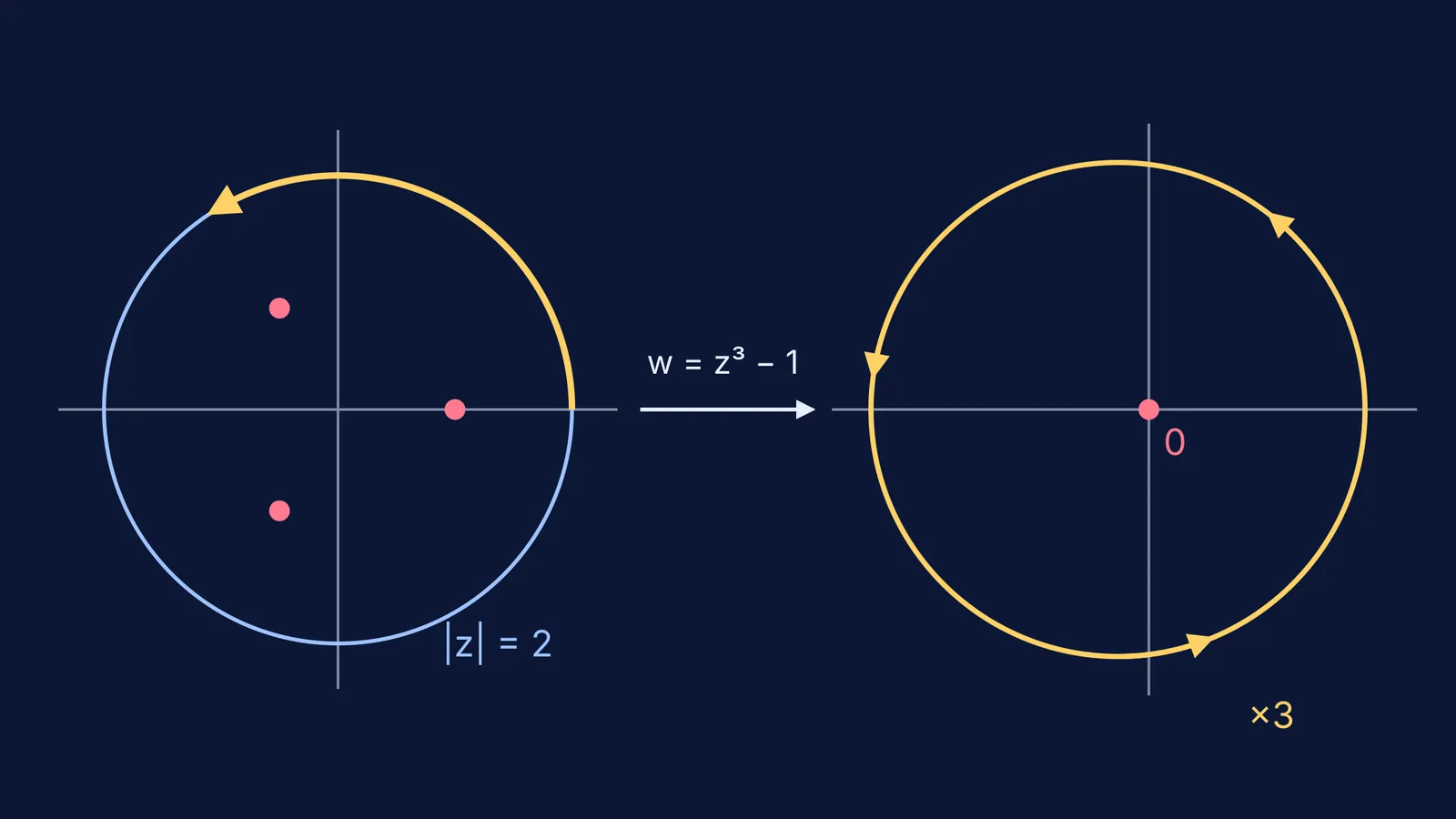
Let f(z) = z³ − 1 and let C be the circle |z| = 2.
Parametrise: z = 2e^{iθ} for θ from 0 to 2π, so z³ = 8e^{3iθ} and f(z) = 8e^{3iθ} − 1.
Picture the image: f(C) is a circle of radius 8 centred at −1, so the origin lies well inside it.
Track the argument: as θ goes round once, z³ goes round three times, so the image circle is traced three times. The −1 only nudges the direction: arg f stays within sin⁻¹(1/8), about 7.2°, of 3θ, so arg f changes by 3 × 2π = 6π.
Read off the count: winding number = 6π / 2π = 3. A polynomial has no poles, so P = 0 and Z = 3.
Check: the zeros are the three cube roots of unity, 1, e^{2πi/3} and e^{4πi/3}, all of modulus 1, so all three sit inside |z| = 2. This matches the fundamental theorem of algebra: a cubic has exactly three roots, counted with multiplicity.
Shrink the contour to |z| = 1/2 and f stays within 1/8 of −1, never circling 0: winding number 0, no zeros inside. On |z| = 1 the principle does not apply at all, because the contour passes through the zeros.
How does the argument principle lead to Rouché's theorem and Nyquist stability?
Rouché's theorem states that if f and g are holomorphic inside and on a simple contour and |g(z)| < |f(z)| on it, then f and f + g have the same number of zeros inside, counted with multiplicity. In the example, take f = z³ and g = −1: on |z| = 2, |g| = 1 < 8 = |f|, so z³ − 1 has as many zeros inside as z³, namely three. Our Rouché's theorem guide has more examples of this size comparison.
Harry Nyquist published his feedback stability test as "Regeneration Theory" in the Bell System Technical Journal in 1932. His own proof took a different route, but modern books derive the test from the argument principle: map the boundary of the right half-plane through the open-loop transfer function G(s) and count how often the plot circles −1. In the Nyquist stability criterion, Z = N + P, where Z is the number of closed-loop poles in the right half-plane, N the number of clockwise encirclements of −1, and P the number of open-loop right-half-plane poles. A stable closed loop needs Z = 0.
What mistakes should you avoid?
Check that no zero or pole lies on the contour before you start.
Go round anticlockwise; a clockwise contour flips the sign.
Count multiplicity: z² has one zero but contributes 2.
Remember poles subtract, so Z − P = 0 does not mean no zeros.
Track the argument continuously; do not reset it at π.
If residues or logarithmic derivatives still feel shaky, rebuild them in the Fermi Concept Library, then check your counts with the step-by-step solver in the Fermi Problem Library, which explains the reasoning rather than printing an answer.