

On this page
Finding the roots of z⁵ + 3z + 1 = 0 by hand is hard, but you can say exactly how many lie inside a circle, often in two lines. The tool is Rouché's theorem, and you can picture it with a dog on a leash.
What does Rouché's theorem say?
Take two functions f and g that are holomorphic (complex-differentiable) on and inside a simple closed curve C, such as a circle. According to the Wikipedia article on Rouché's theorem, if |g(z)| < |f(z)| at every point z on C, then f and f + g have the same number of zeros inside C, each counted with its multiplicity.
The theorem is named after the mathematician Eugène Rouché, whose paper "Mémoire sur la série de Lagrange" appeared in the Journal de l'École Polytechnique in 1862, as listed in the references of the same article.
Two details matter. The inequality must be strict on the whole contour, which also means no zero sits on the boundary. And zeros count with multiplicity: z⁵ has one zero at 0, but it counts as five. In practice, f is the "big" term whose zeros you already know, and g is everything else.
What is the dog-walking intuition?
The proof rests on the argument principle: the number of zeros of f inside C equals the number of times the image curve f(C) winds around the origin. Jeremy Orloff's MIT 18.04 notes on the argument principle prove Rouché's theorem this way, noting that the in-class version was a heuristic about a person walking a dog on a leash.
The Wikipedia article cites Tristan Needham's Visual Complex Analysis for the picture. A person walks round and round a tree with a dog on a leash. If the person always stays farther from the tree than the leash is long, the person and the dog go round the tree the same number of times.
Match the pieces: the tree is 0, the person is f(z), the dog is f(z) + g(z), and the leash is g(z). The condition |g| < |f| is exactly "leash shorter than the distance to the tree". Equal winding numbers mean, by the argument principle, equal numbers of zeros.
How do you prove the fundamental theorem of algebra with Rouché's theorem?
This is the proof given in Orloff's MIT notes, in four steps.
Let P(z) = zⁿ + aₙ₋₁zⁿ⁻¹ + ... + a₀. Split it as f(z) = zⁿ and g(z) = P(z) − zⁿ.
Pick a radius R larger than 1 and larger than n|aₖ| for every coefficient aₖ.
On |z| = R, each term |aₖ|Rᵏ is less than (R/n)Rⁿ⁻¹, and there are n terms, so |g| < Rⁿ = |f|.
By Rouché, P has as many zeros inside |z| = R as zⁿ does, which is n. Since R can be as large as you like, P has exactly n zeros in the whole plane.
As a bonus, every root of P has modulus at most the largest of 1 and the numbers n|aₖ|.
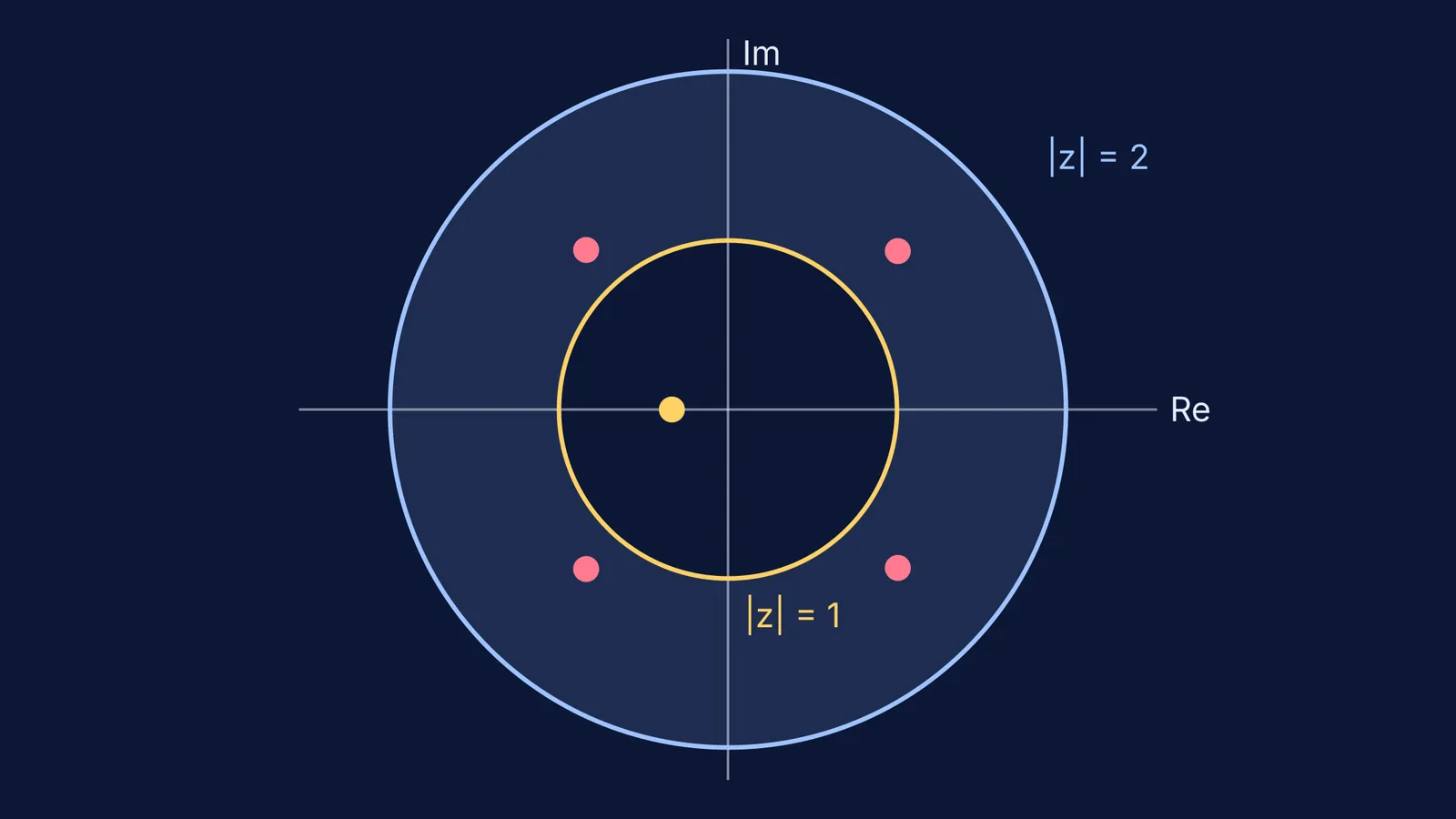
How many zeros does z⁵ + 3z + 1 have in the annulus 1 < |z| < 2?
The trick is to apply the theorem twice, with a different dominant term on each circle, then subtract. The outer step is Example 11.7 in the MIT 18.04 notes; the inner step uses the same method.
Outer circle |z| = 2. Take f = z⁵ and g = 3z + 1. Then |f| = 32, while |g| ≤ 3·2 + 1 = 7. Since 7 < 32, the polynomial has as many zeros in |z| < 2 as z⁵: five.
Inner circle |z| = 1. Now z⁵ is small, so take f = 3z and g = z⁵ + 1. Then |f| = 3, while |g| ≤ 1 + 1 = 2. Since 2 < 3, the polynomial has as many zeros in |z| < 1 as 3z: one.
Neither circle carries a zero (the inequalities are strict), so the annulus holds 5 − 1 = 4 zeros.
Sanity check: the polynomial is −3 at z = −1 and 1 at z = 0, so the one inner root is real and lies between them.
How do you choose f and g?
Use this checklist on any circle |z| = r:
Write down |each term| at radius r as a number.
Choose f to be the single largest term. Its zero count inside the circle is easy: k zeros for a term az^k.
Bound everything else with the triangle inequality and check the total is strictly smaller.
If it is not smaller, change the radius or the dominant term; do not force it.
For an annulus, repeat on the inner circle and subtract.
If the argument principle or winding numbers still feel shaky, the Fermi Concept Library covers concepts across mathematics, so you can revisit the idea first. To practise the split itself, the Fermi Problem Library has a step-by-step solver that explains the reasoning rather than printing an answer.
Try it now on z⁵ + 3z³ + 7 inside |z| = 2, and check which term wins.


