

On this page
You learn early that x² + 1 = 0 has no real solution. The introduction to the NCERT Class 11 chapter on complex numbers uses exactly that equation to argue that the real number system must be extended so it can be solved (NCERT Class 11 Mathematics, Chapter 4). The fundamental theorem of algebra is the payoff for that extension: once complex numbers are allowed, no non-constant polynomial equation is left without roots.
What does the fundamental theorem of algebra say?
Every polynomial of degree n ≥ 1 with complex coefficients has exactly n complex roots, counted with multiplicity (Fundamental theorem of algebra, Wikipedia).
The shortest form, as MathWorld states it, is that such a polynomial has at least one complex root. The "exactly n" follows by dividing out that root and repeating on the smaller polynomial until nothing is left.
So a cubic has 3 roots and a quartic 4. Real numbers are complex numbers with zero imaginary part, so this covers every school polynomial. For factorising, it means any polynomial can be written as a(x − r₁)(x − r₂)…(x − rₙ): over the complex numbers, it always splits completely into linear factors.
What does "counted with multiplicity" mean?
Take (x − 2)²(x + 1), which expands to x³ − 3x² + 4. It has only two different roots, 2 and −1, but the factor (x − 2) appears twice. So 2 is a double root, and the count is 2 + 1 = 3, matching the degree. On a graph, a double root is where the curve touches the x-axis without crossing it.
Why do complex roots come in conjugate pairs?
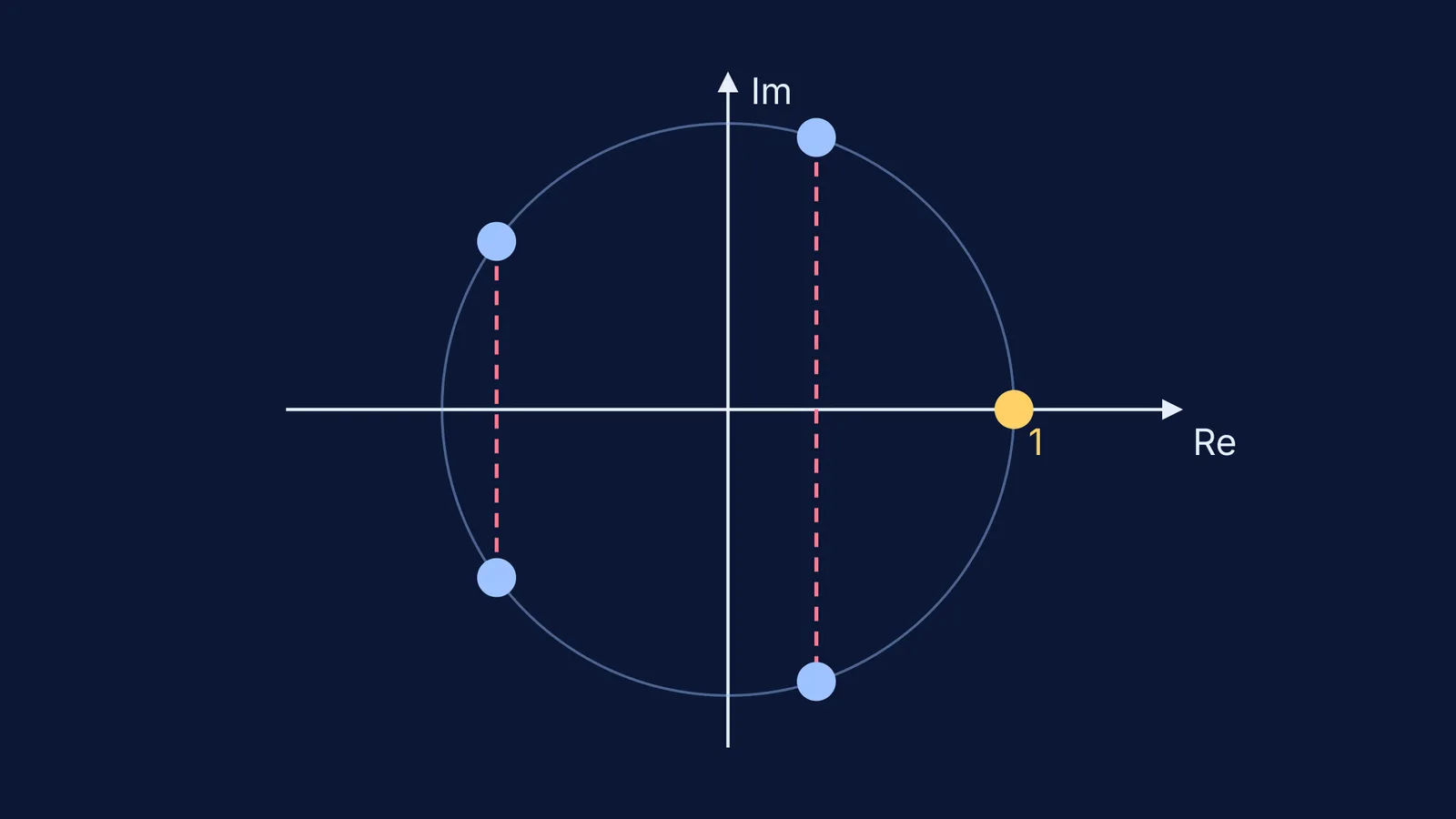
If a polynomial has real coefficients and a + bi is a root, then its conjugate a − bi is also a root (complex conjugate root theorem). Conjugate both sides of p(z) = 0: real coefficients do not change, so p(z̄) = 0 too.
Two consequences come up again and again:
A real polynomial of odd degree has at least one real root, because non-real roots pair off and an odd total leaves one over (same theorem, Wikipedia).
Every real polynomial is a product of real linear and real quadratic factors (MacTutor History of Mathematics). Each quadratic comes from one conjugate pair: (x − (a + bi))(x − (a − bi)) = x² − 2ax + (a² + b²).
This is also why a quadratic whose graph never meets the x-axis still has two roots; we explain the picture in complex roots of a quadratic with no x-intercept.
Why does the theorem need complex numbers?
Over the real numbers alone, the statement is false: x² + 1 has degree 2 and no real roots. Complex numbers are enough: a polynomial with complex coefficients always has its roots among the complex numbers, so no bigger number system is needed.
According to MacTutor, the first claim that a degree-n equation always has n solutions was made by Albert Girard in 1629, d'Alembert made the first serious attempt at a proof in 1746, and Gauss presented his first proof in his doctoral thesis of 1799, a proof the same page says had serious gaps.
The name is a little misleading. The theorem cannot be proven with purely algebraic methods; every proof uses some analysis, such as the intermediate value theorem (Wikipedia).
How do you use it to factorise a polynomial?
Here is a worked example. Factorise p(x) = x³ − 3x² + 4x − 2 completely.
Count the roots. Degree 3, so expect exactly 3 roots in total.
Find an easy real root. The coefficients add to 1 − 3 + 4 − 2 = 0, so p(1) = 0 and (x − 1) is a factor. Our post on the rational root theorem for integer polynomials shows how to list every candidate.
Divide it out: p(x) = (x − 1)(x² − 2x + 2).
Solve the quadratic. The discriminant is 4 − 8 = −4, so x = (2 ± 2i)/2 = 1 ± i.
Check against the theorem. The coefficients are real and the non-real roots 1 + i and 1 − i form a conjugate pair; 1 + 2 = 3 roots, matching the degree.
Check with the coefficients. Sum of roots 1 + (1 + i) + (1 − i) = 3, which equals −(−3)/1. Product 1 × (1 + i)(1 − i) = 2, which equals −(−2)/1. For more of these relations, see Newton sums and power sums of roots.
Over the reals the answer is (x − 1)(x² − 2x + 2); over the complex numbers it is (x − 1)(x − 1 − i)(x − 1 + i). Before any polynomial question, run the same three checks: how many roots in total, which conjugates are forced, and whether an odd degree guarantees a real root.
If conjugates or multiplicity still feel shaky, the Fermi Concept Library has its own lesson for every concept in mathematics, each with its place in the map, so you can revisit complex numbers before polynomials. To practise, the Fermi Problem Library has worked problems with a step-by-step solver that explains the reasoning rather than printing an answer.


