

On this page
If a polynomial has whole-number coefficients, you do not have to guess its roots blindly. The rational root theorem gives you a short list of the only possible rational roots, and the first one that works splits a cubic into a linear factor and a quadratic.
What does the rational root theorem say?
Take a polynomial with integer coefficients and a non-zero leading coefficient. Wolfram MathWorld states the theorem this way: every nonzero rational root p/q, written in lowest terms, has a numerator p that divides the constant term and a denominator q that divides the leading coefficient. OpenStax College Algebra 2e gives the same result under the name Rational Zero Theorem.
If the leading coefficient is 1, q can only be ±1, so every rational root is an integer that divides the constant term.
The theorem only gives candidates. It does not promise that any of them is a root, and it says nothing about irrational or complex roots.
How do you list the possible roots of a polynomial?
Check that every coefficient is an integer. If there are fractions, first multiply through by the LCM of the denominators.
Write down every positive factor of the constant term. These are your p values.
Write down every positive factor of the leading coefficient. These are your q values.
Form every fraction p/q, cancel to lowest terms, strike out repeats, and put ± in front.
OpenStax works this through for 2x⁴ − 5x³ + x² − 4: the factors of −4 give ±1, ±2, ±4, the factors of 2 give ±1, ±2, and the candidates are ±1, ±2, ±4 and ±1/2. Notice that 2/2 and 4/2 add nothing new once you cancel.
Worked example: how do you factorise 2x³ − 3x² − 11x + 6?
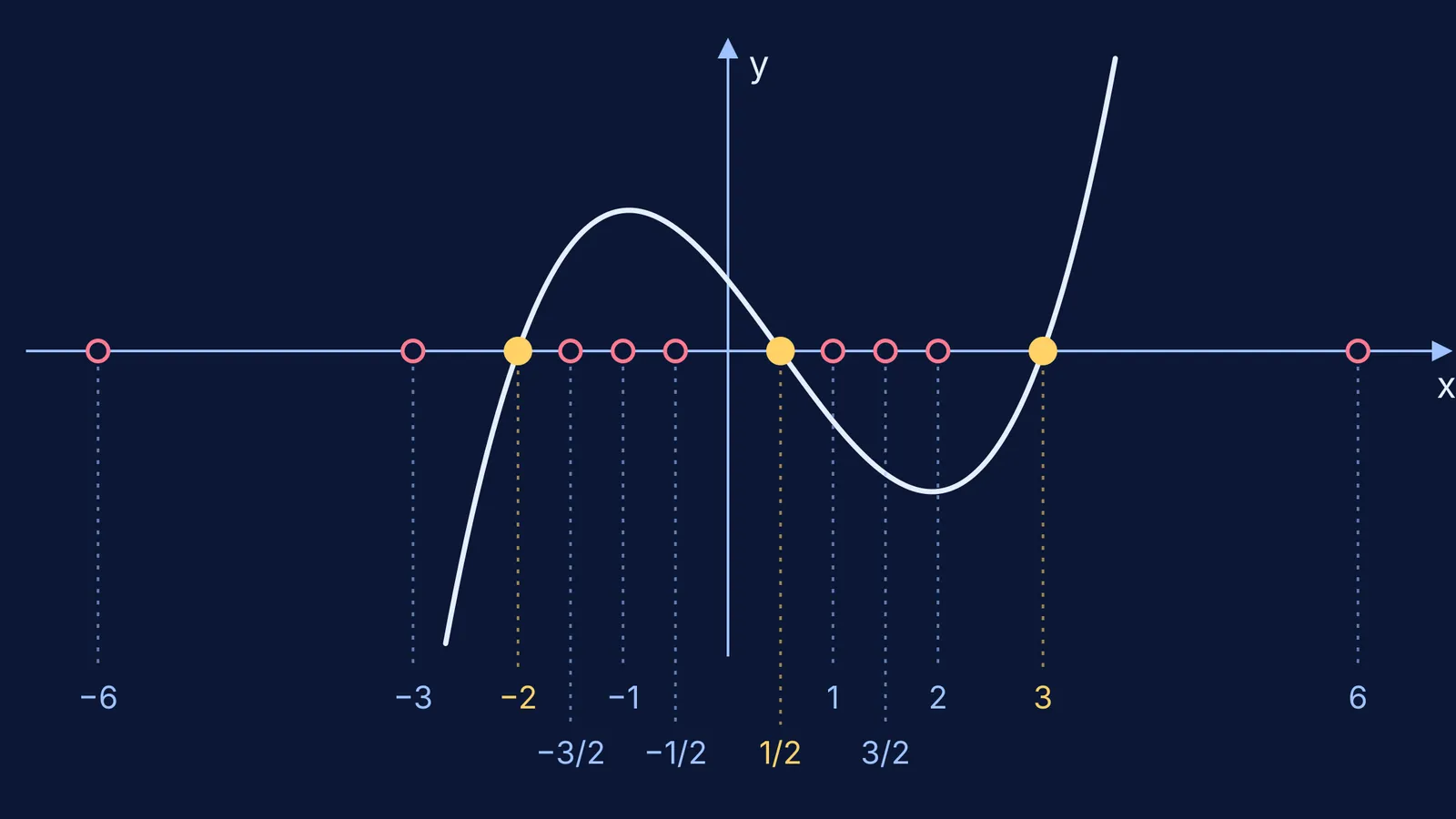
Step 1: list the candidates. The constant term is 6, so p is 1, 2, 3 or 6. The leading coefficient is 2, so q is 1 or 2. That gives twelve candidates: ±1, ±2, ±3, ±6, ±1/2 and ±3/2.
Step 2: test the cheapest ones first. f(1) is just the sum of the coefficients: 2 − 3 − 11 + 6 = −6. f(−1) flips the sign of the odd-power terms: −2 − 3 + 11 + 6 = 12. Neither is zero, but the sign change puts a root between −1 and 1, so keep ±1/2 in mind.
Step 3: keep going. f(2) = 16 − 12 − 22 + 6 = −12. f(−2) = −16 − 12 + 22 + 6 = 0. So x = −2 is a root, and by the factor theorem (x + 2) is a factor.
Step 4: divide. Run synthetic division by −2 on the coefficients 2, −3, −11, 6:
Bring down 2.
2 × (−2) = −4, and −3 + (−4) = −7.
−7 × (−2) = 14, and −11 + 14 = 3.
3 × (−2) = −6, and 6 + (−6) = 0. A remainder of 0 confirms the root.
The quotient is 2x² − 7x + 3.
Step 5: finish the quadratic. 2x² − 7x + 3 = (2x − 1)(x − 3), so 2x³ − 3x² − 11x + 6 = (x + 2)(2x − 1)(x − 3), with roots −2, 1/2 and 3.
All three roots were on the list, including the fraction 1/2, which an integers-only search would miss.
For steps 3 and 4 in depth, see factorising a cubic with the factor theorem and synthetic division, step by step.
What if none of the candidates work?
Then the polynomial has no rational roots. Take x³ − 2. The candidates are ±1 and ±2, and f(1) = −1, f(−1) = −3, f(2) = 6, f(−2) = −10. None is zero, so its real root, the cube root of 2, is irrational: it cannot be written as a fraction.
The flip from f(1) = −1 to f(2) = 6 puts the root between 1 and 2, and Descartes' rule of signs tells you the possible numbers of positive and negative roots.
Which candidates should you test first?
Start with ±1: the sum and the alternating sum of the coefficients are mental arithmetic.
Use sign changes. If f(a) and f(b) have opposite signs, a root lies between them, so test the candidates in that interval next.
Once you find one root, stop testing and divide; the leftover quadratic is quicker than the rest of the list.
A candidate that failed for the cubic will also fail for the quotient, so cross it off. A root you found can repeat, so do test it on the quotient.
To practise on more cubics, the Fermi Problem Library has worked problems with a step-by-step solver that explains the reasoning rather than printing an answer. If the factor theorem itself feels shaky, each idea has its own lesson in the Fermi Concept Library.
Next time a cubic has a leading coefficient other than 1, write the ±p/q list before you touch anything else.


