

On this page
You have a cubic or a quartic in front of you and no idea where its roots are. Before you try factors or reach for a calculator, Descartes' rule of signs gives you a short list of what is possible in about a minute. René Descartes used it in *La Géométrie*, published in 1637 (Wikipedia: La Géométrie), the book where he joined algebra to geometry, which we covered in how René Descartes put algebra on a grid. Pair the count with a sketch and you end up with an answer, not a list.
What does Descartes' rule of signs say?
Write the polynomial in descending powers, with real coefficients. The number of positive real roots either equals the number of sign changes between consecutive coefficients or is less than it by an even number (OpenStax College Algebra 2e, section 5.5).
Zero coefficients are skipped when you count, and a root of multiplicity k is counted as k roots (Wikipedia).
For negative roots, count sign changes in f(−x) instead. Replacing x with −x flips the sign of every odd-power term and leaves the even-power terms alone (Wolfram MathWorld).
Roots that are not positive, negative or zero are non-real. For a polynomial with real coefficients, non-real roots come in conjugate pairs (complex conjugate root theorem). That keeps the list of options short.
How do you count sign changes in f(x) and f(−x)?
Write the terms in descending powers and skip any power that is missing.
If there is no constant term, factor out x first. Then x = 0 is a root, and zero is neither positive nor negative.
Write the signs of f(x) in a row and count the switches. Call this p.
Build f(−x) by flipping the sign of each odd-power term, then count again. Call this n.
List the possible positive roots: p, p − 2, p − 4 and so on, stopping at 1 or 0. Do the same for n.
Write out the combinations: all roots must add up to the degree, with non-real roots in pairs.
Worked example: how many roots does x³ − 4x² + x + 6 have?
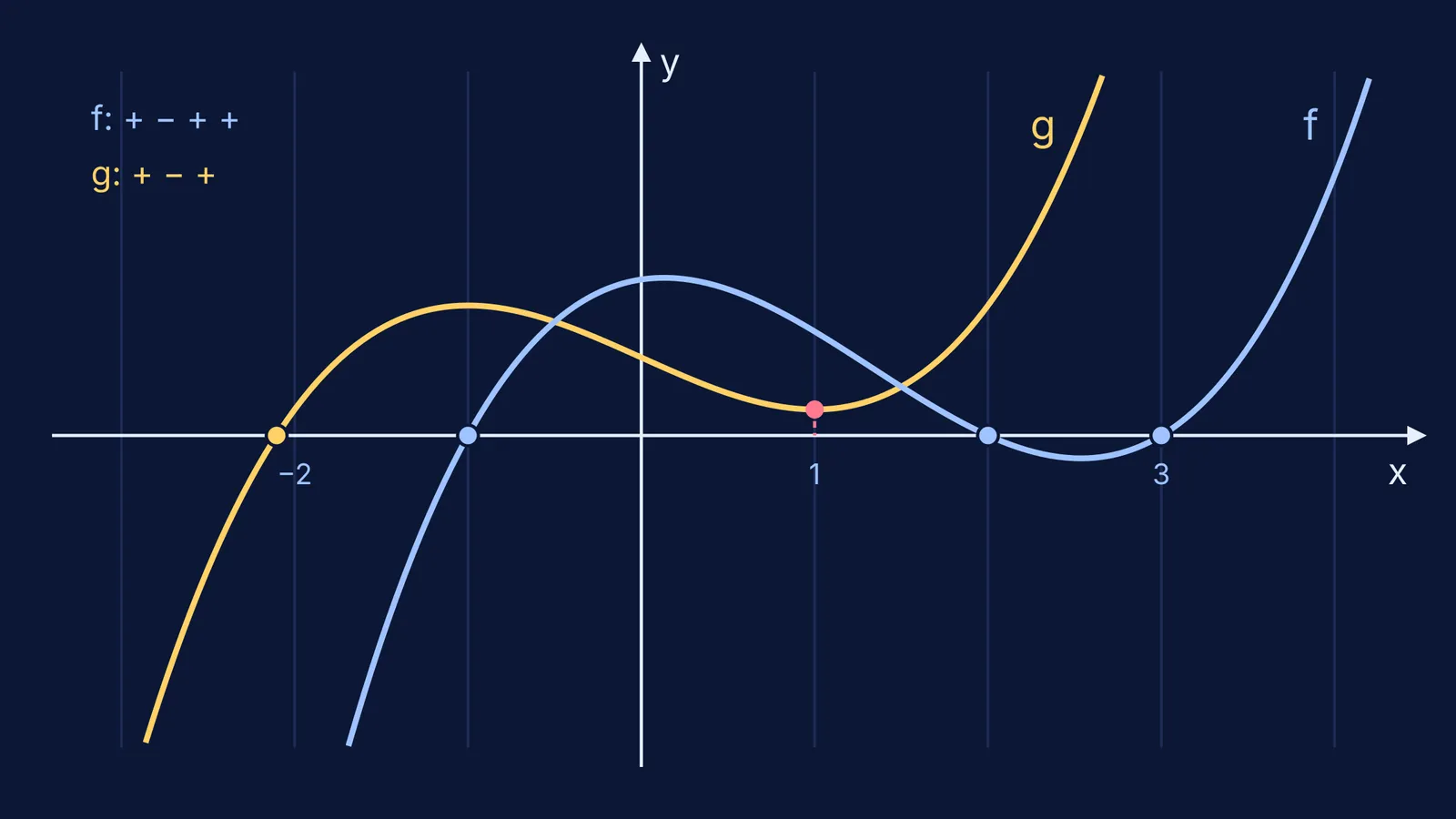
Take f(x) = x³ − 4x² + x + 6. The signs are + − + +. It switches twice, so p = 2. That means two positive roots or none.
Next, f(−x) = −x³ − 4x² − x + 6. The signs are − − − +. There is one switch, so n = 1. You cannot subtract 2 from 1, so there is exactly one negative root.
The degree is 3, so there are two possibilities: 2 positive and 1 negative root, or 0 positive, 1 negative and 2 non-real roots.
Now check with a sketch. f(0) = 6 is above the axis and f(2.5) = −0.875 is below it, so the curve crosses the axis somewhere between 0 and 2.5. Since f(x) becomes large and positive as x grows, the curve has to cross back up again. So zero positive roots is impossible, and the answer is 2 positive roots and 1 negative root. Factorising confirms it: f(x) = (x + 1)(x − 2)(x − 3). The step "if the value of f changes sign, the curve crosses the axis" is the intermediate value theorem, the idea behind Bernard Bolzano's proof.
What if the rule leaves two options and the sketch says no?
Take g(x) = x³ − 3x + 3. With the missing x² term skipped, the signs are + − +, so p = 2. Then g(−x) = −x³ + 3x + 3 has signs − + +, so n = 1. That gives the same two options as before.
This time the sketch rules out the positive pair. The derivative g′(x) = 3x² − 3 is zero at x = ±1, so for x > 0 the lowest point on the curve is g(1) = 1, which is above the axis. The curve never meets the positive x-axis. So g has 0 positive roots, 1 negative root (near x = −2.1) and one pair of non-real roots. To see roots as points where two simpler curves meet, try finding roots by curve intersections.
Which mistakes cost marks with the rule of signs?
Counting a zero coefficient as a sign. Skip it.
Forgetting the root at x = 0 when there is no constant term.
Flipping every sign in f(−x) instead of only the odd powers.
Reading "2 sign changes" as "2 roots". It means 2 or 0.
Forgetting that a double root counts twice.
When you work through a practice set, the Fermi Problem Library has worked problems with a step-by-step solver that explains the reasoning rather than just printing an answer, so you can see where your count went wrong. If the gap comes earlier, for example why non-real roots come in pairs, the Fermi Concept Library has a lesson for every concept in mathematics.
Next time you meet a cubic, count first, sketch second and factor last.


