On this page
One function can carry four claims at once: where it rises, turns and bends, and how many roots it has. Treat each option as its own small proof.
How does partial marking work in JEE Advanced multiple-correct questions?
In the JEE Advanced 2025 Paper 1 mathematics section where one or more options are correct, choosing all the correct options and nothing else earned +4 marks. Choosing only some correct options and no wrong one earned +3, +2 or +1; leaving the question blank earned 0; any other choice earned −2. Recheck the instructions on your own paper.
Questions 1 to 4: which options are true?
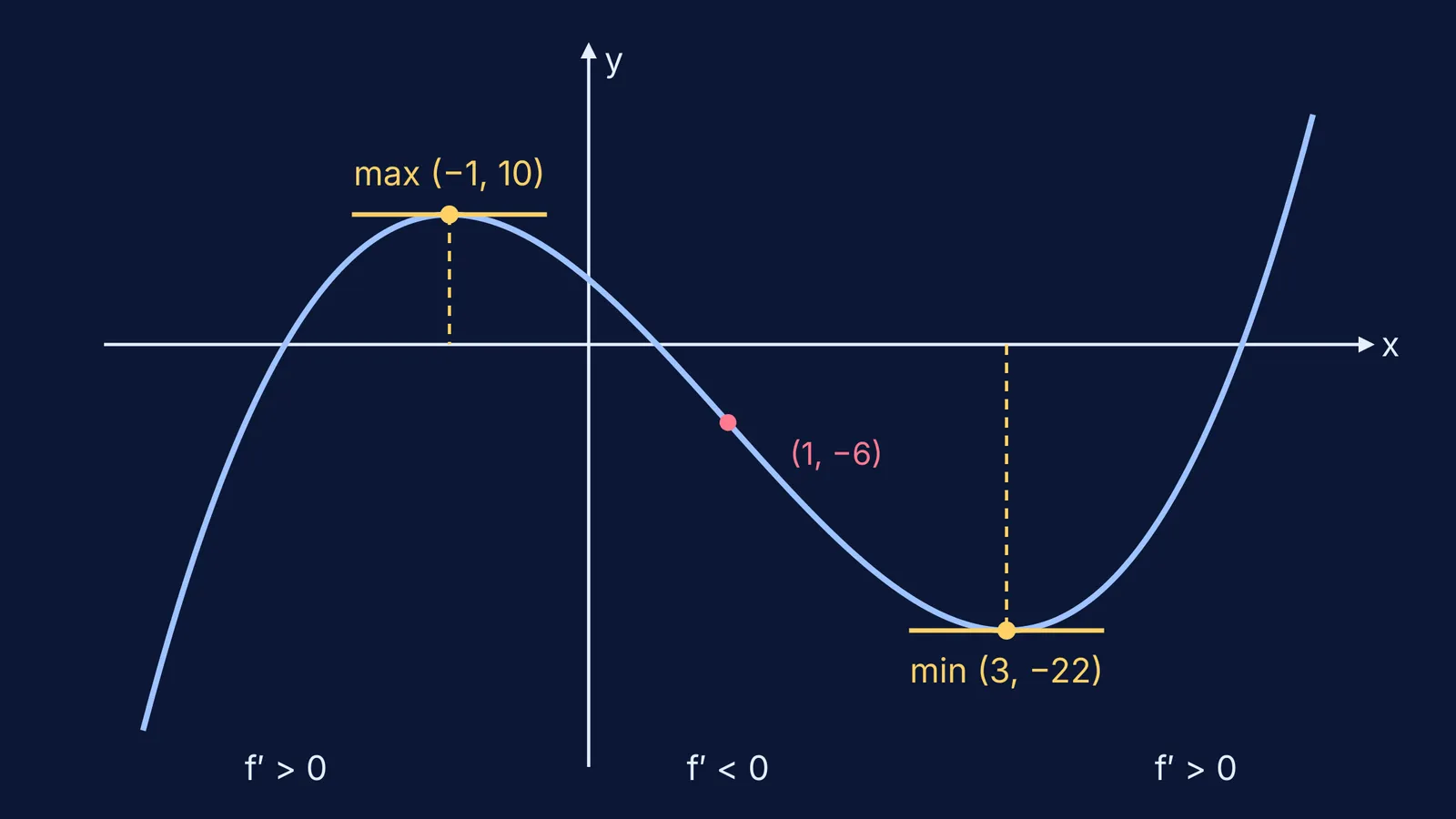
Q1. Let f(x) = x³ − 3x² − 9x + 5.
(A) f has a local maximum at x = −1. True: f′(x) = 3(x − 3)(x + 1) changes from positive to negative there.
(B) The local minimum value is −22. True: f(3) = 27 − 27 − 27 + 5.
(C) f is decreasing on (−1, 3). True: f′ < 0 between the roots.
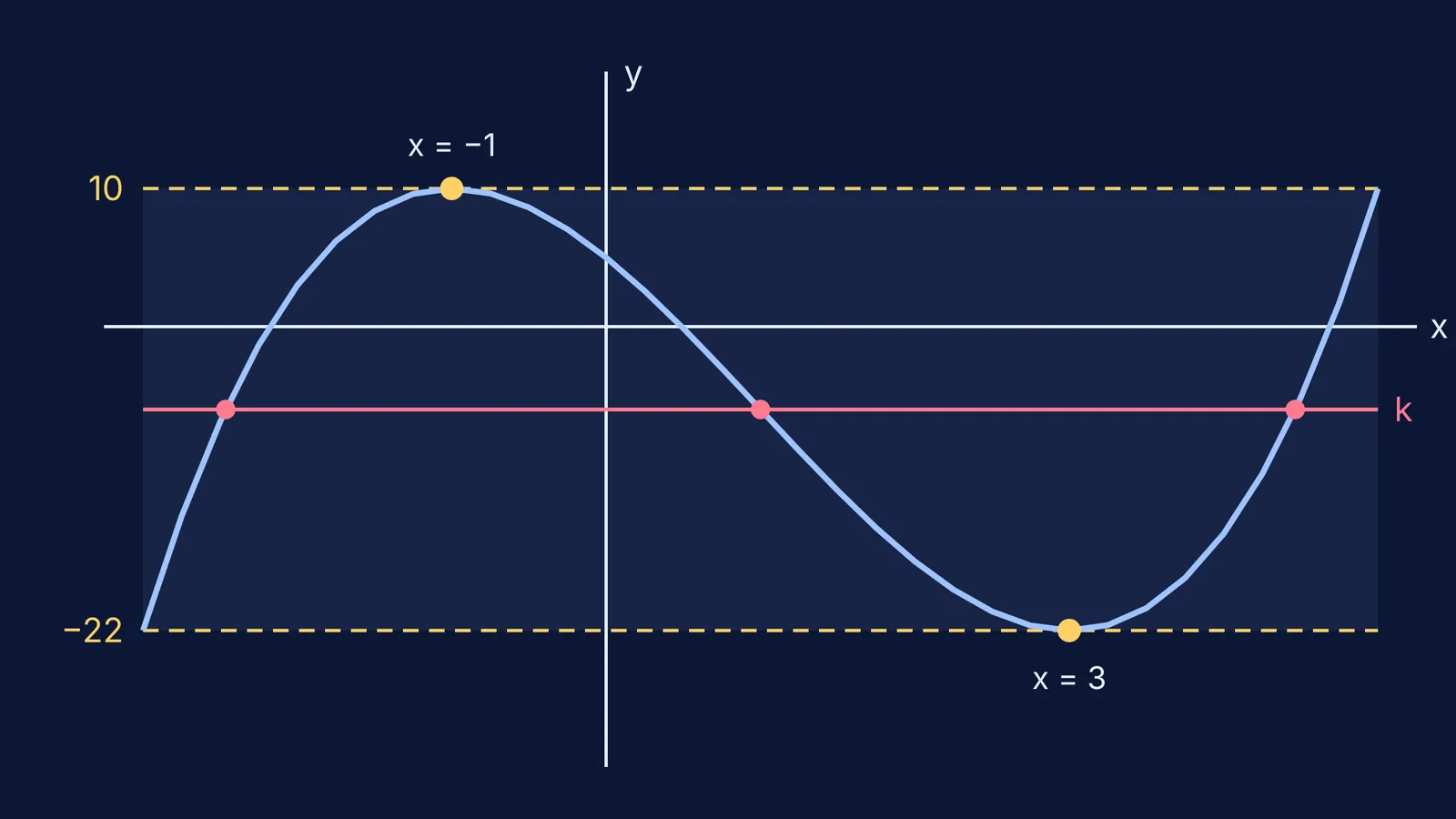
(D) f(x) = 0 has exactly one real root. False: f(−1) = 10 > 0 and f(3) = −22 < 0, so the graph crosses the x-axis three times.
Answer: A, B, C. D is ticked by students who skip the signs of the turning values.
Q2. Consider y = x³ at the point (1, 1).
(A) The tangent is y = 3x − 2. True: the slope is 3.
(B) The normal is 3x + y = 4. False: the normal's slope is −1/3, giving x + 3y = 4.
(C) The tangent meets the curve again at (−2, −8). True: x³ − 3x + 2 = (x − 1)²(x + 2).
(D) The tangent at (−1, −1) is parallel to the tangent at (1, 1). True: 3x² = 3 there too.
Answer: A, C, D. C is easy to miss if you assume a tangent touches the curve only once.
Q3. A spherical balloon's volume grows at 100 cm³/s. When the radius is 5 cm:
(A) dr/dt = 1/π cm/s. True: 100 = 4π(25) dr/dt.
(B) The surface area grows at 40 cm²/s. True: dS/dt = 8πr dr/dt = 8π(5)(1/π).
(C) dr/dt stays the same as the balloon grows. False: dr/dt = 25/(πr²) falls as r grows.
(D) At any radius r, dS/dt = 200/r. True: 8πr × 100/(4πr²).
Answer: A, B, D. D is easy to miss if you only try r = 5.
Q4. Let f(x) = x³ − x.
(A) The mean value theorem on [0, 2] gives c = 2/√3. True: the chord's slope is 3, and 3c² − 1 = 3.
(B) Rolle's theorem on [−1, 1] gives exactly one c. False: c = ±1/√3, both inside.
(C) Rolle's theorem gives g′(c) = 0 for g(x) = |x| on [−1, 1]. False: g is not differentiable at 0.
(D) Rolle's theorem applies on [0, 1] with c = 1/√3. True: f(0) = f(1) = 0.
Answer: A, D. The wrong tick is C: equal end values are not enough.
Questions 5 to 8: which options survive a check?
Q5. f(x) = x³ + ax² + 3x + 1 is increasing on all of ℝ.
(A) a = −4 works. False: f′ = 3x² − 8x + 3 has discriminant 28 > 0, so it goes negative.
(B) a = 3 works. True: f′ = 3(x + 1)² vanishes only at one point.
(C) a = 0 works. True.
(D) The full set of a is [−3, 3]. True: 4a² − 36 ≤ 0.
Answer: B, C, D. If you demand f′ > 0 everywhere, you miss B.
Q6. An open box is made by cutting squares of side x from the corners of a 12 cm square sheet: V = x(12 − 2x)².
(A) V increases on (0, 3). False: V′ = (12 − 2x)(12 − 6x) is negative on (2, 3).
(B) V is greatest at x = 2. True.
(C) The greatest volume is 128 cm³. True: 2 × 8².
(D) The base of the best box is 8 cm wide. True: 12 − 4.
Answer: B, C, D. A is the trap if you guess that the best cut is the midpoint of (0, 6).
Q7. For every x > 0:
(A) ln(1 + x) < x. True: x − ln(1 + x) starts at 0 and has derivative x/(1 + x) > 0.
(B) eˣ < 1 + x. False: eˣ − 1 − x starts at 0 and has derivative eˣ − 1 > 0.
(C) sin x > x − x³/6. True: the difference starts at 0 and its derivative, cos x − 1 + x²/2, is positive, because its own derivative, x − sin x, is positive.
(D) x/(1 + x) < ln(1 + x). True: the difference has derivative x/(1 + x)² > 0.
Answer: A, C, D. D is easy to miss: it looks like a reversed A.
Q8. Let f(x) = x⁴ − 4x³.
(A) x = 0 is a local extremum. False: f′ = 4x²(x − 3) is negative on both sides of 0.
(B) The local minimum is f(3) = −27. True.
(C) The points of inflection are at x = 0 and x = 2. True: f″ = 12x(x − 2) changes sign at both.
(D) f is concave up on (0, 2). False: f″ < 0 there.
Answer: B, C. A is the usual trap: f′ = 0 does not make an extremum.
How should you practise multiple-correct derivative questions?
Write T or F beside each option with a one-line reason first.
At every turning point, check the sign of f′ on both sides.
Score yourself with the real scheme, including the −2.
For full solutions, try the applications of derivatives JEE Advanced practice set, then the numerical-answer questions on the same chapter.
When a slip keeps returning, the Fermi Problem Library has a step-by-step solver that explains the reasoning. For JEE Main and Advanced preparation, see Fermi Test Prep.