On this page
This chapter states a pattern, then names where it fails, and odd-one-out items are built on that gap. Below are 10 rules from NCERT Class 11 Biology, Chapter 6 (Reprint 2026-27), each with the exception the textbook itself names, then 12 original questions. The NEET (UG) 2026 syllabus places this chapter in Biology Unit 2, Structural Organisation in Animals and Plants.
Which rules in Anatomy of Flowering Plants have NCERT exceptions?
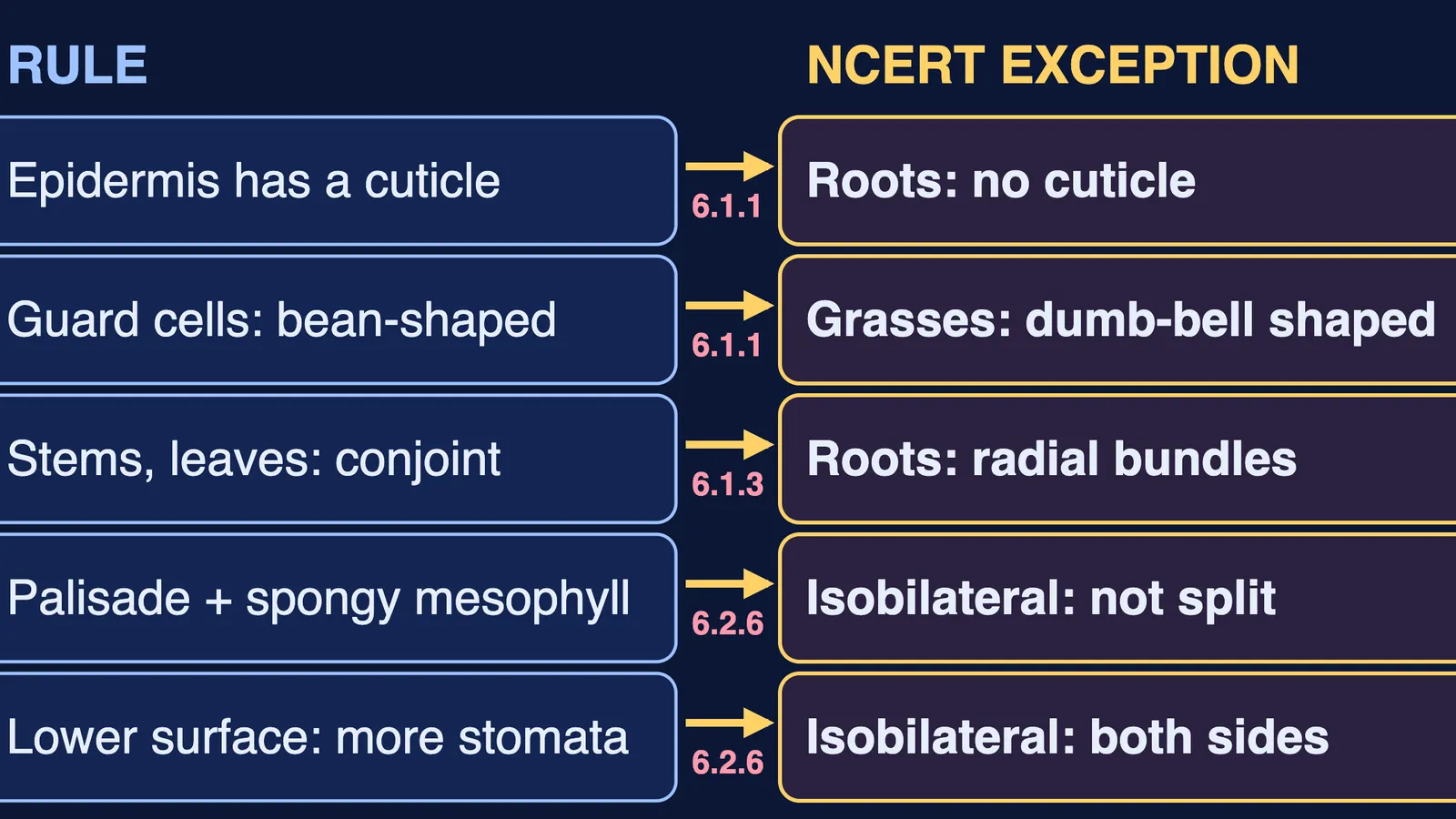
A waxy cuticle often covers the epidermis. Exception: roots have no cuticle (6.1.1).
Guard cells are bean-shaped. Exception: in grasses they are dumb-bell shaped (6.1.1).
Parenchyma usually makes up the cortex of primary stems and roots (6.1.2). Exceptions: the dicot stem's hypodermis is collenchyma (6.2.3), and the monocot stem's hypodermis is sclerenchyma (6.2.4).
Parenchyma is also the usual pericycle tissue (6.1.2), as in the root's thick-walled parenchyma pericycle (6.2.1). Exception: in a dicot stem the pericycle forms semi-lunar sclerenchyma patches above the phloem (6.2.3).
Conjoint bundles, with xylem and phloem on one radius, are common in stems and leaves. Exception: roots have radial bundles (6.1.3).
A dicot root later develops a cambium ring between its xylem and phloem patches (6.2.1). Exception: monocot roots undergo no secondary growth (6.2.2).
Pith is small or inconspicuous in a dicot root (6.2.1). Exception: the monocot root has a large, well-developed pith (6.2.2).
In a dorsiventral leaf the lower surface generally has more stomata, and the upper may have none (6.2.5). Exception: an isobilateral leaf has stomata on both surfaces (6.2.6).
Mesophyll splits into palisade and spongy parenchyma (6.2.5). Exception: in an isobilateral leaf it is not differentiated (6.2.6).
In monocot leaves, parallel venation gives bundles of near similar size. Exception: the main veins (6.2.6).
How do you handle odd-one-out and exception questions?
First find what three options share: tissue type, organ, position, or presence versus absence.
Then test every other axis. If a second option is odd on a different axis, reread the stem for the axis it names.
For "which is NOT" items, judge each pairing alone as true or false before comparing.
Watch for swapped organs, such as a monocot stem feature placed in a root.
Can you spot the odd one out?
Q1. By cell type, which is the odd one out? (1) Hypodermis of a monocot stem (2) Pericycle of a dicot stem (3) Bundle sheath of a monocot stem (4) Hypodermis of a dicot stem
Answer: (4). It is collenchyma; the other three are sclerenchyma (6.2.3, 6.2.4).
Q2. By how xylem and phloem are arranged, which is the odd one out? (1) Monocot stem (2) Isobilateral leaf (3) Dorsiventral leaf (4) Dicot root
Answer: (4). Roots have radial bundles; stems and leaves have conjoint ones (6.1.3).
Q3. By intercellular spaces, which is the odd one out? (1) Endodermis of a dicot root (2) Cortex of a dicot root (3) Spongy parenchyma (4) Pith of a dicot stem
Answer: (1). Its barrel-shaped cells have no intercellular spaces (6.2.1).
Q4. By whether NCERT reports it present or absent, which is the odd one out? (1) Cuticle on root epidermis (2) Phloem parenchyma in monocot stem bundles (3) Intercellular spaces in dicot root endodermis (4) Water-containing cavities in monocot stem bundles
Answer: (4). It is present; the other three are absent (6.1.1, 6.2.1, 6.2.4).
Q5. Three describe one organ. Which is the odd one out? (1) Usually more than six xylem bundles (2) Large, well-developed pith (3) No secondary growth (4) Scattered vascular bundles
Answer: (4). Scattered bundles belong to the monocot stem; the rest describe the monocot root (6.2.2, 6.2.4).
Which of these is NOT an NCERT exception?
Q6. Which rule–exception pairing is NOT correct? (1) Guard cells bean-shaped – dumb-bell in grasses (2) Epidermis with cuticle – none in roots (3) Mesophyll of two cell types – undivided in isobilateral leaf (4) Ring of bundles in dicot stem – scattered bundles in monocot root
Answer: (4). Scattered bundles are a monocot stem feature; roots have radial bundles (6.1.3, 6.2.4).
Q7. Which is NOT what NCERT says about epidermal hairs? (1) Each root hair is a single epidermal cell drawn out (2) Some shoot trichomes secrete (3) Shoot trichomes are never branched (4) Trichomes cut transpiration losses
Answer: (3). NCERT says trichomes may be branched or unbranched, soft or stiff (6.1.1).
How do two-statement and MCQ items test exceptions?
Codes for Q8 to Q10: (1) Both correct (2) Both incorrect (3) I correct, II incorrect (4) I incorrect, II correct
Q8. Statement I: NCERT's summary says secondary growth occurs in most dicot roots and stems. Statement II: Both epidermal surfaces of a dorsiventral leaf carry a conspicuous cuticle.
Answer: (1). See the chapter summary and 6.2.5; leaves keep a cuticle that roots lack.
Q9. Statement I: Monocot roots are usually polyarch, with over six xylem bundles. Statement II: Its xylem and phloem are later separated by a cambium ring.
Answer: (3). The cambium ring belongs to the dicot root; monocot roots show no secondary growth (6.2.2).
Q10. Statement I: An isobilateral leaf has stomata on both surfaces. Statement II: Its palisade layer lies below the upper epidermis only.
Answer: (3). Its mesophyll has no palisade and spongy split (6.2.6).
Q11. Which exception concerns a cell's shape? (1) Dumb-bell guard cells in grasses (2) No cuticle in roots (3) Collenchyma hypodermis in a dicot stem (4) Stomata on both surfaces of an isobilateral leaf
Answer: (1). The others concern presence, tissue type and distribution (6.1.1).
Q12. Which stomatal feature does NCERT describe as present only sometimes? (1) Subsidiary cells (2) Chloroplasts within guard cells (3) Thickened inner guard-cell walls (4) The stomatal pore
Answer: (1). NCERT says nearby epidermal cells "sometimes" become subsidiary cells; it states the other three without a qualifier (6.1.1).
What should you do after this set?
Write all 10 rules from memory, cover the right half, and recall each exception with its section. Then try the statement and match-the-list set on plant anatomy and the assertion-reason questions for this chapter. If the chapter itself is new, begin with a NEET prep plan for this chapter.
Not sure which exceptions still trip you up? Fermi's AI tutor works out what you already know and builds a plan for the session.